Home
» News
»
Restaking Masterclass: How EigenLayer and Symbiotic Are Reshaping DeFi Yields
Restaking Masterclass: How EigenLayer and Symbiotic Are Reshaping DeFi Yields
Restaking can make already-staked crypto capital do another job: instead of securing only its original network or strategy, the same economic value can also back additional services. That is the opportunity behind EigenLayer and Symbiotic—and also the reason the yield is never “free.” Every extra reward is compensation for taking on another layer of protocol, operator, collateral, liquidity, or slashing risk.
For a newcomer, the most useful mental model is simple: restaking turns security into a market. Projects that need credible economic guarantees can pay for them; asset holders can supply those guarantees; operators perform the work; and smart contracts define what can happen when obligations are not met.
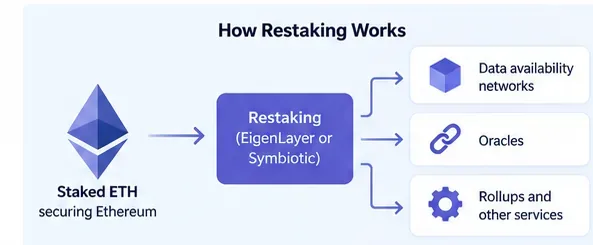
Restaking reuses staked economic value to support additional services such as data availability, oracles, and rollup infrastructure; the extra responsibility can create additional rewards and additional risk.
What restaking actually is
Traditional Ethereum staking commits ETH to Ethereum’s proof-of-stake security. Restaking extends the use of that economic stake so it can also secure other systems. EigenLayer’s original design describes this as letting stakers opt into additional modules and accept their extra slashing conditions in exchange for potential additional fees. The protocol’s technical foundation is documented in the EigenLayer whitepaper.
Symbiotic takes a broader collateral-market approach. Its current documentation describes vaults that hold collateral, allocate it under curator-defined policies, and connect that capital to applications and operators. The official Symbiotic overview frames the system as programmable on-chain economic guarantees rather than only as an Ethereum-staking extension.
That difference matters. Both protocols can support shared security, but a user should not assume they are interchangeable products with the same assets, withdrawal rules, reward sources, or risk model.
First, separate the three layers of “yield”
Restaking returns are often discussed as one number, but a more useful beginner framework separates them into components.
1. Base asset yield
If you start with staked ETH or a liquid staking token, the asset may already reflect Ethereum staking rewards. That base return exists before restaking. It should not be credited entirely to the restaking layer.
2. Security-service rewards
The restaking layer can add rewards because another service is paying for security or work. In EigenLayer, restakers delegate to operators that perform tasks for services historically called AVSs, or Actively Validated Services. EigenLayer moved from early points and retroactive distributions toward continuous programmatic incentives; its official 2024 year-in-review records the launch of Programmatic Incentives in October 2024.
Symbiotic explicitly separates vault accounting from reward economics. Its rewards documentation says networks may fund rewards from protocol fees, scheduled token emissions, external client payments, or amounts routed from slashing, while the vault itself does not dictate the economics.
3. Temporary incentives
Points, token emissions, launch campaigns, or partner incentives can materially change headline returns for a period. They can also disappear. When comparing strategies, treat these as a separate line item rather than assuming they are recurring operating income.
EigenLayer: the operator-and-service marketplace model
EigenLayer’s core flow is built around restakers, operators, and services. A restaker can delegate stake to an operator rather than running every service directly. The operator opts into supported services and performs the required work. If that operator violates a service’s rules and the applicable slashing conditions are triggered, delegated capital can be exposed.
This is why operator choice is not a cosmetic decision. EigenLayer’s whitepaper explicitly notes that delegated restakers share the consequences of the operator they choose. The return side and the risk side are linked: the operator decides which workloads to support, earns compensation for performing them, and passes a portion back to delegators according to the applicable economics.
For beginners, the practical implication is that “I deposited into EigenLayer” is not a complete description of a position. You also need to know what asset was restaked, which operator received the delegation, which services that operator secures, what rewards those services pay, and what slashable conditions apply.
Symbiotic: the vault, curator, and application model
Symbiotic organizes capital around vaults. A vault is an on-chain container that holds a single collateral token and exposes rules for deposits, withdrawals, delegation, and slashing. In the current Core V2 model, vault strategies can allocate capital through adapters to applications and other approved strategies. The official vault documentation explains that vaults issue ERC-4626 shares and can route capital according to a curator’s strategy.
A curator sets the vault policy: which applications or networks can receive capital, how concentrated allocations may be, what operators are eligible, what fees apply, and how risk is managed. That adds a different diligence question from EigenLayer. Instead of only asking “Which operator?”, a Symbiotic depositor should also ask “Which vault and curator strategy am I underwriting?”
Symbiotic’s slashing system is modular. Its slashing documentation describes vaults with no slashing, immediate slashing, or veto-enabled slashing. A valid penalty is bounded by the stake guarantee captured for the relevant operator and application. The configured Burner then determines what happens to penalized collateral—for example, whether it is burned, redistributed, or routed elsewhere.
EigenLayer vs. Symbiotic at a glance
Question
EigenLayer
Symbiotic
Core abstraction
Restaked stake delegated to operators securing services
Collateral vaults allocated by curator-defined strategies
Who makes key allocation choices?
Restaker chooses delegation; operators opt into services
Curators define vault allocation policy; operators and applications opt into compatible relationships
Reward source
Service payments and protocol incentive programs, subject to operator economics
Application/network payments such as fees, emissions, external payments, or other configured reward flows
Depends on EigenLayer mechanics and the delegated/restaked path
Vault epochs and underlying adapter withdrawal mechanics matter
The table is intentionally structural rather than promotional. A higher displayed APR on either side does not automatically mean a better opportunity.
How restaking is reshaping DeFi yield
The important change is not simply “more APY.” Restaking creates a new revenue layer for capital that can credibly back services. In principle, a unit of economic security can support more than one application, so long as the contracts and risk limits allow it.
That can improve capital efficiency, but it also creates risk reuse. If the same collateral secures multiple services, one failure can reduce the economic protection available elsewhere. Symbiotic’s own slashing documentation notes that in multi-network restaking, a slash for one network can reduce the remaining guarantee available to others because the collateral is shared.
The yield therefore comes from a genuine economic trade: capital providers accept additional obligations, and applications pay to access those guarantees. This is more sustainable than treating points alone as “yield,” but it still depends on real demand from applications. If services do not generate enough fees or economic value, high rewards may require token subsidies instead.
A beginner’s due-diligence checklist before depositing
Step 1: identify exactly what asset you are risking
Write down the underlying asset, not just the interface label. ETH, a liquid staking token, and a vault share are different exposures. If the collateral itself can depeg or suffer smart-contract failure, restaking adds risk on top of that base.
Step 2: map every party that can affect the position
For EigenLayer, identify the operator and the services it supports. For Symbiotic, identify the vault, curator, applications, operators, and relevant adapters. More layers do not automatically mean “bad,” but they do mean more contracts and governance assumptions to understand.
Step 3: read the slashing conditions before the reward page
Slashing is a penalty that reduces collateral when defined misconduct or failure conditions are proven. Ask what behavior is slashable, how evidence is submitted, whether there is a veto or dispute window, how much can be slashed, and what happens to penalized assets afterward.
Step 4: understand how you get out
Check withdrawal delays, queue mechanics, vault epochs, liquidity requirements, and any downstream strategy that must unwind before funds can be returned. A position with an attractive nominal yield can still be unsuitable if you may need the capital on short notice.
Step 5: calculate net yield, not advertised yield
A useful estimate is:
Net expected yield = base staking return + service rewards + temporary incentives − operator/curator fees − protocol costs − expected loss allowance.
The final term is not directly observable, but ignoring it is the most common conceptual error. A 2% extra reward is not attractive if the added tail risk is worth more than 2% to you.
Step 6: start with a test-sized allocation
Use a small amount first. Confirm that you understand wallet permissions, deposit receipts, delegation or vault shares, reward claims, and the withdrawal path. This is especially important when a position includes several smart contracts or wrapper tokens.
The risks that matter most
Slashing risk: operator or service failure can reduce collateral under applicable rules.
Smart-contract risk: bugs in the restaking protocol, vault, adapter, reward contract, or collateral token can cause loss.
Collateral risk: liquid staking tokens or other collateral can trade below their expected value or face issuer/protocol problems.
Operator concentration: too much stake behind one operator can create correlated operational risk.
Service correlation: the same event may affect several services using the same collateral.
Liquidity risk: withdrawal queues, epochs, or thin secondary markets can make exit slower or more expensive than expected.
Reward-token risk: rewards paid in volatile or illiquid tokens may be worth far less by the time they are claimable or sold.
Curator/governance risk: in managed vault structures, strategy changes and parameter choices can alter your exposure.
Which model may fit which user?
EigenLayer may be easier to reason about if your thesis starts with Ethereum restaking and operator delegation: you can focus diligence on the restaked asset, the operator, the services it secures, and the reward/slashing relationship.
Symbiotic may appeal to users who want a vault-based framework with broader collateral and strategy design. That flexibility is useful, but it shifts more attention toward curator quality, application selection, adapter risk, vault epochs, and the exact slashing module.
Neither answer is universally “safer” or “higher yielding.” The best fit depends on what collateral you already hold, how much complexity you can monitor, how quickly you may need liquidity, and whether the incremental reward adequately compensates you for the additional risk.
What to monitor after you enter
Restaking is not a deposit-and-forget strategy. Revisit the operator or curator, active services, reward sources, fee splits, slashing configuration, and withdrawal conditions. If a position’s yield rises sharply, ask why. Sometimes the answer is stronger demand; sometimes it is temporary token subsidies; sometimes it is compensation for risk that has increased.
As of September 2026, both ecosystems continue to evolve. Symbiotic’s documentation reflects its Core V2 architecture introduced in 2026, while EigenLayer has continued expanding the services that can use restaked economic security. Because contracts, supported collateral, reward programs, and operator sets can change, verify the current official documentation before approving a transaction.
The bottom line
Restaking is reshaping DeFi yields by turning staked collateral into a reusable source of economic security. EigenLayer approaches that market through restakers, delegation, operators, and services; Symbiotic emphasizes vaults, curators, applications, and configurable collateral guarantees.
The extra yield can be economically meaningful when real applications pay for security. But the correct question is never “Which protocol has the highest APR?” It is “What new obligation am I accepting, who controls the risk, how can I exit, and how much am I being paid for that exposure?” If you can answer those four questions clearly, you are evaluating restaking like an allocator rather than chasing a number on a dashboard.