Home
» News
»
Hyperliquid vs. dYdX vs. GMX: Which Decentralized Perpetual Exchange Fits Your Trading Style?
Hyperliquid vs. dYdX vs. GMX: Which Decentralized Perpetual Exchange Fits Your Trading Style?
Decentralized perpetual exchanges are often grouped together as if they were interchangeable. They are not. Hyperliquid, dYdX, and GMX all let traders take leveraged long or short exposure without using a traditional centralized exchange account, but they differ sharply in how orders are matched, how liquidity is supplied, how fees accumulate, and what kinds of risks matter most.
To make those differences concrete, this article uses one clearly hypothetical example throughout. Imagine Maya, a trader with 5,000 USDC who wants to open a 10,000 USDC ETH perpetual position and may keep it open for roughly 24 hours. She is not trying to maximize leverage. Her priorities are execution quality, predictable costs, transparent risk, and the ability to exit quickly if the market moves against her. This is an illustrative scenario only, not a real trade, backtest, recommendation, or claimed result.
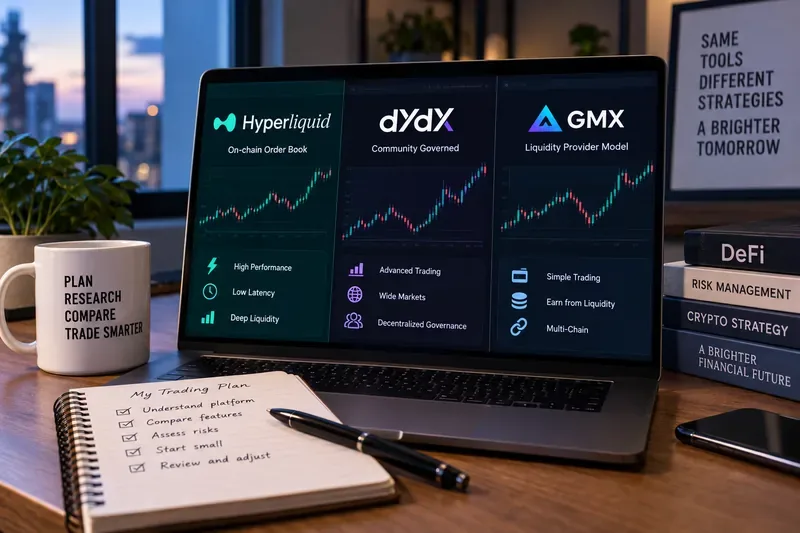
A side-by-side research setup emphasizes the core choice: order-book execution on Hyperliquid and dYdX versus oracle-and-pool execution on GMX.
The short version: these three DEXs solve perpetual trading differently
As of September 16, 2026, the most important distinction is architectural. Hyperliquid uses fully onchain order books inside HyperCore, its specialized trading execution layer. dYdX also uses an order-book model on its own blockchain, with validators participating in order handling and price-oracle processes. GMX does not use a traditional order book for perpetual execution; it routes trades against liquidity pools and uses oracle-based pricing with explicit mechanisms for price impact, funding, and borrowing.
Category
Hyperliquid
dYdX
GMX
Core execution model
Onchain central limit order book
Order book on dYdX Chain
Oracle pricing against liquidity pools
Best fit in our example
Trader prioritizing fast order-book execution
Trader who wants order-book trading with chain-level governance
Trader who prefers pool-based execution and can monitor borrowing/funding costs
Fee structure
Maker/taker tiers based on volume, with staking discounts and possible rebates
Maker/taker schedule governed by protocol parameters
Position fee plus funding, borrowing, price-impact effects, and network execution costs
Collateral / margin
USDC-based perpetual margining; cross and isolated modes
Market-specific margin parameters; chain software supports isolated markets as well
Flexible collateral depending on market and network
Liquidity source
Resting orders from traders and market makers
Resting orders from traders and market makers
GM/GLV liquidity pools
Action for Maya: before comparing headline fees, she should first decide whether she wants an order book or an oracle-and-pool execution model. That single choice changes how she should think about slippage, depth, price impact, and ongoing position costs.
Hyperliquid: the closest of the three to a high-performance onchain order-book venue
Hyperliquid describes itself as a layer-one blockchain optimized for trading. Its HyperCore execution state contains fully onchain perpetual and spot order books, and orders are matched by price-time priority. The official documentation says every order, cancellation, trade, and liquidation is processed transparently through the chain’s trading system. See the Hyperliquid documentation and its order-book documentation.
For Maya, that means the execution mental model will feel familiar if she has used a centralized futures exchange: she can look at bids and asks, submit market or limit orders, and care directly about spread and displayed depth. This is different from GMX, where a trade is not consuming a conventional bid/ask book.
What is verified about Hyperliquid fees?
Hyperliquid’s official fee page currently shows a base perpetual fee tier of 0.045% for takers and 0.015% for makers before volume-based reductions, staking discounts, or maker rebates. Fees depend on rolling 14-day weighted volume, and the documentation also lists HYPE staking discounts. Because fee schedules can change, traders should verify the live tier rather than treating these numbers as permanent. The current schedule is published in the Hyperliquid fee documentation.
If Maya crossed the spread to open a 10,000 USDC position at the base 0.045% taker rate, the opening trading fee alone would be about 4.50 USDC. Closing as a taker at the same base rate would add another roughly 4.50 USDC. This simple calculation excludes funding, execution-price movement, and any future fee changes. It is an illustration of fee arithmetic, not a forecast of her final cost.
Common misunderstanding: “onchain” does not mean there is no exchange-style microstructure. Hyperliquid still has order-book depth, maker/taker behavior, funding, margin rules, liquidations, and market-specific constraints. Action: Maya should inspect both fee tier and visible depth for ETH before placing a large market order.
Margin and funding still matter
Hyperliquid’s contract specifications describe linear perpetuals with USDC margining and hourly funding payments. Cross margin and isolated margin are supported. Market leverage limits and order-size rules vary by asset. The relevant source is the Hyperliquid contract-specification documentation.
For a 24-hour hypothetical position, Maya should therefore compare more than entry and exit commissions. A seemingly cheap trade can become more expensive if funding is persistently unfavorable. Action: she should record the current funding rate when entering and set a threshold at which the carrying cost makes the trade unattractive.
dYdX: order-book trading with protocol parameters controlled through the dYdX ecosystem
dYdX also uses an order book, but its implementation and governance model differ from Hyperliquid. The dYdX Chain software supports market, limit, stop market, stop limit, take-profit market, and take-profit limit orders. The official help center distinguishes short-term orders, which can remain in validators’ memory for a limited block window unless filled, from longer-lived stateful orders that are committed to chain state. See the official dYdX order-type documentation.
For Maya, the practical consequence is familiar order-book trading with protocol-specific behavior under the hood. She can still think in terms of makers, takers, limit prices, time-in-force settings, and available market depth.
Fees are not a single timeless number
The dYdX help center explains that the default open-source software uses a maker-taker fee model, with taker tiers based on trailing 30-day USD trading volume. It also emphasizes that governance can adjust these parameters. The documentation states that canceled orders are not charged trading fees and that traders do not, by default, pay a separate gas fee for each trade in the same way they might on a general-purpose chain. Current details are available in the official dYdX trading-fee article.
Common misunderstanding: a decentralized exchange does not necessarily make users pay a visible blockchain gas charge on every order. dYdX’s software can abstract that experience into trading fees. Action: Maya should check her live fee tier in the interface rather than comparing an old fee table copied from another website.
Funding is calculated from order-book premiums and oracle prices
dYdX’s funding mechanism uses a premium derived from impact bid and ask prices relative to the index price. The software calculates samples over time and applies funding on an hourly schedule. The official explanation is in the dYdX funding documentation.
In Maya’s 24-hour example, that matters because the exchange with the lowest entry fee may not be the cheapest venue over an entire day. Action: she should compare expected funding over her intended holding period, not just the fee charged when the position opens.
Risk parameters can tighten as market conditions change
dYdX markets have initial and maintenance margin fractions, open-interest caps, and market-specific maximum leverage. The software can increase effective margin requirements as open interest rises beyond configured thresholds. That makes the maximum advertised leverage less informative than the live effective requirement in a stressed market.
Action: Maya should check the selected ETH market’s current margin parameters and leave a meaningful equity buffer instead of sizing her position right up to the liquidation boundary.
GMX: a different model built around oracle pricing and liquidity pools
GMX requires a different mental model. Its current documentation describes a decentralized spot and perpetual exchange operating on supported networks such as Arbitrum and Avalanche, with trading powered by GM and GLV liquidity pools. Orders are priced using oracle data rather than matched against a conventional central limit order book. The protocol documentation is available at the official GMX documentation.
For Maya, this means she should not ask, “How deep is the ETH bid book at my price?” in the same way she would on Hyperliquid or dYdX. Instead, she should look at pool capacity, open-interest imbalance, oracle pricing, price-impact rules, borrowing rates, funding, and execution fees.
GMX position fees are only one part of the cost
The GMX fee documentation currently states that most markets charge a position fee of 0.04% or 0.06% when increasing or decreasing a position, depending on whether the trade improves or worsens the imbalance between long and short open interest. GMX also has funding fees, borrowing fees, network execution costs, and price-impact mechanics. See the current GMX fee documentation.
If Maya opens a 10,000 USDC position, a 0.04% position fee would equal 4 USDC and a 0.06% fee would equal 6 USDC for that size change. But treating that as the “total GMX fee” would be misleading because borrowing and funding can accumulate while the position remains open, and price-impact effects can matter when the position is reduced or closed.
Common misunderstanding: GMX is not simply “an AMM with a fixed swap-style fee.” Its perpetual system has several dynamic cost components tied to open-interest balance and pool utilization. Action: Maya should inspect the live borrow rate, funding rate, expected position fee, network fee, and estimated price impact together before entering.
Oracle-based does not mean execution risk disappears
GMX uses Chainlink Data Streams and protocol-specific execution logic for pricing. Its order documentation explains the use of minPrice and maxPrice and how different actions reference those bounds. Oracle pricing can reduce dependence on a locally visible order book, but traders still face price movement, pool constraints, keeper/execution timing, funding, borrowing, and smart-contract risk. See the GMX positions and order-types documentation.
Action: Maya should read the estimated execution values shown before signing and avoid assuming that “no order book” means “no slippage or price impact.”
Applying the comparison to Maya’s hypothetical ETH trade
Suppose all three venues list the ETH perpetual she wants and Maya is comfortable with the relevant chain and wallet setup. She can now reduce the decision to four practical questions.
1. Does she care most about familiar order-book execution?
If yes, Hyperliquid and dYdX are the natural first comparison. She can inspect displayed liquidity, use limit orders, and reason directly about maker versus taker execution. Hyperliquid may appeal if she prioritizes a trading-first L1 with an onchain order book and highly integrated trading infrastructure. dYdX may appeal if she values its own chain architecture, governance-adjustable market parameters, and familiar advanced order types.
Action: compare the actual ETH spread, depth, funding, and personal fee tier on both venues at the moment of the trade.
2. Does she prefer pool-based liquidity and oracle execution?
If yes, GMX is structurally different enough to deserve separate analysis. A trader who dislikes worrying about every individual order-book level may prefer an oracle-and-pool framework, but that does not remove cost uncertainty; it shifts the important variables toward pool balance, borrowing, funding, and price-impact rules.
Action: estimate the full round-trip cost under the current long/short imbalance rather than comparing only the 0.04% or 0.06% position fee.
3. Is she holding for minutes or for days?
For very short trades, spread and entry/exit fees can dominate. For positions held many hours or days, funding and borrowing become more important. Hyperliquid and dYdX both use funding to keep perpetual prices near underlying references. GMX adds borrowing costs tied to pool utilization in addition to funding mechanics.
Action: write down an expected holding period before opening the position, then compare carrying costs over that same horizon.
4. What happens if volatility explodes?
During a sharp move, the exchange’s architecture matters. Order-book venues can experience rapidly changing spreads and depth. Pool-based venues can experience changing imbalance, borrowing rates, and price-impact conditions. All three can liquidate undercollateralized positions according to their respective rules.
Action: Maya should size the trade based on the loss she can tolerate, not the maximum leverage the interface allows. A 2x position in this example leaves substantially more room for adverse movement than using the same 5,000 USDC to chase the platform’s maximum leverage.
Which decentralized perpetual exchange is “best”?
There is no defensible universal winner because the platforms optimize different things.
Hyperliquid is the strongest fit when a trader wants an exchange-like onchain order book, clear maker/taker economics, and a trading-specific execution environment.
dYdX is attractive when a trader wants decentralized order-book trading on a purpose-built chain with governance-controlled risk and fee parameters.
GMX is the most distinct option when a trader prefers oracle-based pool execution and is willing to evaluate borrowing, funding, pool utilization, and price-impact mechanics instead of order-book depth.
Those are use-case recommendations, not guarantees about returns, liquidity, or future protocol quality. All three systems can change through software upgrades, governance decisions, market listings, fee revisions, and risk-parameter updates.
What is verified, what depends on conditions, and what remains uncertain?
Verified from current official documentation: Hyperliquid and dYdX use order-book-based perpetual trading; GMX uses oracle pricing against liquidity pools. Hyperliquid publishes maker/taker fee tiers, dYdX uses governance-adjustable maker/taker parameters, and GMX has position fees plus funding, borrowing, and execution-related costs.
Condition-dependent: the cheapest venue for Maya’s example depends on her personal fee tier, whether she is maker or taker, market depth, funding direction, pool imbalance, borrowing utilization, holding period, network conditions, and the size of her order.
Not knowable in advance: which exchange will have the best effective execution at the exact moment she trades, how funding will evolve over the next 24 hours, or which platform will experience future outages, governance changes, software bugs, oracle incidents, liquidity shocks, or smart-contract failures.
Action: before every material trade, reopen the official fee and risk pages, verify the live market conditions in the trading interface, and compare the estimated total cost of the complete position lifecycle—entry, holding period, and exit.
A practical decision checklist
Choose order book versus oracle-and-pool execution first.
Confirm that the exact perpetual market and collateral you want are supported.
Check your personal maker/taker fee tier instead of relying on an old screenshot or third-party table.
Measure current spread and depth on Hyperliquid or dYdX.
Check pool capacity, long/short imbalance, borrow rate, and price impact on GMX.
Compare funding over your expected holding period.
Review liquidation and margin rules for the specific market.
Keep extra collateral rather than sizing to maximum leverage.
Use limit, stop, and take-profit orders only after understanding how each protocol triggers and executes them.
Recheck official documentation after major protocol upgrades because fee schedules and risk parameters can change.
For Maya’s hypothetical 10,000 USDC ETH perpetual, the right choice is therefore not the exchange with the most impressive headline or the lowest isolated fee number. It is the venue whose execution model, live liquidity, carrying costs, and risk controls best fit how she actually intends to trade.