Home
» News
»
Telegram Trading Bots: Banana Gun, Maestro, and SOL Trading Safety Tips
Telegram Trading Bots: Banana Gun, Maestro, and SOL Trading Safety Tips
Telegram trading bots can turn a token address into a trade in seconds. That speed is useful, especially on fast-moving Solana markets, but it also compresses the time available to notice a fake bot, a wrong mint address, an aggressive slippage setting, or a wallet-security mistake. The right question is not simply whether Banana Gun, Maestro, or Sol Trading Bot is “fast.” It is whether you can use the automation without giving up basic control over your account and funds.
This article uses one clearly hypothetical example throughout. Imagine that Jordan, a fictional trader, sees a new SOL-paired token mentioned in a Telegram group. Jordan is considering Banana Gun, Maestro, and Sol Trading Bot, but has never used a Telegram trading bot with real funds before. Nothing in Jordan’s story is a real test, testimonial, performance result, or recommendation to buy a token.
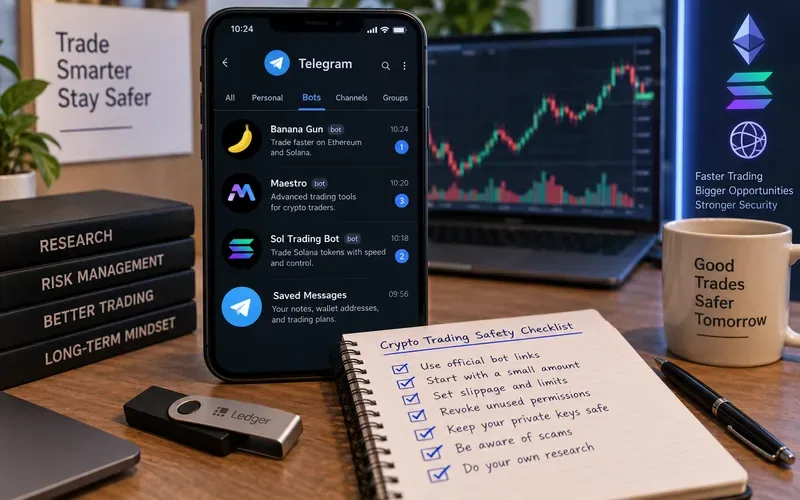
A trading desk with Telegram bot entries, a market chart, a hardware wallet, and a safety checklist highlights the main trade-off: faster execution should not replace wallet, account, and transaction checks.
What can these Telegram trading bots actually do?
Verified: Banana Gun’s official documentation says its tools support spot buys and sells, auto-sniping, limit orders, copy trading, and protections related to rugs and MEV. Its documentation also includes a dedicated Solana Telegram bot and lists supported Solana venues such as Raydium, Orca, Meteora, Pump.fun, PumpSwap, and others. Readers should confirm the current supported list before trading because integrations can change. See the Banana Gun documentation and its supported DEX list.
Verified: Maestro’s official site describes a multi-chain Telegram bot that includes Solana and advertises features including auto-snipe, copy trading, limit orders, multi-wallet operation, signal automation, trade monitoring, funds management, and bridging. Its public manual also has sections for wallet setup, auto-buy warnings, copy trading, anti-rug functions, and other controls. Check the official Maestro site and Maestro manual for the current feature set.
Verified, but more limited from the public pages reviewed: Sol Trading Bot’s official web tool currently exposes wallet import/generation controls along with settings for slippage, priority fee, tip amount, buy amount, and sell percentage. Its official Telegram presence links to soltradingbot.com. I could verify those controls, but I could not verify a detailed public custody or key-management architecture from the pages reviewed. That part should be treated as unknown until confirmed in current official documentation. See the official Sol Trading Bot site.
Action for Jordan: before comparing fees or execution speed, Jordan bookmarks each project’s official website and documentation and launches bots only from links published there. That removes one of the easiest ways to lose funds: interacting with an impersonator that has a nearly identical Telegram username.
Is a Telegram bot wallet the same as a normal self-custody wallet?
Not necessarily. “Telegram trading bot” describes the interface, not one universal custody model. Some services generate a wallet for the user, some allow private-key import, and implementations can change. The security consequences depend on how signing keys are created, stored, encrypted, backed up, and accessed.
Verified: Banana Gun’s terms state that users are responsible for safeguarding the private key associated with the blockchain address they use and that lost private keys cannot be restored by the company. Banana Gun also tells users that virtual-asset trading is risky and that service access can be affected by operational or technical problems. Those terms are worth reading directly in the Banana Gun Terms of Service.
What depends on the bot: whether a particular bot can access a key, how the key is protected, and whether exporting or importing it changes the threat model. Do not assume that a Telegram bot wallet has the same isolation as a hardware wallet merely because you control an address.
Action for Jordan: Jordan creates or uses a dedicated low-balance trading wallet instead of importing the wallet that holds long-term savings. Jordan keeps only the amount intended for short-term bot trading plus a reasonable fee buffer. Long-term assets remain in a separate wallet that is never connected to or imported into a Telegram trading bot.
What is the biggest Telegram-specific security risk?
Account takeover and impersonation deserve as much attention as the trading settings. If an attacker gains access to a Telegram account that controls a trading workflow, the consequences may extend beyond chat privacy.
Verified: Telegram supports Two-Step Verification, which adds a password when logging in from a new device. Telegram also lets users review active sessions and terminate sessions they do not recognize. Its FAQ says users can also set up a passkey, depending on current app support. See Telegram’s official FAQ and its Active Sessions and Two-Step Verification guidance.
Action for Jordan: before funding the trading wallet, Jordan enables Telegram Two-Step Verification, secures the recovery email with its own strong authentication, reviews active sessions, and closes anything unfamiliar. Jordan also refuses private messages claiming to be “support” unless the contact path is explicitly listed by the project’s official site.
Should Jordan trust a token just because the bot can trade it?
No. A bot’s ability to route a swap is not the same thing as a token-quality review. Fast execution can actually make it easier to skip the checks that would normally happen before a manual trade.
For the hypothetical SOL token, Jordan first verifies the exact mint address from a primary project source and cross-checks it on a reputable Solana explorer. Jordan also checks liquidity, token distribution, whether the token uses unusual functionality, and whether the intended exit route is actually liquid. None of those checks proves that a token is safe; they reduce avoidable mistakes.
Verified technical context: Solana’s Token Extensions can add behaviors such as transfer fees, transfer hooks, and wallet allowlists or blocklists. Transfer hooks can run custom program logic during token transfers. These features can be legitimate, but they mean that “SPL token” does not imply one uniform behavior. Solana documents these capabilities in its Transfer Hook documentation.
Action for Jordan: Jordan treats token verification as a separate task from bot selection. If the token contract, mint authority, extension behavior, liquidity, or source cannot be understood well enough, Jordan skips the trade rather than assuming a bot’s “anti-rug” or safety feature is a guarantee.
How much slippage should a Solana bot use?
There is no universally safe percentage. Slippage is the difference you are willing to tolerate between an expected trade price and the executed price. The appropriate setting depends on liquidity, trade size, route, volatility, and the mechanics of the token and venue.
A higher slippage tolerance can increase the chance that a volatile trade executes, but it can also allow a significantly worse fill. A very low tolerance can protect the price but cause more failed transactions. That trade-off is especially important for small-cap tokens with thin liquidity.
Action for Jordan: Jordan does not copy an influencer’s slippage preset. Jordan checks the pool depth, starts with a small position, and chooses the lowest tolerance that is still practical for the specific market. If a trade only seems executable with an unusually large tolerance, Jordan treats that as a reason to investigate rather than a reason to keep raising the number.
Do higher priority fees guarantee a Solana trade will land first?
No. Paying a higher priority fee can improve transaction scheduling priority, but it is not a guarantee of successful execution, a profitable fill, or first place in a race.
Verified: Solana’s current fee documentation explains that total transaction cost includes a base fee plus an optional prioritization fee. It also states that transaction fees are charged even when a transaction fails. Priority depends on several inputs, including fee and compute-related factors. See the Solana fee structure.
Action for Jordan: Jordan sets a spending ceiling for priority fees and tips before trading. A token opportunity that only makes sense if Jordan repeatedly escalates fees is not treated as “free speed.” Those costs are part of the trade’s risk and break-even math.
What about auto-snipe, copy trading, and signal automation?
Automation removes hesitation, but it also removes opportunities to catch a bad assumption. Banana Gun and Maestro both document automated trading functions; Maestro, for example, publicly lists auto-snipe, copy trade, limit orders, and signal-based automation. These features can be convenient, but they increase the importance of preset limits.
What depends on the setup: the exact conditions under which an automated strategy buys, sells, retries, applies slippage, or uses multiple wallets. These details are product-specific and can change. The safe approach is to read the current bot documentation rather than relying on an old YouTube video or Telegram screenshot.
Action for Jordan: Jordan does not enable every automation feature at once. One variable is tested at a time with a low-balance wallet. Copy trading is capped at a small amount, auto-buy is disabled until Jordan understands the trigger, and any recurring strategy gets a hard budget that is lower than the wallet’s total balance.
What should Jordan do before the first real trade?
Jordan’s final checklist is deliberately boring. That is a feature, not a flaw:
Launch the bot only from the project’s official website or documentation.
Enable Telegram Two-Step Verification and review active sessions.
Use a dedicated trading wallet, not a long-term treasury wallet.
Back up any recovery material according to the wallet’s official instructions and never send a seed phrase or private key to “support.”
Verify the Solana mint address independently before pasting it into a bot.
Check liquidity and token behavior before enabling automation.
Start with an amount small enough that a complete loss would not change the financial plan.
Set slippage, priority-fee, and tip limits before pressing buy.
Test withdrawals or transfers out of the bot-associated wallet before scaling up.
Keep long-term holdings separate from the active trading wallet.
Which bot is safer: Banana Gun, Maestro, or Sol Trading Bot?
There is not enough public, comparable evidence to declare one universally safest. Their documented feature sets differ, their architectures can change, and security depends partly on how the trader configures Telegram, wallets, automation, and funding limits.
What can be compared today is narrower. Banana Gun publishes extensive product documentation, official bot links, supported DEX information, and terms that explicitly discuss private-key responsibility and trading risk. Maestro publishes a broad list of automation and multi-chain features plus a public manual. Sol Trading Bot’s current public site exposes trading controls such as wallet import/generation, slippage, priority fee, tips, and buy/sell settings, but the pages reviewed did not provide enough detail to independently compare its custody design with the other two.
Action for Jordan: Jordan chooses only after answering four questions: Where did the official bot link come from? What wallet/key model does the current documentation describe? What is the maximum amount that can be exposed to the bot? And what settings could cause an automated transaction without another manual review? If any answer remains unclear, Jordan keeps the wallet unfunded.
The practical takeaway
Telegram trading bots are best understood as execution tools, not safety substitutes. Banana Gun, Maestro, and Sol Trading Bot can reduce the friction of on-chain trading, while Solana’s fast market structure makes that convenience attractive. The same speed, however, can magnify a wrong mint address, a compromised Telegram account, an overfunded hot wallet, an aggressive slippage setting, or an automation mistake.
In the hypothetical example, Jordan’s most important decision is not which bot buys fastest. It is to separate long-term funds from bot funds, verify official links and token addresses, secure Telegram, define fee and slippage limits, and test with small amounts before increasing exposure. Those controls do not eliminate crypto risk, but they make the risks more visible and bounded before automation takes over.