Home
» News
»
Risk Management Rules Every Crypto Derivatives Trader Must Follow
Risk Management Rules Every Crypto Derivatives Trader Must Follow
Crypto derivatives can turn a small price move into a large account move. That is not a slogan; it follows directly from leverage. The U.S. Commodity Futures Trading Commission warns that leveraged virtual-currency futures amplify gains and losses and can force traders to add margin or close positions when markets move against them. The practical consequence is simple: before thinking about entries, traders need rules that keep one bad position, one volatility spike, or one platform event from becoming an account-ending loss.
A disciplined derivatives setup starts with position size, a planned exit, and a margin buffer—not with the maximum leverage the platform makes available.
Rule 1: Size the loss first, then size the position
Verified principle: position size should be determined from the amount you are willing to lose and the distance to the planned exit, not from the maximum position your margin balance can support. CME Group’s risk-management education makes the same point: a trader needs to know the stop location and the dollar or percentage amount of account equity at risk before calculating position size. See CME Group’s position-sizing guidance.
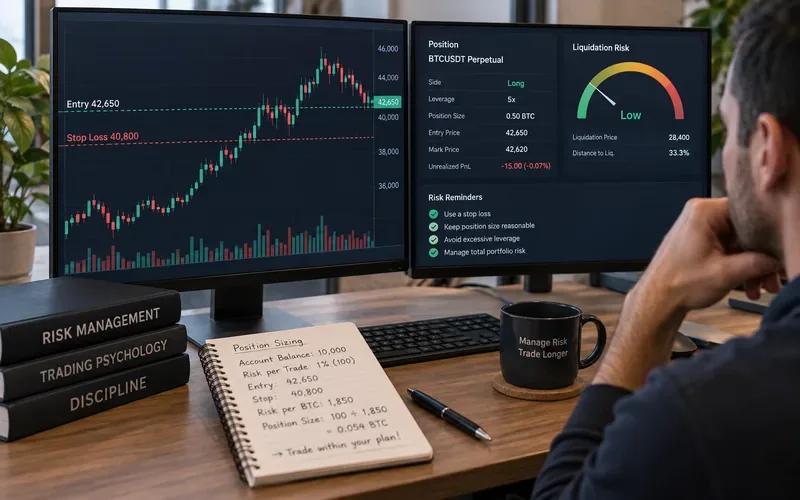
A basic sizing framework is: risk budget divided by loss per unit between entry and stop. If an account is $20,000, the trader chooses a $200 risk budget, and the planned stop is $400 away on a one-BTC position, the theoretical size before fees and slippage is 0.5 BTC. The leverage setting does not change that planned dollar loss; it changes how much collateral is required and how close liquidation may be.
Common misconception: “If the exchange lets me open it, the position is appropriately sized.” Margin eligibility is an exchange risk control, not a personal risk recommendation.
Action: write down the maximum dollar loss, stop distance, and resulting position size before sending the entry order.
Rule 2: Treat leverage as a constraint, not a target
Verified: leverage magnifies exposure relative to posted margin. The CFTC’s virtual-currency risk advisory explicitly warns that leverage amplifies the effect of market moves and that losses may require additional margin or forced position closure.
Context-dependent: there is no universally safe leverage number. Five-times leverage on a very small position can expose less capital than two-times leverage on a much larger position. Contract volatility, stop distance, collateral type, maintenance margin, funding, and portfolio concentration all matter.
Action: choose position risk first; then use the lowest leverage that still leaves practical capital efficiency and a comfortable buffer from maintenance margin.
Rule 3: Never use liquidation as your stop-loss plan
Verified: liquidation is an exchange protection mechanism, not a trader-friendly exit. Current Coinbase derivatives documentation states that when margin becomes insufficient, positions may be automatically liquidated, potentially at less favorable prices and with additional fees. For its international derivatives product, Coinbase describes liquidation after the margin ratio reaches the venue’s threshold. See the Coinbase liquidation-management documentation.
Common misconception: “My liquidation price is the most I can lose.” That is not a reliable general rule. Liquidation mechanics, collateral, fees, cross-margin effects, insurance funds, and deficit treatment vary by venue and jurisdiction. Some venues also describe liquidation prices as estimates in cross-margin accounts.
Action: place the planned invalidation exit materially before liquidation, and monitor the venue’s maintenance-margin metric rather than relying on a single displayed liquidation-price number.
Rule 4: Know whether you are using isolated or cross margin
Verified on venues that offer both modes: isolated margin restricts the collateral assigned to a specific position, while cross margin lets multiple positions share a common collateral pool. Coinbase’s current international-derivatives documentation explains that isolated positions use allocated USDC, whereas cross-margin positions draw from shared eligible collateral. See Coinbase’s margin-type comparison.
Common misconception: “Isolated margin makes the trade safe.” It only changes which collateral is available to absorb losses. A badly sized isolated position can still be liquidated quickly, while a badly managed cross-margin portfolio can allow one position to consume collateral supporting others.
Action: before opening a position, identify the margin mode and write down exactly which assets can be used to support it.
Rule 5: Use stops, but understand execution risk
Verified: stop orders are useful risk controls, but an order trigger and an executed fill are not the same thing. CME explains that a stop order becomes executable after its trigger condition is met; a stop-limit order can remain unfilled if the market moves beyond its limit, while market-style stop execution can fill across available prices. See CME Group’s futures order-type guide.
Common misconception: “A stop guarantees my exact maximum loss.” In a gap, thin book, outage, or violent liquidation cascade, realized loss can exceed the loss calculated from the trigger price. Stop-limit orders introduce the opposite trade-off: more price control but a risk of no fill.
Action: include a slippage allowance in position sizing, learn the exact stop behavior of your venue, and avoid sizing so tightly that a modest execution gap breaks your account-level risk limit.
Rule 6: Understand which price can trigger liquidation
Verified for Coinbase International Exchange: the venue uses a mark-price process to calculate unrealized profit and loss, evaluate margin compliance, and trigger liquidation procedures. Its documentation is available at Coinbase’s mark-to-market explanation.
Context-dependent: exchanges do not all calculate mark price, index price, maintenance margin, or liquidation buffers identically. A trader looking only at the last traded price can therefore misunderstand how close the account is to forced liquidation.
Action: read the contract specification and liquidation methodology for the exact product you trade, including the mark/index inputs and maintenance-margin schedule.
Rule 7: Count funding and fees as part of risk, not as bookkeeping noise
Verified: perpetual futures can transfer funding payments between longs and shorts. As of September 2026, Coinbase’s international-derivatives documentation states that funding is charged or credited hourly and that its sign depends on the relationship between perpetual and spot pricing. See Coinbase’s funding-rate documentation.
Common misconception: “Positive funding means the long is a bad trade” or “negative funding is free yield for longs.” Funding is one component of total return. Price movement can dominate funding, the rate can change, and the interval and formula differ across venues.
Action: estimate expected trading fees, funding payments, and likely holding time before entering. For longer holds, compare total carrying cost with the strategy’s expected edge rather than looking only at the chart.
Rule 8: Set a portfolio risk cap, not just a per-trade cap
A trader can follow a one-trade risk rule and still be dangerously concentrated. Three simultaneous long positions in BTC, ETH, and a high-beta altcoin may behave like one larger directional crypto bet during a market shock. The exact correlations are not stable, so there is no fixed multiplier that works in every regime.
What is known: each open derivatives position contributes to total exposure and margin demand. What depends on circumstances: how strongly those positions move together during the next stress event.
Action: maintain a maximum total open-risk budget. Group positions by shared drivers—such as broad crypto beta, a single ecosystem, or the same event catalyst—and reduce size when several trades would likely lose together.
Rule 9: Keep a margin buffer for volatility and rule changes
Maintenance requirements are not merely numbers shown at entry. Exchanges and brokers can change margin requirements, and volatile markets can consume equity quickly. CME notes that futures positions must maintain required margin and that firms can liquidate positions when accounts fall out of compliance. See CME Group’s position and risk-management overview.
Common misconception: “Unused buying power is wasted capital.” For leveraged trading, unused buying power is also a shock absorber.
Action: define a minimum margin buffer at which you automatically reduce exposure. Do not wait until the platform’s liquidation warning becomes your decision trigger.
Rule 10: Separate trading capital from life money
The CFTC advises speculators to use only money they can afford to lose. That matters more with derivatives because leverage can accelerate losses and forced exits. Trading capital should not be money needed for rent, debt payments, taxes, emergency reserves, or near-term commitments.
Action: keep a clearly defined derivatives allocation and do not replenish it impulsively after losses. If reaching a loss limit creates pressure to transfer essential savings, the trading allocation is too large.
Rule 11: Predefine daily and drawdown stop rules
Per-trade discipline can fail during a losing streak if a trader keeps increasing frequency, revenge-trades, or repeatedly re-enters the same invalidated idea. A daily loss limit and a larger account drawdown limit create a second layer of defense.
What is not universally known: no regulator can tell every trader that one specific daily percentage is optimal. Strategy frequency, volatility, account size, and statistical edge differ. CME educational material sometimes uses modest single-trade risk examples, but those examples should not be mistaken for a universal performance formula.
Action: choose hard thresholds in advance—for example, a maximum number of full-risk losses in a day and a drawdown level that forces size reduction or a trading pause—then encode them in a checklist or platform controls where available.
Rule 12: Treat venue and operational risk as part of the trade
A perfect market call can still fail operationally if the trader cannot close a position, collateral becomes unavailable, an account is restricted, or the platform is not appropriate for the trader’s jurisdiction. The CFTC recommends researching virtual-currency platforms and verifying registration when someone offers regulated futures or options products in the United States.
Action: before funding an account, verify regulatory status where applicable, withdrawal procedures, collateral rules, outage communications, liquidation documentation, and whether the product is legally available to you. Keep only the trading collateral you deliberately need on a derivatives venue.
A practical pre-trade risk checklist
Check
Question to answer before entry
Thesis
What specific market condition proves this trade wrong?
Stop
Where is the exit trigger, and what order type will execute it?
Size
What is the planned dollar loss including a slippage allowance?
Leverage
How much notional exposure does the position create?
Liquidation
What margin metric and price methodology can trigger liquidation?
Margin mode
Is the position isolated or drawing from shared collateral?
Carry
What are expected fees and funding over the intended holding period?
Portfolio
How much total risk is already open in correlated positions?
Exit failure
What happens if the stop slips, does not fill, or the venue is unavailable?
The rule that matters most: survive the trades you get wrong
Risk management cannot make a losing trade profitable, and it cannot guarantee protection from gaps, outages, or extreme market events. Its job is narrower and more valuable: keep ordinary mistakes and adverse moves small enough that the next decision still matters.
A robust crypto derivatives process therefore works in this order: define the invalidation point, cap the acceptable loss, calculate position size, check leverage and liquidation distance, account for funding and execution risk, then confirm that total portfolio exposure remains within limits. If any of those answers is unclear, reducing size—or skipping the trade—is itself a valid risk-management decision.
This article is educational and does not provide individualized investment, legal, or tax advice. Derivatives rules, margin formulas, product availability, and protections differ by venue and jurisdiction and can change over time. Confirm the current contract and account documentation before trading.