Home
» News
»
CBDCs vs. Decentralized Crypto: A Beginner’s Guide to Two Very Different Kinds of Digital Money
CBDCs vs. Decentralized Crypto: A Beginner’s Guide to Two Very Different Kinds of Digital Money
Digital money can look deceptively similar on a phone screen. A central bank digital currency may appear in a wallet app, and so can Bitcoin, ether, a stablecoin, or a token used in a decentralized application. Underneath the interface, however, they can represent very different systems.
A central bank digital currency (CBDC) is digital central bank money: a liability of a central bank, designed for use in electronic form. Decentralized cryptocurrency is a digital asset whose ownership and transfer are coordinated by a distributed network rather than issued and administered as a direct central-bank liability. The distinction matters because it changes who sets the rules, what backs the asset, how transactions are validated, what risks you take, and what happens when something goes wrong.
A central-bank digital currency and decentralized crypto can both be digital, but they rely on very different issuers, governance models, and forms of trust.
Start here: CBDC does not mean “government cryptocurrency”
One of the most common beginner mistakes is treating every blockchain-related or digital-money project as the same category. That is not accurate. The International Monetary Fund defines a CBDC as a digital version of fiat currency issued by a central bank. The Bank for International Settlements (BIS) likewise describes CBDCs as direct liabilities of the central bank. A retail CBDC would be designed for public use, while a wholesale CBDC is generally aimed at transactions among financial institutions.
This is an important starting point because a CBDC does not have to copy Bitcoin’s architecture. A central bank can choose different technical models, intermediaries, privacy arrangements, transaction limits, offline functions, or ledger structures. The BIS notes that actual CBDC designs vary by jurisdiction and policy objective. See the BIS executive summary on central bank digital currencies and the IMF Digital Finance Lexicon.
What to do: whenever you read about a CBDC, identify the issuing central bank and the specific project. Do not infer features such as anonymity, blockchain use, interest payments, or offline access unless the official design says so.
What “decentralized crypto” means
Bitcoin was introduced as a peer-to-peer electronic cash system that allows participants to transfer value without routing every payment through a financial institution. Its transaction history is maintained through a distributed network and consensus rules rather than by one issuer. The original design is described in the Bitcoin white paper.
Ethereum uses a different architecture and consensus mechanism, but it is also designed as an open, decentralized blockchain network. It supports smart contracts, which are programs that execute on the blockchain and can power decentralized applications. Ethereum’s official documentation describes the network as a public blockchain maintained by independent nodes and validators. See Ethereum’s introductory guide.
Decentralization is not an all-or-nothing label. A blockchain can be decentralized at the protocol layer while individual exchanges, wallet providers, bridges, stablecoin issuers, or applications remain centralized. In practical use, you need to examine both the network and the service you are relying on.
What to do: separate the underlying asset from the company or app you use to access it. Holding bitcoin through a centralized exchange is not the same custody arrangement as controlling bitcoin with your own private keys.
CBDCs and decentralized crypto solve different problems
Question
CBDC
Decentralized crypto
Who issues it?
A central bank.
Usually no central issuing authority in the CBDC sense; issuance follows the network protocol or smart-contract rules.
What is the core claim?
A direct claim on the central bank where the CBDC exists.
A crypto asset governed by network rules; it is not a central-bank liability.
Who validates transfers?
Depends on the CBDC design and authorized infrastructure.
Distributed network participants according to the protocol’s consensus rules.
Price relative to national currency
Designed as the national currency in digital form, such as one digital unit equaling one unit of that currency.
Usually market-priced and potentially volatile unless the asset is specifically designed to track another asset.
Account recovery
Depends on the official wallet and intermediary model.
Self-custody can make the user responsible for private keys and recovery phrases.
Transaction reversal
Depends on legal and technical rules.
On networks such as Bitcoin, confirmed transfers generally cannot be unilaterally reversed by a central administrator.
Privacy model
Depends on the jurisdiction and design.
Depends on the blockchain; public chains are typically transparent or pseudonymous, not automatically anonymous.
Before you use either one, decide what you actually need
If your goal is everyday national-currency payments
A retail CBDC, where available, is conceptually closer to digital public money than to a speculative crypto asset. Its intended role is generally payment and settlement in the national unit of account. That can make it easier to reason about prices: a product priced at 20 units of national currency is still 20 units, rather than an amount that changes because the token’s market price moved.
But availability is highly jurisdiction-specific. CBDC research is widespread, while design, launch status, and public access differ materially between countries. In the BIS survey published in August 2025, 91% of the 93 responding central banks were exploring a retail CBDC, wholesale CBDC, or both, and wholesale work was generally further advanced. Exploration is not the same as public launch. See the BIS 2024 CBDC survey results, published in 2025.
What to do: check your central bank’s official website before assuming a CBDC is available to the public.
If your goal is open access to blockchain applications
Decentralized crypto can provide capabilities that a national digital currency is not necessarily intended to provide. Ethereum, for example, supports smart contracts and decentralized applications for areas such as asset exchange, lending protocols, digital ownership, and other programmable services. Access is typically through a wallet that signs transactions.
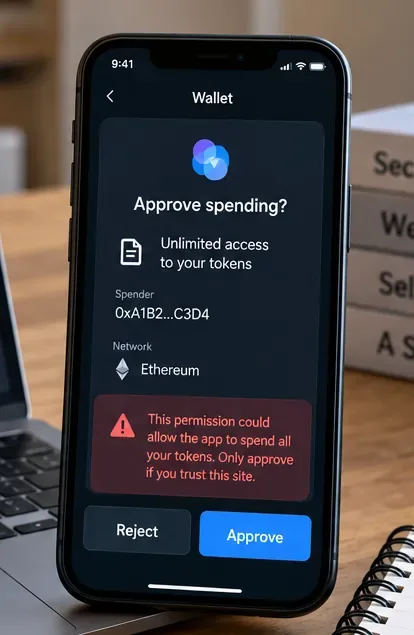
This flexibility comes with additional responsibility. Smart-contract interactions can be difficult to interpret, applications can contain bugs, and malicious approvals can expose assets. Ethereum’s documentation specifically warns about “blind signing,” where a user authorizes a transaction without clearly understanding its effect.
What to do: begin with small amounts, verify the application and transaction details, and do not approve a wallet request you do not understand.
If your goal is self-custody
Self-custody means controlling the cryptographic keys that authorize transfers from your wallet. This removes dependence on a custodian for access to the asset, but it also removes many familiar recovery mechanisms. Ethereum’s official wallet guidance warns that users are responsible for protecting their keys and recovery phrases. Bitcoin’s official user guidance similarly notes that transactions can be irreversible and lost wallet access may be permanent.
What to do: learn wallet backup and recovery before moving meaningful value into a self-custodied wallet. Never share a seed phrase or private key with support staff, websites, or people contacting you online. Review Ethereum’s wallet safety guidance and Bitcoin’s “you need to know” guidance.
Prepare for the biggest difference: who carries the risk?
With a CBDC, the monetary liability sits with the central bank. The BIS notes that central bank money does not carry the same issuer credit risk as commercial-bank deposits because the CBDC is a direct central-bank liability. However, that does not mean every CBDC implementation is risk-free in every dimension. Operational outages, cybersecurity, device security, fraud, privacy design, and the role of intermediaries still matter.
With decentralized crypto, risks can include price volatility, key loss, protocol vulnerabilities, smart-contract bugs, scams, bridge failures, exchange insolvency, and regulatory uncertainty. Bitcoin’s official materials explicitly warn that its price can move unpredictably and that users must secure their wallets carefully.
CBDC design can also create broader financial-system questions. An IMF Fintech Note published in November 2025 identifies several channels through which retail CBDCs could affect financial stability, including bank funding, lending, run risk, information flows, and payment-system resilience. The effects depend on adoption levels, national financial structures, and safeguards rather than following one universal outcome. See the IMF analysis of CBDC and financial stability.
What to do: compare risks by layer: issuer risk, market risk, custody risk, technology risk, and service-provider risk. “Digital” is not a risk category by itself.
Privacy: avoid two opposite misconceptions
The first misconception is that a CBDC must give a central bank a complete, directly operated surveillance system. That conclusion cannot be made from the term “CBDC” alone. Privacy depends on architecture, laws, intermediary roles, data access, identity requirements, transaction thresholds, and offline design. The BIS has examined offline CBDC payments partly because of potential resilience, inclusion, and privacy benefits, while also emphasizing substantial security and operational tradeoffs. See the BIS Project Polaris handbook on offline CBDC payments.
The opposite misconception is that decentralized crypto is automatically anonymous. Bitcoin’s public ledger records transactions permanently, and Ethereum is also a public blockchain. Addresses are pseudonymous, meaning they are identifiers rather than real names, but activity can sometimes be linked to individuals through exchanges, reused addresses, public disclosures, or blockchain analysis.
What to do: read the privacy documentation for the exact CBDC, wallet, exchange, or blockchain you plan to use. Do not rely on a generic slogan such as “government money is fully tracked” or “crypto is anonymous.”
Do not confuse CBDCs with stablecoins
A stablecoin is a crypto token designed to maintain a value relative to another asset, often a national currency. That does not make it a CBDC. A dollar-referenced stablecoin issued by a private company is a liability or token arrangement created by that issuer, not digital Federal Reserve money. Similarly, an algorithmic or decentralized stablecoin has its own mechanism and risks.
This distinction matters because two assets that both target “$1” can have very different legal claims, reserve structures, redemption rights, and failure modes.
What to do: before using a stablecoin, identify who issued it, what supports its value, whether direct redemption exists, and what disclosures or audits are available. Do not infer central-bank backing from the currency symbol.
A beginner-friendly way to evaluate a digital currency
Name the asset precisely. Is it a CBDC, Bitcoin, ether, a stablecoin, or another token?
Identify the issuer or protocol. Find the central bank, protocol documentation, or token issuer responsible for the system.
Determine what gives it value. A CBDC represents central-bank money; decentralized crypto assets may derive value from scarcity, network use, market demand, or other protocol economics.
Understand custody. Know whether a bank, exchange, wallet provider, or you personally control the authorization keys.
Check transaction rules. Learn whether transfers can be reversed, frozen, delayed, or recovered.
Review privacy and identity requirements. Public blockchains and regulated CBDC systems can both expose information, but in different ways.
Start small. Test the sending, receiving, backup, and recovery process with an amount you can afford to lose.
Mistakes to avoid
Assuming all digital currencies use blockchain. CBDC technology is a design choice, not a universal definition.
Calling every crypto asset decentralized. Some projects have concentrated governance, centralized issuers, or critical centralized infrastructure.
Treating a CBDC as an investment token. Its core purpose is generally to represent the national currency digitally, not to appreciate against that same currency.
Assuming self-custody is automatically safer. It removes custodian risk but adds key-management risk.
Assuming crypto is anonymous. Public blockchains can provide extensive transaction visibility.
Assuming a CBDC already exists in your country because a pilot was announced. Research, pilots, limited trials, wholesale systems, and public retail launches are different stages.
So which one is “better”?
There is no universal winner because CBDCs and decentralized crypto are not simply two brands of the same product. A CBDC can be useful when the objective is digital access to central-bank money within a regulated national payments framework. Decentralized crypto can be useful when the objective is open participation in a public blockchain, self-custody, programmable assets, or applications that do not depend on a single operator.
The tradeoff is fundamentally about trust and responsibility. CBDCs place monetary issuance and core governance within the central-bank framework. Decentralized networks distribute validation and protocol operation across network participants, while asking users to accept market, technical, and sometimes self-custody risks that do not arise in the same form with central-bank money.
For a beginner, the most useful next step is not to choose a side. It is to learn to ask five questions whenever you encounter digital money: Who issues it? Who can change the rules? Who controls my funds? What can make me lose money? What happens if I make a mistake? Those questions reveal far more than the label “digital currency.”