Home
» News
»
Cold Storage vs. Hot Wallets: How to Build a Resilient Multi-Sig Vault
Cold Storage vs. Hot Wallets: How to Build a Resilient Multi-Sig Vault
The strongest multi-signature vault is usually not the one with the most devices or the highest threshold. It is the one that removes single points of failure without making recovery so complicated that you lock yourself out.
For many advanced individuals, a carefully documented 2-of-3 setup is a practical starting point: two independent hardware-wallet signers kept in separate locations, plus a third independent signer used for recovery or operational flexibility. For a business treasury with several responsible people, 3-of-5 can make more sense. A hot wallet can play a role in day-to-day operations, but it should not be confused with cold storage and should not become the only barrier between an attacker and long-term funds.
This article separates what is well established from what depends on your circumstances. It focuses on architecture and operating discipline rather than promising that any one wallet brand or threshold is universally safest.
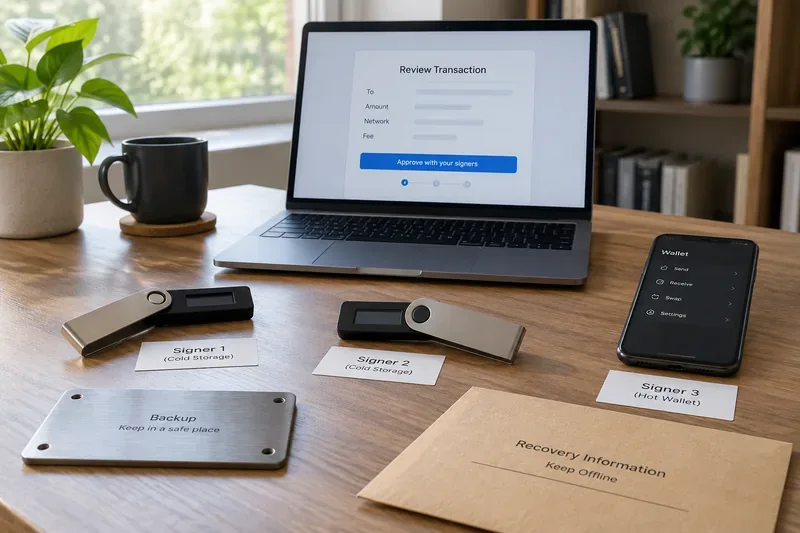
A multi-signature design can combine independent signers, offline backups, and a separate transaction-review device; the key is ensuring that one compromised device or location cannot authorize a vault spend by itself.
Cold storage and hot wallets solve different problems
Verified: a hot wallet keeps signing capability on an internet-connected phone, browser extension, desktop app, or similar environment. That makes it convenient, but also exposes the signer to a broader attack surface. Cold storage aims to keep private-key signing material isolated from general-purpose online systems, typically by using a hardware signing device or another offline process.
That distinction matters because “multi-sig” does not automatically mean “cold.” A 2-of-3 wallet whose three keys all live on online laptops is still exposed to online compromise. Multi-signature reduces dependence on one key; cold storage reduces exposure of individual keys. They are complementary controls.
Action: classify each signer by where its private key lives and how it signs. Do not label a signer “cold” merely because you rarely use it.
Misconception: multi-sig always makes a wallet safer
Verified: multi-signature can eliminate a single private key as the sole authorization point. Bitcoin supports n-of-m multisignature conditions, and Safe Smart Accounts on EVM networks let owners define a confirmation threshold. Safe's official documentation explains that the threshold is the minimum number of owners required to confirm a transaction before execution. See Safe Smart Account concepts.
Also verified: extra keys create extra operational requirements. Trezor's multisig documentation warns that users need the public wallet information required to reconstruct and use the setup, and that losing important configuration data can make funds inaccessible even if enough signing devices survive. See Trezor's multisig guidance.
What depends on circumstances: whether 2-of-3, 3-of-5, or another policy is appropriate. Safe's help center explicitly states that there is no single best number of signers or threshold for every use case, while generally recommending a threshold above one and below the total number of signers. See Safe's setup guidance, last updated April 23, 2026.
Action: choose the smallest structure that survives the failures you genuinely care about. Complexity should earn its place.
A practical vault architecture
Use case
Reasonable starting architecture
Main benefit
Main tradeoff
Advanced individual
2-of-3 independent hardware signers
One lost or compromised key does not automatically lose funds
Requires disciplined backups and configuration records
Family or small partnership
2-of-3 with signers controlled by different trusted parties or locations
Reduces one-person and one-location risk
Recovery and inheritance procedures must be explicit
Business treasury
3-of-5 with role separation
Supports shared approval and continuity
More devices, people, policy, and testing
Operational spending
Separate low-balance hot wallet or tightly limited signer path
Fast routine access without exposing the vault
Hot-wallet funds remain more exposed
The most important design principle is separation. If two devices are stored in the same safe, backed up in the same drawer, initialized on the same compromised computer, or administered by the same password manager account, the design may still fail in one incident.
Action: draw your failure domains on paper: device failure, house fire, theft, malware, coercion, cloud-account takeover, and loss of one trusted person. Confirm that no single event can both reach the signing threshold and destroy your recovery path.
Should one signer be a hot wallet?
Condition-dependent: a hot signer can be acceptable as a convenience key if the threshold still requires an independent cold signer. For example, in a 2-of-3 design, a phone signer plus two hardware signers can make routine signing easier while still requiring a hardware device for each spend.
However, this is not equivalent to a fully cold 2-of-3 vault. A compromised phone has already given an attacker one of the two required approvals. The remaining security margin is then concentrated in a single cold signer.
For long-term savings, many users will prefer keeping every vault signer on dedicated hardware and using a completely separate hot wallet for small spending balances. This creates a clean boundary: the hot wallet handles convenience; the vault handles preservation.
Action: if you include a hot signer, model it as already compromised. Ask whether the remaining controls are still strong enough.
Key separation matters more than brand diversity alone
Using multiple hardware-wallet brands can reduce dependence on one implementation, but brand diversity is not magic. If all seeds, devices, and backups are stored together, the same burglary or fire can still defeat the system. Conversely, three identical devices in genuinely separate failure domains may be more resilient than a “diverse” setup kept in one location.
Ledger's educational guidance on multisig similarly emphasizes distributing keys geographically and using hardware devices for signing. See Ledger's multisig best-practices overview.
Action: prioritize independent locations, independent backups, and independent access control before buying extra brands solely for diversity.
Back up more than the seed words
This is one of the most dangerous misconceptions in multi-signature storage. A single-signature wallet can often be reconstructed from its seed plus derivation assumptions. A multisig wallet also depends on wallet policy and public-key metadata that tells software how the signers fit together.
For Bitcoin descriptor-based workflows, Bitcoin Core exposes wallet descriptors and documents them as the script information used by descriptor wallets. Its current documentation includes the Bitcoin Core 30.0 listdescriptors RPC. Older multisig RPC documentation also shows that a multisig address is defined by a required-signature count plus the participating keys. See Bitcoin Core's addmultisigaddress documentation.
Action: preserve the wallet policy, signer fingerprints or equivalent identifiers, derivation paths, descriptors or account configuration, network, wallet software used, and clear recovery instructions. Keep recovery metadata available to authorized people without placing all private secrets together.
Verify addresses and transaction details on trusted displays
Multi-sig cannot save you if every signer blindly approves the same malicious transaction. The human layer still matters. A compromised coordinator computer can present a wrong destination, malicious contract call, or unexpected amount. Hardware signers are most useful when you verify critical details on the device itself rather than trusting only the computer screen.
For smart-contract accounts, the risk model is broader than “where are the keys?” Safe documents modules and guards that can extend behavior, but also warns that modules and guards are security-critical. A broken guard can even block transaction execution. See Safe's setGuard security warning.
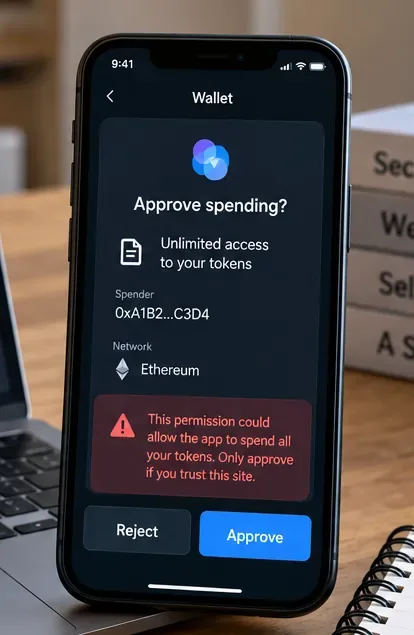
Action: before signing, verify destination, amount, network, fee, and—when interacting with contracts—the actual operation being authorized. Treat a new module, guard, allowance, or policy change as a high-risk transaction.
Do not make the threshold equal to every signer unless you truly need unanimity
A 3-of-3 wallet sounds stronger than 2-of-3 because every transaction needs every key. It also means one permanently lost key can freeze the funds. For many users, that is a poor resilience tradeoff.
Safe's official setup guidance recommends considering a threshold lower than the total signer count so that one inaccessible signer does not automatically lock the account. That is not a universal rule—some governance situations intentionally require unanimity—but it is a useful default for personal custody and many operational treasuries.
Action: decide whether your bigger risk is unauthorized spending or permanent loss of access. Set the threshold only after answering that question.
Recovery drills are part of the vault
Verified principle: a backup that has never been tested is only an assumption. The most robust design includes a safe way to verify that signers, configuration records, and recovery instructions still work.
A recovery drill does not require moving your entire balance. You can verify that replacement wallet software recognizes the intended policy, that each signer can sign, that receive addresses match independently, and that responsible people know where the required information is located. For a business, document what happens when an employee leaves, a signer is lost, a device model is retired, or a key is suspected compromised.
Action: schedule a periodic recovery review and perform a small, controlled test transaction after major wallet, firmware, signer, or personnel changes.
Keep the daily wallet outside the vault
The best cold-storage design often improves usability by admitting that not every transaction deserves a vault ceremony. A small hot-wallet balance can handle routine payments, decentralized applications, or exchange deposits while the multi-sig vault remains intentionally inconvenient.
This separation limits blast radius. If the hot wallet is phished or compromised, the attacker gets the operational balance rather than the treasury. Refill it from the vault according to a predefined amount or schedule instead of turning the vault itself into a frequently used browser wallet.
Action: set a maximum hot-wallet balance based on what you can afford to lose without threatening your long-term holdings.
A concise blueprint for a resilient multi-sig vault
Use a threshold greater than one so a single key cannot spend the vault.
Keep the threshold below the total number of signers unless unanimity is an intentional requirement.
Separate signers and backups across real failure domains, not just different drawers.
Prefer dedicated hardware signers for long-term vault keys.
If a hot signer is used, ensure it cannot authorize a spend without an independent cold signer.
Back up wallet configuration and public metadata as well as private recovery material.
Verify transaction details on trusted signer displays whenever possible.
Keep routine spending funds outside the vault.
Test recovery and signer replacement before an emergency forces you to learn under pressure.
What cannot be universally determined
No source can tell you the “perfect” threshold, signer count, storage locations, or wallet stack without knowing your threat model, estate plan, technical ability, jurisdictions, and who must be able to recover the funds. A solo holder protecting retirement savings has different needs from a five-person treasury, and an organization may need internal controls that go well beyond wallet software.
The useful goal is therefore not maximum complexity. It is a design in which no single compromised device, person, account, or physical location can both authorize the vault and erase your recovery options.
Final action: write the design down, test it with a small amount, rehearse recovery, and only then move significant funds into the vault.