Home
» News
»
DePIN Explained: 5 Networks With Strong ROI Potential—If You Have the Right Hardware
DePIN Explained: 5 Networks With Strong ROI Potential—If You Have the Right Hardware
You buy a hotspot, GPU, dashcam, or storage server because a DePIN project advertises token rewards. A few months later, the uncomfortable question appears: is the hardware actually producing enough useful work to recover its cost? That is the real DePIN problem. The highest-return opportunity is rarely the network with the loudest token narrative; it is usually the one that can monetize an asset, location, route, or compute resource you already have at a competitive operating cost.
DePIN, short for decentralized physical infrastructure networks, uses distributed contributors to supply real-world resources such as wireless coverage, map imagery, GPU compute, cloud servers, or storage. Blockchain-based payments and tokens coordinate incentives, but the underlying economics still look familiar: revenue must exceed hardware depreciation, electricity, internet, maintenance, financing, downtime, taxes, and the opportunity cost of your capital.
This guide focuses on five established DePIN-style networks with active contributor or provider models as of September 14, 2026. “High ROI” here means strong return potential when the operator has a genuine cost or location advantage, not guaranteed profit.
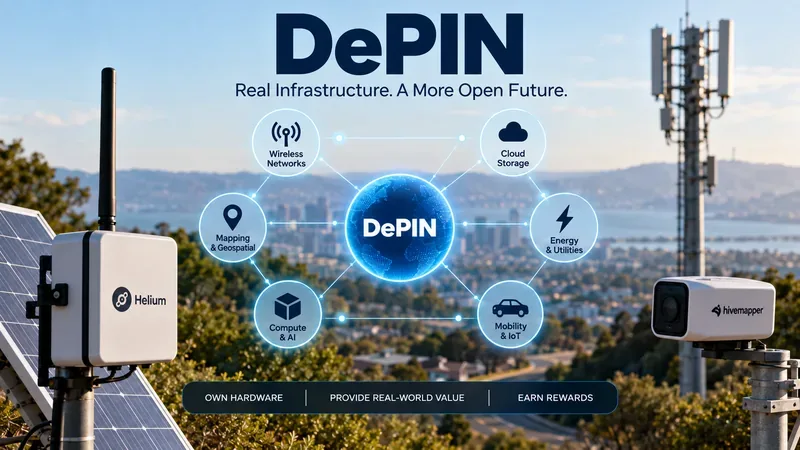
DePIN economics connect physical assets such as wireless radios, mapping devices, compute hardware, and storage infrastructure to networks that reward useful real-world services.
Why do so many DePIN ROI calculations go wrong?
The most common mistake is calculating revenue before verifying demand. Token emissions can temporarily make a node look profitable even when few customers use the service. That can reverse quickly when reward schedules change, more suppliers join, or the token price falls.
A better calculation starts with five questions: What useful service does the network sell? What determines your share of rewards? How much new capital must you spend? What are the recurring costs? And can your specific location or hardware outperform the average contributor?
Then divide that result by the capital you actually had to commit. If you already own the hardware and it would otherwise sit idle, the economics can be dramatically better than buying equipment specifically to chase rewards.
Which DePIN networks currently offer the strongest ROI potential?
Network
Physical resource
Best fit
Capital intensity
Main ROI driver
Helium
Wireless coverage and carrier data offload
Businesses or sites with useful foot traffic and internet
Low to medium
Eligible data traffic through a well-placed hotspot
Hivemapper
Street-level mapping imagery and map editing
Drivers with frequent, diverse routes
Low to medium
Fresh, useful coverage in less-saturated areas
Render Network
GPU rendering and AI compute
Operators with idle compatible GPUs
Medium if hardware is owned; high if purchased
Utilization, uptime, hardware capability, work allocation
Akash Network
CPU, GPU, RAM, storage, and cloud infrastructure
Experienced server or data-center operators
Medium to high
Lease utilization and competitive provider pricing
1. Helium: best when you control a genuinely useful location
Helium operates decentralized wireless infrastructure for IoT and mobile connectivity. The current economics are materially different from the early hotspot-mining era. Helium’s official documentation says Proof-of-Coverage data was deprecated after Proof-of-Coverage was removed from the networks on July 6, 2026. Today, the most important question is whether your deployment carries useful traffic.
For the Mobile Network, community-operated hotspots and converted Wi-Fi networks provide carrier offload. The operator supplies real estate, power, and internet connectivity and can receive HNT for eligible data transfer. Helium specifically describes commercial locations where slow-moving users gather—such as restaurants, shopping areas, and transit locations—as useful hotspot environments. See the official Helium Mobile Network documentation.
For IoT, Helium states that LoRaWAN gateways can join the network and earn HNT for device data they carry. The official IoT hotspot onboarding documentation explains the current model.
When can Helium produce attractive ROI?
The strongest setup is usually not “buy a radio and hope.” It is an operator who already controls a high-value site, already pays for broadband and power, and can place hardware where real subscribers or IoT devices generate traffic. Your incremental operating cost can then be small relative to a new standalone deployment.
Self-check: if you cannot explain who will actually use the coverage at your location, do not use token rewards alone to justify the purchase.
2. Hivemapper: strong for drivers who already travel valuable routes
Hivemapper turns routine driving into map-data collection. Contributors use approved devices to capture street-level imagery, while the network rewards useful contributions with HONEY. The official documentation says Bee Maps is currently the only certified device manufacturer for the Hivemapper Network. Review the current contributor requirements in Hivemapper’s mapping documentation.
The ROI logic is unusually location-dependent. Hivemapper evaluates coverage, freshness, and quality. Its reward system also reduces the value of repeatedly mapping highly saturated areas while increasing the relative incentive for less-saturated routes. That means two drivers with the same camera and the same number of miles can earn very different amounts. The mechanism is documented in Hivemapper’s map tile saturation rules.
The network also ties map consumption to its token model. Map customers burn HONEY to obtain Map Credits; under the current burn-and-mint design, a portion of that usage can return to contributors as consumption rewards. See the official HONEY burn-and-mint documentation.
When can Hivemapper produce attractive ROI?
It is most compelling when you already drive frequently for work or daily life and can cover under-mapped or freshness-sensitive roads without materially increasing fuel, vehicle wear, or labor time. A taxi, delivery, fleet, field-service, or long-distance operator may have a structural advantage over someone who drives extra miles purely to collect rewards.
Self-check: estimate incremental miles caused by mapping. If the project makes you drive substantially farther, include fuel, maintenance, tires, depreciation, and your time before calling the rewards profit.
3. Render Network: potentially attractive for idle GPUs, not speculative hardware purchases
Render Network connects GPU capacity with rendering and compute demand. Node operators can contribute compatible hardware and receive RENDER-based rewards tied to work and availability. The Render Foundation explains that node operator emissions are allocated based on availability and share of completed work, rather than simply rewarding ownership of a GPU. Its current model is summarized in the official Render Foundation FAQ.
The network’s public dashboard reported more than 80 million total frames rendered when checked for this article, demonstrating that the system has processed substantial real workloads. Current network statistics can be verified on the Render Foundation dashboard.
The most important ROI warning comes from Render itself. Its compute-node guidance explicitly says the program is a call for existing hardware and strongly advises against purchasing new hardware merely to join the compute network. Current requirements for some compute-node paths include modern GPUs, substantial RAM and SSD capacity, Linux, and minimum network performance. Review the official compute-node FAQ before spending money.
When can Render produce attractive ROI?
The best candidate already owns GPUs that are paid off or underutilized, has relatively cheap electricity, reliable bandwidth, and can keep nodes online. Buying a premium GPU at retail price solely because a token reward calculator looks attractive creates a much harder payback problem.
Self-check: calculate profitability twice—once assuming your current expected utilization and once at half that utilization. If the investment only works in the optimistic case, the margin of safety is weak.
4. Akash Network: a real provider business, not passive mining
Akash is a decentralized cloud marketplace where providers offer CPU, GPU, memory, storage, network connectivity, and other resources. Providers compete for deployment orders by submitting bids, and revenue comes from serving actual tenant workloads. The model is described in Akash’s official provider and lease documentation.
Akash’s own provider guide is unusually useful for ROI planning because it publishes indicative cost and revenue ranges while repeatedly warning that results vary. The guide lists example initial hardware costs of roughly $500 to $5,000 or more, electricity of roughly $20 to $200 or more per month, and highly variable potential monthly revenue ranging from approximately $10–$100+ for CPU/memory resources to $100–$1,000+ for GPUs. These are not promises; Akash says outcomes depend on capacity, uptime, pricing, and market demand. Check the latest figures directly in Akash’s “Should I Run a Provider?” documentation.
This is why Akash belongs in a different category from a plug-and-play hotspot. Running a competitive provider involves Linux, networking, monitoring, Kubernetes or provider tooling, pricing strategy, and operational maintenance.
When can Akash produce attractive ROI?
It is strongest for operators who already have servers, rack space, bandwidth, operational skills, and power economics that are competitive with other providers. GPUs can command more revenue, but expensive hardware sitting idle can destroy returns just as quickly.
Self-check: calculate break-even utilization. If your monthly fixed costs require near-constant lease occupancy, your business is fragile. A provider with lower fixed costs can survive much more variable demand.
5. Filecoin: potentially powerful economics, but the highest operational barrier here
Filecoin storage providers supply persistent storage and cryptographically prove that data remains available. Providers can earn FIL through storage services and block rewards, but this is not a beginner-friendly “attach a spare hard drive” model.
The official Filecoin documentation says at least 10 TiB of storage power is required to be eligible for Winning Proof-of-Spacetime block rewards. Greater storage power increases the probability of block election. Verified Filecoin Plus deals can receive a 10x quality-adjusted-power multiplier, increasing their weight in the reward mechanism. See the Filecoin block reward documentation and verified-deal documentation.
Providers also face collateral and reliability requirements. Missing proof deadlines or violating storage obligations can lead to penalties and slashing. The official collateral documentation explains those risks.
When can Filecoin produce attractive ROI?
The opportunity is more suitable for professional operators that can acquire storage efficiently, maintain reliable systems, win useful-data deals, manage collateral, and operate at scale. A provider with enterprise storage expertise may have a real advantage; a casual retail buyer generally does not.
Self-check: model the cost of failure, not only the expected reward. Include collateral exposure, hardware redundancy, replacement drives, bandwidth, staff time, and downtime.
How should you choose a DePIN project before buying hardware?
Start with the easiest advantage you already possess. If you control a retail location with real mobile traffic, investigate Helium before buying GPUs. If you drive hundreds of useful miles every week, Hivemapper may fit better than a server business. If you already own idle GPUs, compare Render and Akash. If you operate serious storage infrastructure, Filecoin deserves deeper modeling.
Verify real demand: rewards linked to paid usage are generally more durable than rewards based only on expansion.
Use incremental cost: existing hardware, internet, routes, and locations can materially improve ROI.
Stress-test token prices: recalculate returns at 50% of the current reward-token value.
Stress-test utilization: assume fewer jobs, fewer leases, less traffic, or more competition.
Include depreciation: GPUs, drives, radios, and vehicles wear out or become obsolete.
Check exit value: specialized hardware with no secondary market raises investment risk.
Read current official rules: reward formulas can change. Helium’s 2026 removal of Proof-of-Coverage is a clear example of why old ROI guides can become misleading.
Which network has the best ROI?
There is no defensible universal winner. For a driver already covering under-mapped roads, Hivemapper may have the best marginal economics. For a business with a high-traffic location, Helium can make more sense. An owner of idle GPUs may prefer Render, while an experienced cloud operator can potentially extract more value from Akash. Filecoin can reward scaled storage expertise but demands far more capital and operational discipline.
The practical ranking is therefore personal: the best DePIN ROI usually comes from matching a network to an asset you already own and a service customers actually need. Buying a new asset first and searching for demand later reverses that logic.
Final self-check: is your DePIN ROI thesis strong enough?
Before committing capital, write down four numbers: total cash investment, monthly fixed cost, conservative monthly reward or service revenue, and expected resale value after one year. Then rerun the model with token prices and utilization both cut in half.
If the project still has a reasonable payback period, the economics may deserve further due diligence. If profitability disappears immediately, treat the opportunity as speculative rather than infrastructure income.
DePIN can turn distributed hardware into useful economic networks, but the blockchain does not repeal ordinary business math. Location, utilization, operating cost, service demand, and disciplined capital allocation remain the variables that matter most.
Information is current through September 14, 2026 and is provided for educational purposes only. Token rewards, hardware economics, taxes, regulation, and network rules can change. This article is not investment, tax, or financial advice, and no DePIN return is guaranteed.