Home
» News
»
DePIN Hardware Nodes in 2026: Is Hosting a Node Still Profitable?
DePIN Hardware Nodes in 2026: Is Hosting a Node Still Profitable?
Buying a DePIN box can still look deceptively simple: pay for hardware, plug it in, keep it online, and collect tokens. The practical problem in 2026 is that several mature decentralized physical infrastructure networks no longer reward hardware merely for existing. They increasingly reward useful traffic, high-quality data, good placement, or scarce coverage. That makes profitability much more site-specific than the old “daily token yield × token price” screenshots suggested.
The short answer is that hosting a DePIN hardware node can still be profitable, but only when the node produces something the network actually wants and the all-in cost is low enough. A strong location can outperform a cheap device in a weak location. A technically perfect installation can still disappoint if rewards dilute, the token price falls, the area becomes oversupplied, or the protocol changes its economics.
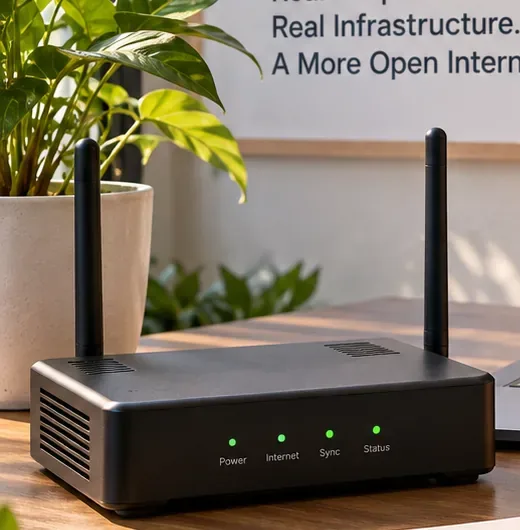
A compact network node represents the physical side of DePIN: hardware, connectivity, uptime, and placement all matter before token rewards can become real profit.
What does “profitable” actually mean for a DePIN node?
A node is not profitable just because its wallet balance increases. The useful metric is cash-equivalent net profit after hardware, installation, electricity, added internet or cellular service, maintenance, replacement risk, transaction fees, and any site rent or revenue sharing. Taxes also matter, but treatment depends on jurisdiction and individual circumstances.
Verified: reward formulas differ sharply by network. Helium Mobile pays deployers for eligible data transfer; GEODNET evaluates GNSS base stations using online time and signal-quality rules; WeatherXM scores weather stations using proof of location and data quality and can exclude stations in overcrowded cells. Action: model the exact network you plan to join rather than applying an ROI figure from another DePIN project.
Depends on circumstances: token-denominated rewards may have real market value, but the USD value realized by a host depends on the token price and the ability and cost to sell it. Action: calculate profitability twice: once in native reward units and once in cash at a conservative token price.
Unknown: no operator can know today what a volatile token, future governance vote, future hardware policy, or local competitive density will be a year from now. U.S. Investor.gov warns that crypto assets can involve volatility, illiquidity, technical risks, and the possibility that a market becomes unavailable. Action: never make the purchase case depend on one optimistic future token price. See the Investor.gov crypto-asset risk alert.
The biggest misconception: “If the node is online, it earns”
Helium: useful traffic now matters far more than passive coverage
Helium is a clear example of why old profitability calculators can be misleading. Helium documentation says Proof-of-Coverage data was deprecated after Proof-of-Coverage was removed from the networks on July 6, 2026. Current Mobile documentation describes a decentralized carrier-offload network in which deployers provide real wireless service and receive HNT for eligible data transfer. Action: ignore older ROI posts centered on passive Proof-of-Coverage and evaluate how much rewardable data your proposed site can actually serve. See the Helium Oracle Data documentation and Helium Mobile network documentation.
As of September 2026, Helium's store lists its indoor Mobile Hotspot at $249.99 and the outdoor version at $499.99. The network's Data Credit documentation lists Mobile data at $0.10 per GB. HIP-150, approved in late August 2026, raised the target minimum for Mobile deployer earnings from 50% to 80% of what payers pay for rewardable data for a defined period and introduced the possibility of higher per-site multipliers for selected high-value venues. Those are protocol economics, not a promise that every hotspot will have enough rewardable traffic to recover its hardware cost. Action: first estimate eligible GB per month at the exact venue, then compare that with hardware and site costs. Check current Helium Mobile hardware pricing, Helium Data Credit pricing, and the approved HIP-150 specification.
For perspective only, if a hotspot actually realized $0.08 per rewardable GB—the 80% target applied to a $0.10 payer rate—then recovering a $249.99 indoor unit from data rewards alone would require about 3,125 GB, before electricity, bandwidth, fees, downtime, tax, or installation. The $499.99 outdoor unit would require about 6,250 GB on the same simplified basis. This is a break-even illustration, not a revenue forecast, because eligible traffic and realized rewards are location-dependent.
GEODNET: installation quality can determine whether a base station earns at all
GEODNET rewards GNSS reference stations, but its current rules make quality and location central. Its tokenomics documentation states that base rewards halve annually on June 30. The published table shows a maximum of 12 GEOD per day for the July 2025 through June 2026 period and then continues with an annual-halving schedule rather than promising that old rate indefinitely. Its performance rules also state that stations can lose rewards when two-hour Rolling Reward Rate falls below 80%, multipath exceeds 0.75 meters, and dual-band stations are ineligible for GEOD rewards. Action: do not copy a 2025 daily-reward figure into a 2026 payback sheet; verify the current rate and your station metrics in the GEODNET console. See GEODNET tokenomics and GEODNET performance-based reward rules.
The authorized GEODNET store currently lists a MobileCM triple-band GNSS base station at $695. That price alone does not tell you whether it is a good deployment. Nearby-station rules, open-sky antenna placement, multipath, uptime, and special SuperHex incentives can change realized rewards. Action: inspect the network map, confirm that you can mount the antenna with a clean sky view, and treat any special multiplier as temporary unless its current rules explicitly say otherwise. The authorized GEODNET hardware listing and GEODNET reward metrics are better inputs than an old earnings screenshot.
WeatherXM: a cheap station can still be a poor reward location
WeatherXM demonstrates a different form of saturation risk. Its Reward Mechanism v2.0 considers proof of location and data quality, while its Cell Capacity documentation says each cell currently has a fixed capacity of 10 rewardable stations. When more eligible stations compete in a cell than its capacity, ranking by reward score and seniority determines which stations receive rewards. Action: check the intended cell before buying hardware; a sale price does not compensate for entering an already overcrowded cell. See the WeatherXM Reward Mechanism and WeatherXM Cell Capacity rules.
WeatherXM's official shop was advertising its reward-capable D1 WiFi and H2 Helium stations at $139 during September 2026, reduced from a displayed $400 list price. Sale pricing can change, and the cheaper D1 Lite is explicitly described elsewhere by WeatherXM as not generating WXM rewards. Action: confirm the exact SKU is reward-capable before checkout and never infer rewards merely from the fact that two devices share a product family. Check current WeatherXM station pricing.
Another misconception: electricity is always the main operating cost
Electricity matters, but for many small wireless, sensor, and GNSS nodes it may be less important than hardware depreciation, site access, internet service, or lost rewards from a weak location. The U.S. Energy Information Administration reported an average U.S. residential electricity price of 18.16 cents per kWh for January through June 2026. At that rate, a continuously operating 10-watt device would use about $15.91 of electricity per year, while a 30-watt device would use about $47.72. Those examples are arithmetic illustrations only; actual node wattage and local electricity prices vary. Action: measure or obtain the device's real power draw and use your utility rate instead of assuming electricity is either free or ruinous. See EIA Electric Power Monthly price data.
A better way to calculate DePIN node profitability
Before buying, build a simple three-case model. Do not start with token price. Start with what the node does and how the protocol measures that work.
Small recurring costs compound over a multi-year payback.
Downtime and dilution
Expected availability plus a margin for new competing nodes
Perfect-lab assumptions overstate real rewards.
A practical formula is: annual net cash flow = realized annual reward value minus annual operating costs. Simple payback period = all-in upfront cost divided by monthly net cash flow. If monthly net cash flow is zero or negative, there is no finite payback period under that scenario.
Action: run at least three cases. A base case can use today's rules and conservative local activity. A stress case should cut either token price or reward value substantially and assume some downtime. An upside case can model better utilization, but it should not be the case that makes the purchase barely work.
What makes a node more likely to remain profitable?
Real demand at the location. A Helium hotspot in a venue with genuine offload demand has a clearer utility path than a hotspot placed only because the coverage map looks empty. Action: estimate users and eligible traffic, not just radio range.
Scarce, high-quality data. GEODNET rewards are sensitive to signal quality and performance, while WeatherXM explicitly incorporates data quality and location. Action: evaluate whether you can install the hardware to the project's published standard before buying it.
Low deployment friction. Existing roof access, power, broadband, a vehicle route, or a business location can turn an otherwise marginal deployment into a reasonable one. Action: value assets you already control, but do not pretend they have zero opportunity cost.
Useful hardware even without the token. A weather station, RTK reference station, or connectivity device may provide non-token utility to an owner. Action: assign that secondary value separately rather than counting it as guaranteed cash income.
A short enough payback period. Protocol rules can change faster than traditional infrastructure contracts. Action: be cautious when the purchase only works under a multi-year optimistic forecast.
When should you walk away?
Avoid the deployment when the seller's main argument is historical APY, when the protocol's current documentation no longer matches the calculator being promoted, when you cannot estimate the network's desired work at your location, or when break-even requires the token to appreciate. Also reconsider if the site depends on a temporary reward multiplier that may expire before the hardware pays back.
Verified versus unknown matters here. Hardware price, current protocol rules, published reward formulas, and today's cell or performance requirements can often be verified. Next year's token price, next year's competitor density, future governance decisions, and future customer demand cannot. Action: put verified inputs in the main model and place unknowns in sensitivity ranges, not in the assumptions you need to break even.
So, is hosting a DePIN hardware node still profitable in 2026?
Yes, selectively. The strongest opportunities are no longer simply “early network + high token emissions.” They are deployments where a host has a good physical location, low incremental operating costs, hardware that meets current standards, and measurable demand for the service or data being produced. Helium's 2026 shift away from Proof-of-Coverage is the clearest signal of that direction: useful data transfer now matters. GEODNET and WeatherXM similarly reward quality and scarcity rather than treating every box equally.
The result to aim for is not the highest advertised token yield. It is a deployment that remains cash-flow positive after conservative assumptions and still makes sense if rewards weaken. Before purchasing, verify the current rules on the project's own documentation, calculate the hardware-only and all-in payback, stress-test token value and reward dilution, and set a maximum payback period you are unwilling to exceed. If the node still works under that test, it may be a viable infrastructure deployment. If it only works in the best case, the risk is probably being priced as optimism rather than profit.