Home
» News
»
DePIN Use Cases: How Telecom, Storage, and Energy Tokens Are Building Real-World Networks
DePIN Use Cases: How Telecom, Storage, and Energy Tokens Are Building Real-World Networks
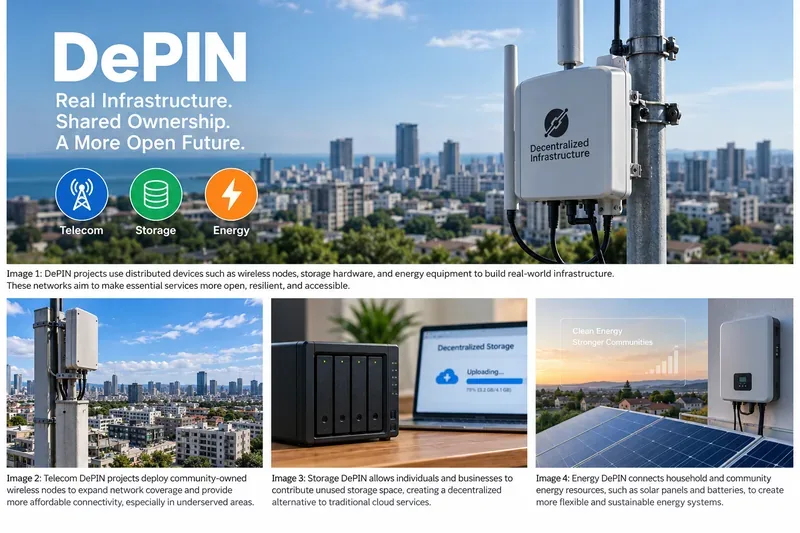
Decentralized Physical Infrastructure Networks, or DePIN, use blockchain-based coordination and token incentives to organize real-world infrastructure supplied by many independent participants. The basic idea is not that a token magically replaces a telecom carrier, cloud provider, or electric utility. Instead, the token can help coordinate who contributes equipment, who consumes the service, how usage is measured, and how participants are compensated.
That distinction matters because the strongest DePIN projects are increasingly judged by useful service delivered, not by how many devices can be subsidized with emissions. Telecom, storage, and energy illustrate three very different versions of the model. Telecom emphasizes local coverage and traffic. Storage emphasizes verifiable custody of data. Energy projects often emphasize market coordination, traceability, and verification around distributed assets such as solar generation, batteries, and flexible loads.
Telecom, storage, and energy DePIN projects apply token incentives to very different physical resources, so their economics and operational risks should be evaluated separately.
What makes a DePIN network different?
A useful way to evaluate DePIN is to separate three layers. First is the physical layer: radios, servers, disks, solar meters, batteries, or other equipment. Second is the coordination layer: software that measures service and matches supply with demand. Third is the economic layer: payments, rewards, staking, credits, or tokens that encourage participants to provide capacity.
The token is therefore only one piece of the system. A healthy network still needs real demand, reliable hardware, quality controls, customer support, fraud prevention, and compliance with local rules. This is why the same token model can work well in one infrastructure category and poorly in another.
Telecom DePIN: best when local coverage is the scarce resource
Telecom is one of the clearest DePIN use cases because network coverage is inherently geographic. Traditional carriers must decide where it is economical to deploy infrastructure. A decentralized model can let households, businesses, and property owners add radios or Wi-Fi access points where users actually need service.
Helium is the best-known example. Its official documentation says the network supports a global LoRaWAN network for IoT devices and a cellular offload Wi-Fi network for mobile connectivity. Community-operated Hotspots provide coverage, while operators can earn HNT for useful network work. Helium also uses Data Credits, derived from HNT, to pay for wireless data transmission. See the Helium documentation and HNT token documentation.
For the mobile network specifically, Helium describes its architecture as a decentralized carrier-offload network. Community-deployed Wi-Fi hotspots can connect subscribers from participating carriers, and rewards are tied to eligible data transfer and service quality. That is a much stronger economic design than paying only for installing hardware, because usage becomes part of the reward signal. See Helium Mobile documentation.
Where telecom DePIN fits best
Dense venues: cafes, malls, transit areas, campuses, and other places where offload demand is concentrated.
IoT coverage: sensors and low-bandwidth connected devices that do not require the same throughput as consumer broadband.
Incremental coverage: locations where a small local deployment can improve service without waiting for a full carrier buildout.
Trade-offs
The main weakness is variability. A network built from many independent operators may have inconsistent placement, backhaul quality, power reliability, and maintenance. Token rewards can attract supply, but they do not automatically put radios in economically useful places. Telecom also faces spectrum, certification, security, and carrier-integration constraints that storage networks generally do not.
Practical recommendation: telecom DePIN is most compelling when you can identify a measurable local coverage problem and verify actual traffic demand. It is less compelling when the business case depends mainly on token appreciation rather than service usage.
Storage DePIN: best when verifiability and provider diversity matter
Storage DePIN addresses a different problem. Instead of geographic coverage, the scarce resource is reliable disk capacity and the ability to prove that data remains available. Filecoin is built around this idea. Its official materials describe a decentralized storage network in which independent providers store client data and use cryptographic proofs to demonstrate that the data is being stored over time. FIL aligns incentives among storage providers and users. See Filecoin's official overview.
Filecoin's architecture is particularly relevant for archives, large datasets, Web3 infrastructure, AI data pipelines, and workloads where verifiable storage commitments are valuable. In 2025, Filecoin introduced Proof of Data Possession for verifiable hot storage, expanding beyond its earlier reputation for archival storage. The project's 2026 strategy explicitly shifted emphasis from simply growing storage supply toward increasing paid, on-chain demand. See the 2026 Filecoin network strategy and the Proof of Data Possession announcement.
Where storage DePIN fits best
Long-lived archives: data that should remain available across organizational changes.
Verifiable datasets: scientific, AI, or public-interest datasets where proving custody matters.
Multi-provider resilience: organizations seeking alternatives to dependence on one cloud vendor.
Web3-native applications: systems already using content addressing or on-chain logic.
Trade-offs
Decentralized storage can create operational complexity. Retrieval performance may vary by provider and storage tier. Enterprises still need encryption, access control, lifecycle policies, replication strategy, disaster recovery, and predictable support. A decentralized market also does not eliminate the need to evaluate provider quality.
There is also a major difference between capacity and demand. A network can advertise enormous storage capacity without proving that customers are paying to use it. Filecoin's own 2026 strategy recognizes this by prioritizing paid storage deals and network economics rather than supply growth alone.
Practical recommendation: storage DePIN is strongest when verifiability, portability, or provider diversity are more important than having the simplest possible managed-cloud experience. For latency-sensitive enterprise applications, a hybrid architecture may be more practical than moving everything off a conventional cloud.
Energy DePIN: best when coordination and proof matter more than raw generation
Energy is often discussed as if DePIN tokens directly create electricity supply. In practice, the stronger use cases are usually market coordination, renewable-energy tracking, distributed-resource participation, and verification.
Powerledger, for example, develops software for peer-to-peer energy trading, energy traceability, environmental commodity markets, and EV-related use cases. Its official site says the platform uses blockchain technology to support more distributed energy markets, while the POWR token is part of its blockchain ecosystem. Powerledger has integrated its products with Solana mainnet and supports POWR on both Ethereum and Solana. See Powerledger and Powerledger's blockchain page.
Energy Web illustrates another model. Its Verified Compute Cloud is designed to create verifiable, tamper-evident results for claims such as matching renewable electricity generation with consumption by time and location. That is closer to a decentralized verification layer than a peer-to-peer electricity marketplace. See Energy Web's Verified Compute Cloud.
Where energy DePIN fits best
Renewable-energy traceability: proving where and when clean energy was generated and consumed.
Community energy markets: coordinating local generation and consumption where regulation allows it.
Distributed energy resources: connecting solar, batteries, EV charging, and flexible demand into coordinated programs.
Environmental markets: improving transparency around energy attributes and sustainability claims.
Trade-offs
Energy is the most regulation-heavy of the three categories. Electricity markets involve utilities, grid operators, tariffs, metering standards, settlement rules, and consumer-protection requirements. A blockchain cannot bypass these institutional constraints. Powerledger's own FAQ notes that its platform is not generally direct-to-consumer software; participation may require a local retailer, network operator, or other partner. See Powerledger's FAQ.
Practical recommendation: energy DePIN should be evaluated first as market and verification infrastructure, not as a speculative token theme. The strongest deployments are usually those integrated with utilities, retailers, meter data, or recognized environmental markets.
Telecom vs. storage vs. energy: a practical comparison
Category
Primary physical resource
Best proof of utility
Main advantage
Main trade-off
Telecom
Radios, Wi-Fi, backhaul
Useful coverage and traffic
Local, demand-driven deployment
Quality and geographic variability
Storage
Disk, servers, bandwidth
Verified storage and retrieval
Provider diversity and verifiability
Operational complexity and retrieval performance
Energy
Meters, solar, batteries, grid-connected assets
Verified energy data, settlement, market participation
Better coordination of distributed assets
Heavy regulatory dependence
What should users, operators, and investors look for?
The most important question is not whether a project has a token. It is whether the network delivers a service somebody is willing to pay for. Several practical tests help separate infrastructure from token-driven speculation.
Measure demand, not just nodes. A high hardware count is less meaningful than paid traffic, storage deals, or verified market activity.
Check reward dependence. If operator economics collapse without token emissions, the infrastructure may not yet have sustainable demand.
Look for service-level evidence. Telecom needs quality and traffic metrics; storage needs durability and retrieval performance; energy needs validated meter or market integration.
Understand token utility. Distinguish governance, payment, staking, collateral, and reward functions. They create different sources of demand.
Account for regulation. Telecom and energy can be constrained by local rules even when the protocol itself is permissionless.
Evaluate hardware economics. Equipment cost, depreciation, electricity, bandwidth, maintenance, and site access can matter more than headline token rewards.
Where DePIN is most likely to create durable value
The common thread across successful DePIN designs is underused or fragmented physical capacity. A business can sometimes deploy one centrally managed network more efficiently, but when useful resources are already distributed among thousands of participants, a marketplace and incentive layer can be powerful.
Telecom benefits from distributed real estate and local connectivity. Storage benefits from globally distributed disk capacity and cryptographic verification. Energy benefits from millions of distributed assets that increasingly need coordination as grids absorb more renewable generation, batteries, and EVs.
Those sectors should not be valued with the same metrics. Telecom should be judged on coverage quality and traffic. Storage should be judged on paid capacity, data durability, retrieval, and customer retention. Energy should be judged on real market integration, verified energy flows, and regulatory acceptance.
Bottom line
DePIN is most credible when tokens coordinate real economic activity rather than substitute for it. Helium shows how token incentives can support community-deployed wireless infrastructure and carrier offload. Filecoin shows how cryptographic proofs and market incentives can coordinate decentralized storage. Powerledger and Energy Web show how blockchain can support distributed energy markets, traceability, and verification.
There is no single “best” DePIN category. Telecom offers the clearest geographic infrastructure model but faces deployment-quality constraints. Storage offers strong verifiability and provider diversity but can add operational complexity. Energy may have the largest long-term physical impact, yet it is also the most dependent on regulation and incumbent market integration.
For users and builders, the best choice depends on the actual problem: coverage, data resilience, or energy coordination. For investors, the more useful question is whether token demand is connected to real service demand. That is the point where DePIN stops being a crypto narrative and starts behaving like infrastructure.