Home
» News
»
High-Beta Altcoins: Managing Risk Without Giving Up the Upside
High-Beta Altcoins: Managing Risk Without Giving Up the Upside
A high-beta altcoin can look irresistible when Bitcoin rises 3% and the smaller coin jumps 10%, 15%, or more. The same sensitivity becomes painful when the market reverses. A trader who sized the position as if it were a slower-moving asset can lose far more than planned before there is time to react.
That is the practical problem with high-reward trading pairs: the opportunity is not just “more upside.” It is a package of larger price swings, thinner liquidity, faster changes in correlation, and sometimes leverage layered on top. The solution is not to predict every move. It is to define the amount you can lose before you enter, then make position size, execution, and portfolio exposure obey that limit.
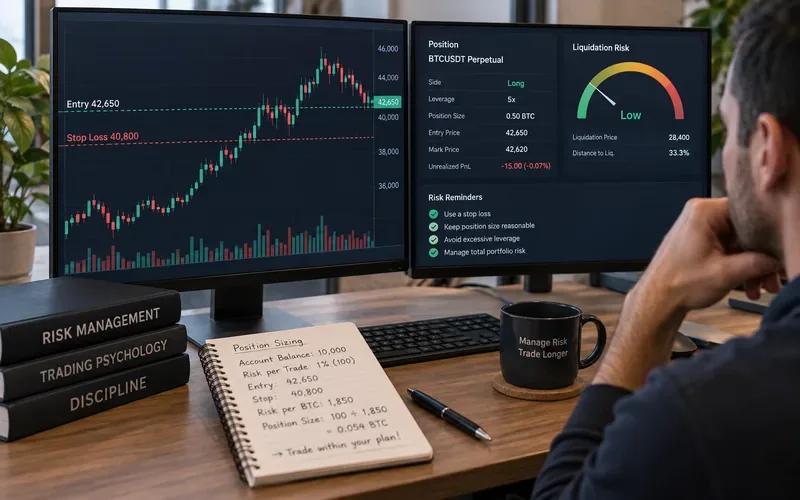
An illustrative trading desk showing why a fast-moving altcoin position should be paired with explicit position sizing, stop planning, and a maximum-loss rule. The screen values are illustrative rather than real-time market quotes.
What “high beta” means in crypto
Beta is a measure of how strongly an asset tends to move relative to a benchmark. Nasdaq defines beta as an asset’s risk or sensitivity relative to a market or other benchmark, while also warning that beta can change over time and is not a complete measure of risk. See the Nasdaq beta definition.
In crypto trading, the benchmark is often Bitcoin, a broad crypto index, or sometimes Ether. If an altcoin has historically moved more than the benchmark in the same direction, traders may call it high beta. But there is no official, permanent list of “high-beta altcoins.” The estimate depends on the benchmark, the lookback period, the sampling interval, and whether the token traded continuously and with enough liquidity.
That distinction matters. Beta describes co-movement with a benchmark; volatility describes the size and frequency of price changes. A token can be extremely volatile while showing unstable or even low measured beta if its moves are driven by token-specific news. Treat beta as one risk lens, not a permission slip to use a larger position.
Why high-beta pairs become dangerous so quickly
The first source of risk is simple price amplification. If a token typically reacts more sharply than the market, a normal market pullback can become a large drawdown in the token. The second source is liquidity. A quoted price may exist, but the amount available near that price can be small. When many traders exit at once, realized losses can be worse than a chart-level stop implies.
The third source is leverage. The U.S. Commodity Futures Trading Commission warns that leverage amplifies underlying virtual-currency risk and can force traders to add margin or close positions when markets move against them. Its guidance is available in the CFTC customer advisory on virtual currency trading.
The fourth source is concentration. Owning several altcoins does not necessarily mean you are diversified. During broad risk-off moves, assets that looked different in calm periods can suddenly fall together. FINRA explains that diversification is intended to reduce concentration risk by spreading exposure across securities and asset classes rather than relying on one narrow source of return. See FINRA’s asset allocation and diversification guidance.
Start with the easiest control: cap the dollars you can lose
The most useful risk rule is also the least sophisticated: decide your maximum loss per trade before deciding how many tokens to buy.
A simple position-sizing relationship is:
Position size = maximum dollar risk ÷ stop distance as a decimal.
Suppose a trader has a $20,000 trading account and allows a maximum loss of 0.5% on one trade. The risk budget is $100. If the trade thesis becomes invalid 8% below the entry price, the theoretical position size is $100 ÷ 0.08 = $1,250.
This is not a promise that the loss will stop at exactly $100. Fees, gaps, slippage, fast markets, and exchange behavior can make the realized loss larger. The calculation is a planning tool. With a high-beta token, that buffer matters more, not less.
Do not make the stop tighter just because the asset is scary
A common mistake is buying a very volatile token and then placing an extremely tight stop so the account “feels protected.” If the stop sits inside normal price noise, repeated small losses can accumulate even when the larger trade idea would have survived.
A better sequence is to identify the price level that invalidates the trade thesis first, then calculate a smaller position that fits the account risk limit. The stop distance should come from market structure, volatility, or the thesis—not from the desire to keep an oversized position.
There is another limitation: a stop price is not necessarily the execution price. FINRA notes that during volatile markets a stop order can execute materially away from the trigger price after it becomes a market order. Review FINRA’s guidance on stop orders in volatile markets. Crypto venues have their own order rules, so check the documentation of the venue you actually use.
Measure liquidity before you measure upside
High-beta trading becomes much harder when the order book is thin. Before entering, look beyond headline 24-hour volume. Inspect the bid-ask spread, visible depth around your intended entry and exit, and how much the price moves when meaningful orders hit the book.
A pair with a 0.05% spread and deep liquidity is operationally different from a pair that jumps 0.8% between available price levels. The second trade may require a smaller position, a limit order, staged execution, or no trade at all.
Liquidity is also time-dependent. A pair may trade cleanly during the most active hours and become fragile during quieter periods. Token unlocks, listings, delistings, governance votes, bridge incidents, or exchange-specific disruptions can change liquidity suddenly. If you cannot estimate a realistic exit cost, your risk model is incomplete.
Treat leverage as a separate risk multiplier
Using leverage on a high-beta altcoin compounds two forms of amplification: the token already moves more aggressively than the benchmark, and borrowed exposure magnifies the P&L again.
For that reason, a risk limit should be based on effective exposure and liquidation mechanics, not merely on the cash margin posted. A $2,000 margin deposit controlling $10,000 of exposure is a $10,000 market position for sensitivity purposes. The liquidation price, maintenance margin, funding costs, and the possibility of rapid deleveraging all matter.
If the trade cannot survive a routine adverse move without approaching liquidation, the leverage is doing too much of the work. Reducing leverage is usually a cleaner risk fix than trying to engineer a perfect stop in a chaotic market.
Check correlation across the whole portfolio
Five altcoin positions can behave like one large trade when the common driver is the same. If all five depend on Bitcoin strength, a broad risk-on narrative, or the same blockchain ecosystem, the portfolio may have far more directional exposure than the position count suggests.
A practical check is to ask how much of the portfolio would lose money if Bitcoin fell sharply, if total crypto market liquidity contracted, or if one ecosystem experienced a major technical or regulatory shock. If nearly everything has the same answer, you have concentration risk.
This is where high-beta exposure should be viewed at portfolio level. A single 2% position might be manageable. Ten 2% positions that all behave like amplified Bitcoin can create a much larger effective bet than the nominal weights imply.
Re-estimate beta instead of treating it as a permanent label
Beta is backward-looking. It can change after a listing, a token unlock, a new incentive program, a change in market leadership, or a shift from speculative trading to broader usage. A token that behaved like “2x Bitcoin” for three months is not contractually obligated to keep doing so.
For active risk management, calculate beta over more than one window—for example, a shorter window for the current regime and a longer window for context. Also inspect raw volatility and drawdowns. If short-window beta is rising while liquidity is falling, the token may deserve a smaller risk budget even if the long-window estimate looks familiar.
Do not over-trust precise decimal values. Crypto returns are noisy, trading is continuous, and the result changes with sampling frequency. The useful question is often not “Is beta exactly 1.83?” but “Has this asset become materially more sensitive to the benchmark than it was before?”
Plan execution for the trade you actually have
A risk plan should specify how you will enter, reduce, and exit. For a high-beta pair, consider whether the position should be built in pieces rather than all at once. Decide what happens if the first move is immediately against you, what happens after a favorable surge, and whether you will reduce size ahead of a known event.
Limit orders can provide price control, but they may not fill. Market orders prioritize execution, but the final price can be worse than expected in a fast or thin market. The right choice depends on whether execution certainty or price certainty matters more at that moment.
Also separate “trade invalidation” from “I am uncomfortable.” If the original thesis remains valid but the position feels unbearable, that is usually evidence that the position was too large.
A compact risk framework for high-beta altcoin trades
Risk question
Practical control
What can still go wrong
How much can I lose?
Set a fixed dollar or portfolio-percentage risk budget before entry.
Slippage or gaps can exceed the planned loss.
Where is the trade wrong?
Define thesis invalidation before sizing the position.
Short-lived volatility can hit the level and reverse.
Can I exit efficiently?
Check spread, depth, and realistic order size.
Liquidity can disappear during stress.
Am I overexposed?
Review correlations and common drivers across holdings.
Correlations can rise suddenly in a market selloff.
Is leverage necessary?
Evaluate effective notional exposure and liquidation distance.
Funding, margin changes, and rapid moves can accelerate losses.
Is beta still relevant?
Recalculate across multiple windows and compare with volatility.
Historical relationships can break.
What not to do
Do not double position size because a token “usually bounces.” A historical pattern is not a risk limit.
Do not rely on a stop order as a guaranteed loss cap. Execution can differ from the trigger price in a fast market.
Do not confuse multiple tokens with diversification. Several high-beta assets can share the same underlying market driver.
Do not use leverage to compensate for a small account. Leverage changes the probability and severity of ruin; it does not create better trade quality.
Do not treat past beta as a permanent property. Re-estimate it when market structure changes.
Self-check: is your high-beta trade actually controlled?
Before placing the order, you should be able to answer every question below without improvising:
What benchmark am I using when I call this altcoin “high beta”?
What is the maximum dollar loss I am willing to accept on the trade?
What price or market condition proves the thesis wrong?
What position size follows from that stop distance and risk budget?
What is the likely slippage if I must exit during a fast move?
How much of my portfolio is already exposed to the same market driver?
If I am using leverage, where is liquidation and how far away is it from normal volatility?
Has the asset’s recent beta, volatility, or liquidity changed materially?
If one of those answers is missing, the trade is not fully defined yet. High-beta altcoins can offer unusually large moves, but the edge comes from controlling exposure when the move goes the wrong way. The SEC’s investor education materials continue to emphasize that crypto assets can be exceptionally volatile and speculative and that only money an investor can afford to lose entirely should be put at risk. See the Investor.gov alert on crypto-asset risk.
Bottom line: high beta is not a reason to avoid every altcoin trade, but it is a reason to size smaller, demand better liquidity, be cautious with leverage, and monitor portfolio-level concentration. The objective is not to eliminate volatility. It is to make sure one volatile trade cannot decide the fate of the entire account.