Home
» News
»
How AI Trading Bots Can Outperform Traditional Crypto Traders—And Where They Cannot
How AI Trading Bots Can Outperform Traditional Crypto Traders—And Where They Cannot
AI trading bots do not broadly “outperform” crypto traders—and that is the useful starting point
There is no authoritative, market-wide evidence that AI trading bots consistently beat traditional crypto traders after fees, slippage, taxes, leverage costs, and changing market conditions. A bot can outperform a manual trader on specific, measurable tasks: watching many markets continuously, enforcing a predetermined rule set, routing orders quickly, and avoiding fatigue-driven deviations. Those operational advantages are not the same as a durable forecasting edge.
The more accurate question is: which parts of a crypto trading process benefit from automation, and which parts still require human judgment? The answer depends on the strategy, data quality, execution venue, risk limits, and the person responsible for monitoring the system.
Educational only: this is a framework for evaluating automation, not financial advice or a recommendation to use a trading bot.
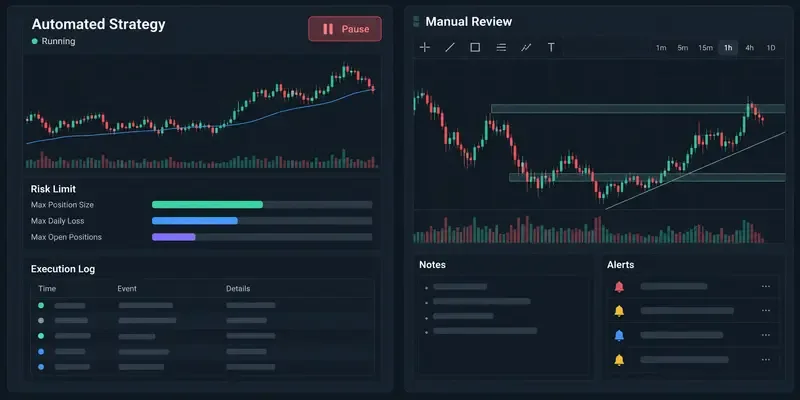
A useful comparison is operational rather than promotional: automation can enforce risk limits and log execution, while manual review can assess context and change the rules when conditions shift. This is a generic interface illustration, not a live platform screen.
Where an automated system can have a real advantage
A crypto market trades around the clock, across venues with different liquidity and fee structures. A person cannot watch every book, alert, and position continuously. A well-built automated system can apply the same rule at 3 a.m. that it applied at 3 p.m.; it can calculate a position size, submit a predefined order type, and record each decision without waiting for attention or confidence.
Those strengths can matter most in four settings:
Repetitive execution: following a specified rebalance schedule, grid, market-making rule, or entry/exit condition.
Multi-market monitoring: screening a defined universe for a spread, price threshold, funding condition, or risk trigger.
Rule adherence: applying maximum exposure, daily loss limits, stop conditions, and cooldowns without bargaining with oneself.
Operational recordkeeping: retaining order, fill, error, and risk-limit logs for later review.
Notice what is absent: “AI” does not automatically create a profitable signal. Many useful bots are deterministic automation, not machine-learning systems. Adding an AI model can help classify text, summarize information, or adapt a parameter-selection process, but it also adds model, data, and testing risk.
What “outperforming” should mean before you compare anything
Performance claims are often too narrow. A bot that shows a higher gross return in a backtest may still be inferior after realistic execution costs or during a market regime it has not seen. Compare a bot and a discretionary trader using the same account, assets, timeframe, and risk budget whenever possible.
Criterion
Bot may have an edge when…
Manual trader may have an edge when…
Availability
The rule must run continuously, including overnight and weekends.
The opportunity is sparse and does not require constant monitoring.
Execution consistency
Orders, sizing, and exits are precisely specified.
The setup requires judgment that cannot be written as a stable rule.
Speed
Latency, venue connectivity, and order handling have been tested.
Speed is not decisive or the individual cannot compete on infrastructure.
Context awareness
Inputs are structured, validated, and within the model’s intended scope.
News, governance events, listing changes, or market breaks need interpretation.
Risk control
Hard limits are enforced independently of the signal.
The trader has a documented process and can pause rather than improvise.
Adaptation
Changes are deployed only after out-of-sample testing and review.
Conditions change faster than the system can be safely retrained or retuned.
The practical benchmark is not “Did it win last month?” Ask whether the approach improves risk-adjusted outcomes, error rate, and consistency after every cost. A bot should be judged against the same alternative: doing nothing, holding the asset, or executing the identical rules manually.
AI can improve workflow; it does not remove the hard parts of trading
Machine-learning models can process large structured datasets, detect patterns under a chosen objective, and automate routine decisions. But market data is non-stationary: relationships that looked useful in one period can weaken or reverse when liquidity, participants, regulations, narratives, or volatility change. A model can also discover accidental correlations in a backtest.
For crypto, the hard parts remain execution and governance. Exchange outages, API failures, rate limits, delistings, stablecoin stress, custody events, abrupt liquidity gaps, and incorrect position state can dominate a model’s theoretical edge. An “AI bot” with unclear data, no independent risk controls, or unrestricted trading permissions is not a more sophisticated strategy; it is a larger operational attack surface.
The SEC’s investor education materials warn that bad actors may use AI-related claims to promote investment fraud. Treat claims of guaranteed performance, secret models, zero risk, or effortless daily returns as red flags rather than evidence of technical capability.
Key tradeoffs: automation versus discretion
Speed versus explainability
A model may react faster than a person, especially when it has direct data and an execution connection. But a complex model can be difficult to explain when it behaves unexpectedly. For a small account or a new strategy, an explicit rule set is often more valuable than a black box because it is easier to test, audit, and disable.
Coverage versus operational risk
Scanning many markets is a genuine benefit. It also means more symbols, APIs, permissions, venue rules, and failure modes. Coverage should grow only after monitoring, logs, and limits work reliably on a smaller scope.
Discipline versus rigidity
Automation prevents impulsive overrides, but it will also keep following a bad rule unless a guardrail stops it. A manual trader can recognize a structural break, yet may be vulnerable to hesitation, overtrading, or confirmation bias. The best choice depends on whether the primary failure mode is emotional inconsistency or insufficiently formalized judgment.
Which approach fits different needs?
For a newer crypto participant: prioritize alerts and simulation
Start with non-trading automation: price alerts, a position journal, a portfolio rebalance calculator, or paper-trading signals. This teaches whether the strategy has clear rules before capital and API permissions are involved. Do not begin with leveraged, always-on execution.
For a rule-based trader: use constrained execution
If entries, exits, maximum position size, and stop conditions are already explicit, a bot can execute those rules consistently. Begin with small scale, a limited number of markets, API keys without withdrawal permission, and a separate kill switch. Measure fills against expected prices and record every intervention.
For a discretionary trader: automate the repetitive layer
You may not need a signal-generating AI bot. Alerts, watchlist scoring, order templates, exposure calculations, and journaling can remove routine work while retaining human decisions about context. This hybrid approach is often better when the edge depends on interpretation rather than speed.
For quantitative teams: treat the bot as a production system
Use data versioning, out-of-sample evaluation, realistic fees and slippage, monitoring, access control, incident procedures, and independent risk limits. A high backtest metric is not production readiness. The system must be able to fail safely.
How to verify a bot’s performance claim
Ask whether the return is live, audited, and net of fees, funding, borrowing, spreads, and slippage.
Compare the same period with a transparent benchmark and the same risk exposure.
Inspect drawdown, liquidation exposure, concentration, and the worst days—not only the average return.
Check whether results include delisted assets, exchange downtime, failed orders, and API errors.
Separate a backtest from forward testing. Do not assume past parameter optimization will survive a new regime.
Confirm who controls custody and what API permissions are required. Never share a seed phrase or grant withdrawal permission to a trading tool.
Look for an emergency pause, maximum-loss controls, and a way to reconcile the bot’s position with the exchange.
Risks that a better model cannot solve
No forecasting model can remove counterparty risk, custody risk, smart-contract risk, market manipulation, liquidity collapse, or an exchange’s operational failure. It cannot make an unregulated or fraudulent service legitimate. The CFTC has noted that digital-asset markets face fraud and cyber-related threats, and investor-protection authorities continue to warn about AI-themed investment fraud.
A sensible setup therefore keeps strategy risk separate from account-security risk. Use the smallest permission set, unique credentials, multifactor authentication where offered, strict position and daily-loss caps, and an independent process for checking balances and open orders. If the system cannot be paused safely, it is not ready for unattended use.
Bottom line
AI trading bots can outperform traditional crypto traders at execution speed, constant monitoring, rule consistency, and logging. They do not automatically outperform at forecasting, adapting to regime changes, or protecting capital. The right choice is based on the task: automate repeatable rules, keep contextual decisions human when they cannot be tested, and require evidence before trusting any claimed edge.