Home
» News
»
How Interest Rate Cuts Can Move Bitcoin: What Matters More Than the Cut Itself
How Interest Rate Cuts Can Move Bitcoin: What Matters More Than the Cut Itself
The short answer: interest rate cuts are often supportive for Bitcoin, but the reason for the cut usually matters more than the cut itself. A “soft-landing” cut—where inflation is cooling, growth remains resilient, and liquidity conditions are improving—can create a favorable backdrop for Bitcoin. A “panic” cut triggered by recession, credit stress, or a sharp labor-market deterioration can initially push investors toward cash and other defensive assets instead.
That distinction is especially important in 2026. As of September 15, 2026, the Federal Reserve had not yet announced the outcome of its September 15–16 meeting. At its July 29 meeting, the Federal Open Market Committee kept the federal funds target range at 3.50% to 3.75%. The next decision was scheduled for September 16. Readers should therefore separate confirmed policy from market expectations. See the Federal Reserve's July 29, 2026 FOMC statement and the official FOMC meeting calendar.
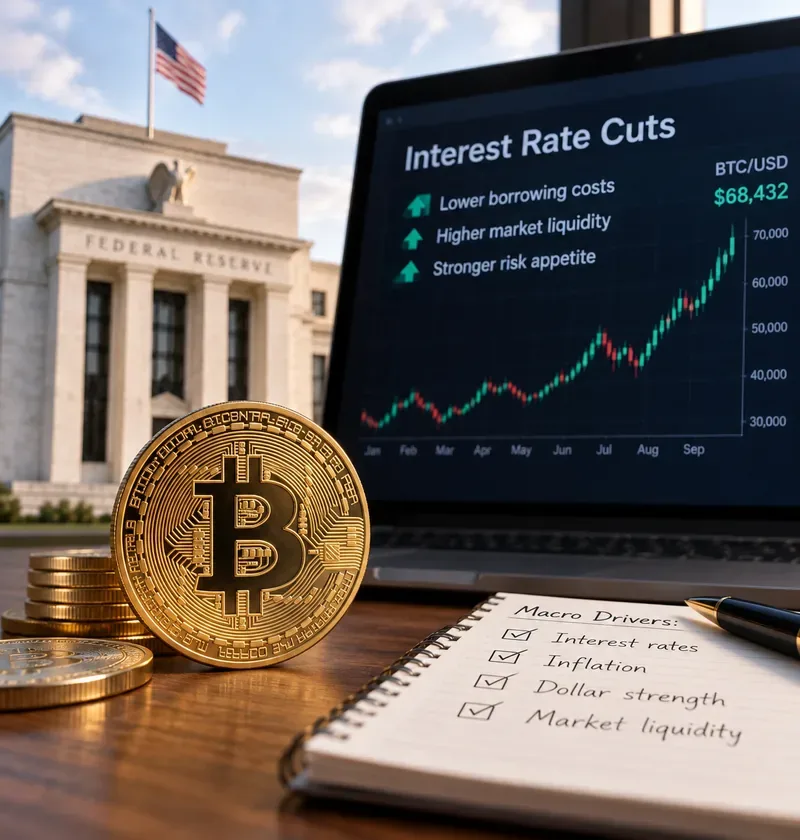
A Bitcoin coin, a market screen, and the Federal Reserve building illustrate the main macro channels investors watch: interest rates, liquidity, the U.S. dollar, and risk appetite. The screen is illustrative rather than a live market quote.
Why lower interest rates can help Bitcoin
Central bank policy works through financial conditions. Lower policy rates can reduce borrowing costs, influence bond yields, change the return available on cash-like instruments, affect asset valuations, and alter currency and risk-taking conditions. The Federal Reserve itself describes these transmission channels: changes in the federal funds rate affect lending rates, deposit rates, asset prices, household wealth, corporate balance sheets, and broader financial conditions. See the Fed's discussion of monetary-policy transmission.
Bitcoin can benefit from several of those channels at once. It does not pay a coupon or dividend, so its relative appeal can improve when the yield on cash and short-duration government securities falls. Lower rates can also make leveraged positions cheaper to finance, support equity valuations, and improve willingness to hold volatile assets. That does not mean Bitcoin behaves exactly like a technology stock, but in many risk-on periods it has responded to the same broad shifts in liquidity and investor risk tolerance.
The four channels that matter most
Macro channel
Why a rate cut may help Bitcoin
What can offset the benefit
Real yields
Lower inflation-adjusted yields reduce the opportunity cost of holding a non-yielding asset.
If inflation expectations fall faster than nominal yields, real yields may remain high.
U.S. dollar
Easier Fed policy can weaken the dollar, which can support dollar-priced risk assets.
Safe-haven demand can strengthen the dollar during a recession or financial shock.
Liquidity and credit
Cheaper funding can improve market liquidity and increase speculative capacity.
Banks and investors may still pull back if credit risk rises.
Risk appetite
Lower discount rates can support equities and other high-beta assets, often improving crypto sentiment.
A cut motivated by economic distress can increase fear before easier policy has time to work.
A rate cut is not automatically bullish
The most common mistake is to look only at the direction of the policy rate. Markets price the future, so Bitcoin may move well before the official announcement. If traders have expected a 25-basis-point cut for weeks, the actual decision may produce little upside. The surprise matters more than the headline.
Recent Federal Reserve research on asset prices makes a similar point. A 2026 Fed paper on monetary-policy announcements distinguishes among pure policy shocks, news about the central bank's reaction function, and information about the Fed's view of the economy. Those different messages can move markets in different directions even when the policy-rate decision itself looks simple. See the Federal Reserve's May 2026 research paper, The Effect of the Federal Reserve on the Stock Market: Magnitudes, Channels and Shocks.
Scenario 1: A soft-landing cut
This is usually the cleaner bullish setup for Bitcoin. Inflation is moving toward target, unemployment is not rising sharply, credit markets remain orderly, and the Fed can reduce rates without signaling a crisis. In that environment, bond yields may fall, financial conditions may ease, and investors may be more willing to move out of cash and into equities, crypto, and other higher-volatility assets.
Who this setup may suit: investors who already have a long-term Bitcoin allocation and are deciding whether macro conditions justify maintaining or gradually adding exposure. The key is not to buy simply because a cut happened; check whether growth and credit conditions remain stable.
Scenario 2: An emergency or recession-driven cut
A rapid cut made because the economy is deteriorating can be very different. During the first phase of a stress event, investors often sell what they can, not only what they dislike. Bitcoin can fall alongside equities as traders reduce leverage and seek dollars or short-term government securities. Easier policy may become supportive later, but the timing is uncertain.
Who should be cautious: traders using leverage, investors with short time horizons, and anyone assuming that a large cut guarantees an immediate rally. A 50-basis-point cut caused by severe economic weakness can be more bearish in the short run than no cut at all.
Scenario 3: Cuts while inflation is still sticky
This is a mixed case. If the Fed eases while inflation remains elevated, nominal rates may decline but inflation expectations can rise. Bitcoin is sometimes described as an inflation hedge because its supply schedule is limited by protocol rules, but its short-term price has also behaved like a volatile risk asset. Investors should therefore avoid assuming that higher inflation expectations alone will lift BTC.
What to watch: real Treasury yields, the dollar, inflation expectations, and whether long-term bond yields are falling or rising. If the Fed cuts short-term rates but long-term yields rise because markets fear persistent inflation, financial conditions may not become as supportive as the policy headline suggests.
Liquidity matters, but it is not one number
Crypto investors often use the word “liquidity” loosely. It can refer to bank reserves, money-market conditions, stablecoin supply, exchange order-book depth, credit availability, or simply investor willingness to deploy capital. These measures can move in different directions.
Research from the Bank for International Settlements provides useful evidence that U.S. monetary policy can influence crypto-market conditions. A BIS working paper finds that U.S. monetary-policy shocks affect both traditional and crypto markets, and that stablecoin market capitalization tends to decline after monetary tightening. This does not prove that every rate cut will increase Bitcoin's price, but it supports the idea that policy conditions help shape the broader risk-taking environment. See the BIS paper Stablecoins, money market funds and monetary policy.
Should you trade the FOMC announcement itself?
For most long-term investors, probably not. FOMC days can produce rapid two-way moves as traders react to the statement, projections, and press conference. A price spike immediately after the decision can reverse minutes later once the market interprets the chair's comments.
Short-term traders may choose to trade the event, but the tradeoff is higher volatility and slippage. If you use leverage, a move that is directionally correct over several days can still liquidate a position during the first few minutes. For investors whose goal is multi-year Bitcoin exposure, position size and entry discipline usually matter more than predicting a single Fed meeting.
A practical framework for different types of investors
If you are a long-term holder
Focus on whether the rate cycle is improving or worsening the multi-quarter liquidity backdrop. A gradual sequence of cuts alongside stable growth is more constructive than one surprise move. Consider dollar-cost averaging rather than making the entire allocation depend on one FOMC meeting.
If you are a swing trader
Track what the market already expects before the decision. The relevant question is not “Will the Fed cut?” but “Will the Fed be more or less dovish than the market has priced?” Compare the decision with Treasury yields, the dollar, equity-index futures, and Bitcoin's own market structure.
If you use leverage
Reduce the importance of directional conviction and increase the importance of risk control. Policy events can create gaps, fast liquidations, and correlation spikes across assets. A smaller position with a wider risk buffer can be safer than a larger position built on a correct but early macro view.
If you are deciding between cash and Bitcoin
Rate cuts reduce the income available on some cash-like instruments over time, which can make risk assets relatively more attractive. But cash also provides stability and optionality. If you may need the money within the next few years, the lower expected return on cash does not remove Bitcoin's drawdown risk.
What to monitor after a cut
Two-year Treasury yields: they often reflect expectations for the Fed's near-term path.
Ten-year real yields: falling real yields can reduce the opportunity cost of holding Bitcoin.
The U.S. dollar: a weaker dollar can improve the backdrop for dollar-priced risk assets, while a flight to safety can do the opposite.
Credit spreads: if they widen sharply, recession or default concerns may outweigh the benefit of lower policy rates.
Equity-market breadth and volatility: Bitcoin often trades better when risk appetite is broad rather than concentrated in a few assets.
Crypto-specific liquidity: stablecoin flows, exchange liquidity, leverage, and forced liquidations can dominate macro factors over short periods.
Bottom line
Interest rate cuts can be bullish for Bitcoin because they can lower real yields, reduce the return advantage of cash, loosen financial conditions, and improve risk appetite. But those effects are conditional. A cut that confirms a soft landing is different from a cut that confirms a recession. A fully expected cut is different from a surprise. And a lower policy rate does not guarantee easier overall financial conditions if long-term yields, the dollar, or credit spreads move the other way.
The most useful approach is to treat the Fed decision as one input in a broader framework. For long-term investors, the rate cycle can help explain the macro backdrop but should not replace portfolio sizing and risk tolerance. For traders, the gap between expectations and reality matters more than the word “cut.” Bitcoin remains a volatile asset, and macro policy can amplify both upside and downside rather than eliminate either one.