Home
» News
»
LayerZero vs. Chainlink CCIP vs. Wormhole: How Cross-Chain Interoperability Really Differs
LayerZero vs. Chainlink CCIP vs. Wormhole: How Cross-Chain Interoperability Really Differs
Imagine a hypothetical DeFi application called Atlas Treasury. This example is fictional and is used only to make the architecture easier to reason about. Atlas holds collateral on Ethereum, wants to trigger strategy logic on another blockchain, and sometimes needs to move a token representation along with a message. Its developers are considering three widely used interoperability stacks: LayerZero, Chainlink CCIP, and Wormhole.
At first glance, all three appear to solve the same problem: getting information or assets from one blockchain to another. In practice, that description is too shallow. A cross-chain protocol must answer several different questions: Who observes the source chain? What evidence convinces the destination chain that a message is valid? Who pays to deliver and execute it? How are token transfers represented? What can the application configure, and what security assumptions remain?
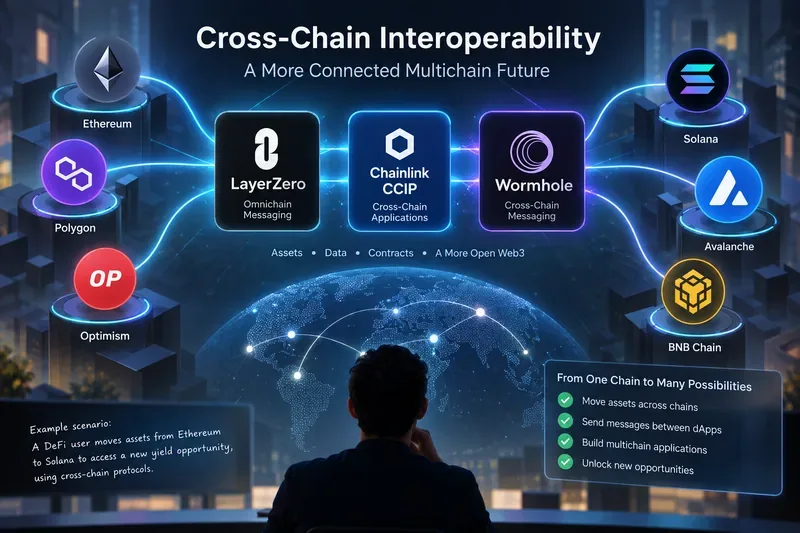
A conceptual view of three interoperability approaches connecting applications and assets across multiple blockchain environments.
Start with the problem, not the protocol name
For Atlas Treasury, a requirement such as “support multiple chains” is not specific enough. The team should first separate its needs into at least three categories: arbitrary messaging, token movement, and destination-chain execution.
Arbitrary messaging could mean that an Ethereum contract sends an instruction saying, “update the lending limit for account X.” Token movement is different: value must be locked, burned, minted, released, or otherwise accounted for across chains. Execution adds another layer because the destination transaction needs gas, ordering rules, failure handling, and a clear rule for who is allowed to call the receiving contract.
This distinction matters because LayerZero, Chainlink CCIP, and Wormhole are not simply interchangeable bridges. Each is a broader interoperability framework with a different verification and delivery architecture.
LayerZero: application-configurable verification and execution
LayerZero V2 organizes cross-chain communication around immutable Endpoint contracts deployed on supported chains. An application sends through a source Endpoint, and the destination Endpoint ultimately delivers the verified message to the receiving application. The official LayerZero V2 protocol overview describes a channel in terms of the sender, source Endpoint ID, destination Endpoint ID, and receiver.
The distinctive design choice is the separation of verification from execution. LayerZero calls its independent verification services Decentralized Verifier Networks, or DVNs. An application can configure required and optional DVNs, including threshold rules, while Executors handle destination delivery after the message has met its verification requirements. The official architecture documentation describes this as an X-of-Y-of-N verification model with pluggable Message Libraries, DVNs, and Executors.
How that would apply to Atlas Treasury
Suppose Atlas wants different security policies for different cross-chain actions. A low-value status update might use one configuration, while a message that can release substantial collateral could require multiple independent DVNs. That flexibility is a core LayerZero characteristic: the application chooses its security stack rather than inheriting one universal verifier set for every path.
Flexibility also creates responsibility. LayerZero’s own OApp documentation states that production deployments should use multiple required DVNs from independent operators because a single-DVN configuration makes the pathway dependent on one verifier. Atlas therefore cannot treat protocol integration as a one-time API decision; DVN selection, peers, Message Libraries, Executor settings, ownership, and upgrade procedures become part of its security design. The relevant guidance is in the LayerZero OApp documentation.
If Atlas only wanted fungible token movement rather than arbitrary business logic, LayerZero also provides its Omnichain Fungible Token standard. That should be evaluated separately from a generic OApp integration because token-transfer semantics and application messaging are not the same problem.
Chainlink CCIP: DON-based messaging with lane-specific controls
Chainlink CCIP uses a different model. In CCIP, a “lane” is a unidirectional path from one blockchain to another. The reverse direction is a separate lane, and lane-specific characteristics can differ. Chainlink’s CCIP key concepts explains that finality matters because the destination should not act on a source event that could still be reorganized.
As documented for the current CCIP v1.6 architecture, a Role Decentralized Oracle Network, or Role DON, runs two Offchain Reporting plugins. The Commit OCR process reaches consensus on source-chain messages and commits Merkle roots to the destination. The Executing OCR process then validates pending executions and carries out messages on the destination chain. The official CCIP offchain architecture page describes this flow in detail.
There is an important 2026 documentation change that is easy to miss when reading older material. Chainlink currently states that the Risk Management Network’s automated offchain role is no longer active in current CCIP deployments and is expected to return as an optional validation layer in future releases. The onchain RMN contract remains as an emergency safeguard for certain functions, while other controls include configurable rate limits, token attestations, and monitoring. Any article that describes the old offchain RMN as an always-active independent validation network would therefore be outdated for current deployments.
How that would apply to Atlas Treasury
Atlas could use CCIP to send arbitrary data, tokens, or programmable token transfers, depending on the supported source-destination pair and integration. Rather than selecting its own DVN composition, Atlas would primarily integrate with the CCIP contracts and the security model provided by the CCIP DON architecture, then apply application-level checks around trusted chains, senders, routers, and message handling.
Those checks are not optional details. Chainlink’s CCIP EVM best-practices documentation explicitly recommends validating destination chains before sending, validating source chains and senders when receiving, verifying router addresses when appropriate, separating message reception from core business logic, testing under adverse conditions, and monitoring for abnormal behavior.
For token issuers, CCIP also provides Cross-Chain Token infrastructure based on token pools and administration rules. Rate limits can be configured for token pools, so Atlas should evaluate token architecture separately from plain arbitrary messaging rather than assuming one configuration fits both.
Wormhole: Guardian attestations produce portable VAAs
Wormhole’s messaging design revolves around its Guardian network and Verifiable Action Approvals, or VAAs. A source contract emits a message through Wormhole’s Core Contract. Guardians observe and sign it, and once the required quorum is reached, the resulting VAA can be submitted to the destination chain for verification.
The current Wormhole Guardian documentation describes a canonical set of 19 Guardians and a standard 13-of-19 multisignature VAA. On some chains, a delegated subset performs direct observation, but canonical Guardians wait for the configured delegate quorum before producing the same standard 13-of-19 VAA.
Delivery is deliberately separated from validity. Wormhole’s messaging overview explains that a VAA is transported to the destination and verified there. Its newer Executor framework provides a permissionless request-and-quote model for message execution. The security documentation also makes an important distinction: a relayer can affect availability or timing, but cannot forge a VAA because validity is enforced by the Guardian signatures.
How that would apply to Atlas Treasury
Atlas might emit an Ethereum message, wait for Guardian attestation, and then have a relayer or Executor deliver the VAA to its destination contract. The receiver would need to validate the message’s origin and implement replay-safe application logic. If Atlas needs tokens rather than only messages, Wormhole distinguishes Native Token Transfers from Wrapped Token Transfers. The official token-transfer overview explains that NTT and WTT share the Guardian messaging layer but differ in how tokens are represented and released or minted.
Wormhole support also varies by product and can change. Its supported-networks documentation is therefore more reliable than assuming every Wormhole product works on every Wormhole-connected chain. In August 2026, Wormhole also announced additional network deprecations, reinforcing the need to check current support before committing to a route.
LayerZero vs. CCIP vs. Wormhole: the practical differences
Question
LayerZero V2
Chainlink CCIP
Wormhole
Core verification model
Application-configurable DVNs and thresholds
Chainlink DON consensus using Commit and Executing OCR roles
Primarily application checks, lane capabilities, gas/execution parameters, rate limits, and token configuration
Primarily receiver/origin validation, product configuration, consistency/finality choices, and application logic
Token-focused option
OFT
Cross-Chain Token infrastructure and token pools
NTT and WTT
Key design responsibility
Choose and maintain an appropriate security stack
Use supported lanes correctly and implement defensive receiver logic
Validate VAA origin and design safe destination execution
This table is an architectural comparison, not a security ranking. The protocols expose different knobs, use different verification assumptions, and evolve at different rates. A protocol with more configuration is not automatically safer, and a protocol with a more opinionated verification stack is not automatically less flexible. The correct question is whether the security model matches the action being authorized.
What the Atlas example reveals about real integration risk
1. Cross-chain security includes both chains
If Ethereum finalizes correctly but the destination chain halts, reorganizes, or behaves unexpectedly, Atlas still has a cross-chain incident. Every protocol ultimately depends on properties of the networks it connects. Chainlink explicitly advises developers to evaluate the security and reliability of the networks they use, and the same principle applies to LayerZero and Wormhole integrations.
2. A valid message can still trigger unsafe application logic
Interoperability protocols prove or attest that a message came through an expected path. They do not automatically make Atlas’s business logic correct. A perfectly valid cross-chain instruction can still exploit a bug in the receiving contract if Atlas fails to verify the sender, destination context, amount, nonce, replay state, or allowed action.
3. Token movement needs a separate threat model
A message saying “Alice owns 100 units” is not the same as moving 100 economically meaningful tokens. Atlas should document whether the cross-chain asset is burned and minted, locked and released, escrowed, wrapped, or natively controlled by the issuer. It should also identify who holds mint authority, who controls rate limits, how emergency pauses work, and what happens if one side of the route becomes unavailable.
4. Delivery failure should not become an accounting failure
Cross-chain systems are asynchronous. Gas spikes, chain congestion, finality delays, relayer problems, or destination reverts can delay completion. Atlas should model “sent,” “verified,” “delivered,” and “business logic completed” as distinct states instead of treating a source-chain transaction as final proof that the destination action succeeded.
How a team should choose among them
Atlas should avoid selecting a protocol from a brand-level feature checklist. A better process is to test each candidate against the exact message route and failure modes.
Choose the exact source and destination networks. Verify current support in the protocol’s official directory rather than assuming ecosystem-wide compatibility.
Define what crosses the boundary. Is Atlas sending arbitrary bytes, a token, a token plus instructions, governance actions, or state synchronization?
Write down the verification assumption. For LayerZero, that includes the chosen DVNs and threshold. For CCIP, it includes the current DON architecture and lane behavior. For Wormhole, it includes Guardian quorum and any delegated observation configuration relevant to the chain.
Model destination execution separately. Identify who can deliver, what happens if delivery is delayed, how gas is funded, and whether messages must be processed in order.
Plan for operational change. Network support, protocol versions, service limits, and recommended configuration can change. Production monitoring should therefore treat documentation updates and deprecations as operational events.
A final self-check for the hypothetical Atlas Treasury
Before Atlas moves from testnet to real value, its team should be able to answer the following questions without relying on marketing shorthand:
Which exact source-to-destination routes are supported today?
Who or what verifies a source-chain event for each route?
What threshold or consensus rule makes the message acceptable?
Who can deliver or execute the destination transaction?
Can a delivery service censor or delay a message, and can it forge one?
What destination-side checks reject an unexpected chain, sender, token, or action?
How are retries, duplicates, out-of-order execution, and destination reverts handled?
If tokens move, what are the mint, burn, lock, release, rate-limit, and admin assumptions?
What emergency controls are available, and who controls them?
How will the team detect changes in supported networks or protocol configuration?
If Atlas cannot answer those questions, it has not yet compared interoperability protocols at the level that matters. LayerZero, Chainlink CCIP, and Wormhole all provide mature ways to coordinate activity across blockchains, but they distribute verification, delivery, configuration, and operational responsibility differently. The practical choice is therefore not “which cross-chain protocol is best?” It is “which security and execution model best matches the exact cross-chain action this application is willing to authorize?”