Home
» News
»
Real Yield vs. Inflationary Yield: How to Find Sustainable DeFi Returns
Real Yield vs. Inflationary Yield: How to Find Sustainable DeFi Returns
Research checked: September 15, 2026. “Real yield” is one of the most useful ideas in DeFi, but it is also one of the easiest labels to misuse. A yield can come from genuine economic activity and still be risky. A token-emission yield can be temporary yet rational. And a headline APY can combine both at the same time. The practical question is not whether a protocol uses the phrase real yield; it is whether you can trace the return to a durable source of value, understand who pays it, and estimate what happens when incentives or market conditions change.
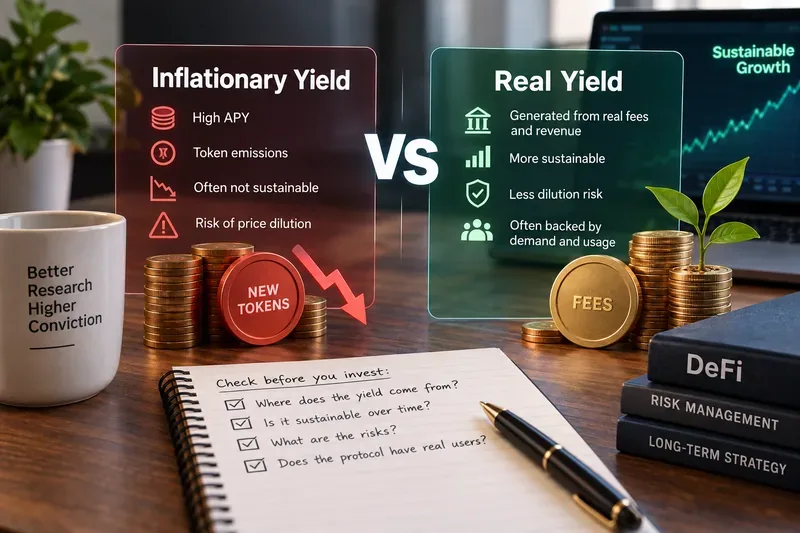
A conceptual comparison of two yield sources. Revenue-backed yield may be more durable than token emissions, but neither side is automatically low-risk or guaranteed.
Real yield vs. inflationary yield: the practical distinction
In common DeFi usage, real yield usually means returns funded mainly by economic activity: borrower interest, trading fees, staking rewards, liquidation or borrowing fees, or other cash-flow-like sources. Inflationary yield usually means returns funded mainly by newly issued or treasury-funded tokens distributed as incentives.
What is verified: major protocols document these different mechanisms directly. Aave suppliers earn interest that changes with borrowing utilization. Lido staking returns come from Ethereum consensus-layer and execution-layer rewards, net of protocol fees. GMX documents protocol fees from trading, liquidations, borrowing, and swaps. Curve’s DAO documentation explicitly describes CRV inflation being distributed through gauges. Action: before looking at APY, identify the exact contract-level or protocol-level source of each reward component.
What depends on context: the word “real” is not an accounting standard, and protocols do not all calculate revenue, fees, or distributable earnings in the same way. A return may be partly fee-backed and partly subsidized. Action: treat “real yield” as a hypothesis to verify, not a certification.
Misconception 1: “Real yield means safe yield”
This is false. A revenue-backed return can still expose you to smart-contract failures, oracle errors, governance changes, liquidity shocks, bad debt, bridge risk, stablecoin depegs, slashing, market-maker losses, or token-price volatility.
Aave is a clear example of why the source of return and the risk of capital must be analyzed separately. Suppliers earn interest from borrowers, and rates change as utilization changes. That is economically grounded, but suppliers still depend on the lending system’s collateral, oracle, liquidation, and liquidity mechanisms. Aave’s official guide explains that supply rates vary with utilization rather than being fixed. See Aave’s supply documentation.
Lido provides another useful case. Its staking APR is based on Ethereum consensus-layer and execution-layer rewards, and Lido currently states that its user APR is protocol APR after the protocol fee. The documentation also notes that APR is only a current estimate, not a forecast. See Lido’s staking documentation. Action: after confirming the yield source, make a separate list of capital-loss risks. Never use “real yield” as a substitute for risk analysis.
Misconception 2: “Token emissions are fake yield and therefore always bad”
That is too simplistic. Token incentives can serve a real purpose: bootstrapping liquidity, compensating participants for security risk, attracting borrowers or suppliers, or directing liquidity toward markets the protocol wants to develop.
Aave’s Umbrella system demonstrates this distinction. Participants can earn their normal Aave supply return and additional safety incentives for accepting slashing exposure. Aave states that reward emissions can adjust according to target liquidity levels, while governance controls parameters and reward tokens. In other words, an emitted reward can be compensation for a real service even if the payment itself comes from token incentives. See Aave’s Safety Incentives documentation.
Curve provides an even clearer example of inflationary incentives. Its DAO documentation describes CRV inflation distributed to users according to gauge measurements. That does not make the system meaningless; it means part of the liquidity-provider return must be evaluated as token issuance rather than protocol cash flow. See Curve’s DAO technical documentation. Action: ask what economic behavior the emissions are buying, how long the budget can continue, and what your return would be if the incentive token fell sharply in price.
The four buckets behind most DeFi APYs
Yield source
Who effectively pays?
Typical sustainability question
Borrower interest
Borrowers using capital
Is borrowing demand organic, and what happens when utilization falls?
Trading or protocol fees
Traders and other protocol users
Are fees recurring, and are they actually distributed to your position?
Native staking rewards
Blockchain issuance plus transaction-related rewards
What is the net return after validator, slashing, and protocol costs?
Token incentives
Token treasury, reserve, or new issuance
How large is the remaining incentive budget and dilution?
A single farm can combine several buckets. For example, a lending position may earn borrower interest plus a governance-token incentive. A liquidity pool may earn swap fees plus emissions. Action: split the displayed APY into components instead of evaluating the blended number.
This is not a universal accounting formula; different protocols expose different data and risk. The point is to stop treating one APY as one homogeneous return.
Suppose a pool displays 18% APY. If 5 percentage points come from trading fees and 13 points come from a reward token, the sustainability question is very different from a pool earning 18% entirely from recurring borrower or trading demand. If the reward token loses 70% of its value, the realized incentive return can be far below the dashboard estimate. Action: record the yield in the asset you actually care about, not only in the number of reward tokens distributed.
Not necessarily. A protocol can generate fees without sending all of them to liquidity providers or token stakers. Fees may pay keepers, oracle providers, developers, insurance mechanisms, a DAO treasury, liquidity providers, or token buybacks.
GMX illustrates why this distinction matters. Its current documentation states that staking GMX earns a share of protocol fees and that 27% of certain fees from leverage trading, liquidations, borrowing, and swaps are used to buy back GMX. The same documentation currently notes that distribution of bought-back GMX is suspended and rewards are accumulating in the Treasury until the stated distribution condition is met. See GMX’s current rewards documentation and GMX token documentation.
Action: follow the money from user payment to your wallet. Do not count gross protocol revenue as your yield unless the distribution mechanism actually allocates it to your position.
Misconception 4: “A higher APY means a better opportunity”
APY is a rate, not a quality score. It says nothing by itself about smart-contract risk, liquidity depth, token dilution, lockups, leverage, drawdowns, or the probability that the rate persists.
For lending, high rates can simply signal scarce liquidity or unusually strong borrowing demand. Aave explicitly ties supplier rates to utilization. For staking, returns can vary with network conditions. Lido notes that execution-layer rewards include priority fees and MEV, both of which can vary with network activity. Action: compare yield together with the mechanism that causes the rate to rise. A rate spike may indicate opportunity, stress, or both.
A six-question test for sustainable DeFi returns
Where does every percentage point come from? Separate interest, trading fees, staking rewards, emissions, and one-off bonuses.
Who is paying? Identify the borrower, trader, network, treasury, or new-token buyer that economically funds the return.
Would the yield exist without incentives? Calculate the base return after removing reward-token emissions.
Is the underlying activity repeatable? Look for sustained borrowing, trading, staking, or service demand rather than a short campaign.
What losses can overwhelm the yield? Include impermanent loss, bad debt, liquidation, slashing, stablecoin depeg, token depreciation, and smart-contract failure.
Can you exit when the thesis changes? Check liquidity, withdrawal queues, cooldowns, lockups, bridge dependence, and redemption rules.
If you cannot answer the first three questions from official documentation or on-chain data, the APY is not yet understandable enough to call sustainable. Action: postpone capital allocation until the reward flow can be explained in plain language.
Real yield examples: what is actually verifiable?
Aave lending
Verified: supplier interest is driven by borrowing utilization and protocol parameters. Context-dependent: a market may also offer additional incentives, which should be separated from base interest. Unknown from APY alone: whether future borrowing demand will keep the rate near today’s level. Action: compare base supply APR with any additional reward APR and monitor utilization.
Lido staking
Verified: rewards arise from Ethereum validator activity, including consensus rewards and execution-layer components such as priority fees and MEV, with a protocol fee applied. Lido currently documents a 10% protocol fee on staking rewards, which can be changed by DAO governance. Context-dependent: realized APR changes with validator and network conditions. Action: use the current APR as an estimate, not a guaranteed forward rate.
GMX fee-backed rewards
Verified: GMX documents fee generation from trading-related activity and a token-buyback allocation. Context-dependent: fee income rises and falls with trading activity, and current distribution mechanics can change through governance. Action: check current reward-distribution status rather than assuming historical tokenomics still apply.
Curve gauge incentives
Verified: CRV inflation has historically been directed through gauges to liquidity providers. Context-dependent: LPs may also earn trading fees, so total return can contain both fee-backed and inflationary components. Action: separate pool fee APR from CRV or other incentive APR before comparing pools.
Red flags that an APY may be subsidy-dependent
The documentation emphasizes rewards but does not explain who pays for the underlying activity.
Most of the displayed APY is paid in the protocol’s own token.
The rate falls dramatically when token price or incentive emissions decline.
Liquidity exists mainly because users are farming emissions rather than using the product.
Protocol fees are small relative to token rewards distributed.
Reward schedules depend on repeated treasury top-ups or governance extensions.
There is no clear distinction between gross fees, protocol revenue, and distributable holder income.
None of these is an automatic disqualification. They are prompts for deeper analysis. Action: estimate the “no-subsidy APY” and decide whether you would still hold the position at that rate.
What cannot be known from a yield dashboard
A dashboard cannot tell you whether future trading volume will remain high, whether governance will alter fees, whether a reward token will retain its price, whether a smart contract will suffer an exploit, or whether liquidity will remain deep during market stress. Even audited contracts do not make those uncertainties disappear.
Action: combine protocol documentation with current on-chain activity, token supply schedules, governance proposals, contract risk, and exit liquidity. Treat future APY as uncertain unless the protocol explicitly fixes a rate and you understand how that fixed promise is funded.
Bottom line: sustainable yield starts with a traceable payer
The most useful way to compare real yield and inflationary yield is not to ask which label sounds better. Ask what economic activity creates the return and whether that activity can continue without continuously issuing more incentives.
Borrower interest, trading fees, and validator rewards can be more durable because they arise from users or network activity, but they still fluctuate and carry risk. Token emissions can be useful when they pay for liquidity, security, or growth, but they should be analyzed as a subsidy with a budget and a dilution cost. Many DeFi positions combine both.
The strongest habit is simple: decompose the APY, identify the payer, remove temporary incentives, estimate the remaining base yield, and then compare that return with the risks required to earn it. Sustainable DeFi returns are not defined by the highest number on the screen; they are defined by whether the underlying cash flow and risk-adjusted economics still make sense when the promotional rewards are gone.