Updated September 14, 2026. A smart contract audit can be useful evidence, but it is not a safety certificate. The most important question is not “Has this project been audited?” It is “What exactly was audited, which version was reviewed, what remained unresolved, and does the deployed code still match the reviewed system?”
Ethereum’s security guidance explicitly warns that audits are not a silver bullet and cannot uncover every bug. OpenZeppelin’s audit workflow likewise treats scope, findings, severity, remediation status, and fix review as separate pieces of the security picture. The practical goal for a buyer is therefore to read the report like a risk document—not like a marketing badge.
Quick Red-Flag Checklist
| What to Check |
Lower-Risk Signal |
Red Flag |
| Scope |
Exact repositories, files, contracts, networks, and exclusions are listed. |
“Audited” is claimed without a clear scope. |
| Version |
Commit hash, tag, or exact code version is identified. |
No commit or the deployed code changed after the audit. |
| Critical / High findings |
Resolved and independently rechecked. |
Open, partially resolved, accepted without a convincing mitigation, or no fix review. |
| Admin powers |
Roles are documented and protected by multisig/timelock where appropriate. |
One wallet can mint, pause, drain, upgrade, or change parameters immediately. |
| Upgradeability |
Proxy model and upgrade authority are in scope and clearly documented. |
The audited implementation can be replaced after the audit without meaningful delay or review. |
| Dependencies and oracles |
Trust assumptions and external systems are identified. |
The report excludes a component that controls pricing, custody, bridges, or core protocol behavior. |
| Audit age |
Recent enough for the current codebase, with follow-up reviews after major changes. |
Old audit reused as proof for a substantially different product. |
Step 1: Confirm That the Report Is Real and Comes From the Auditor
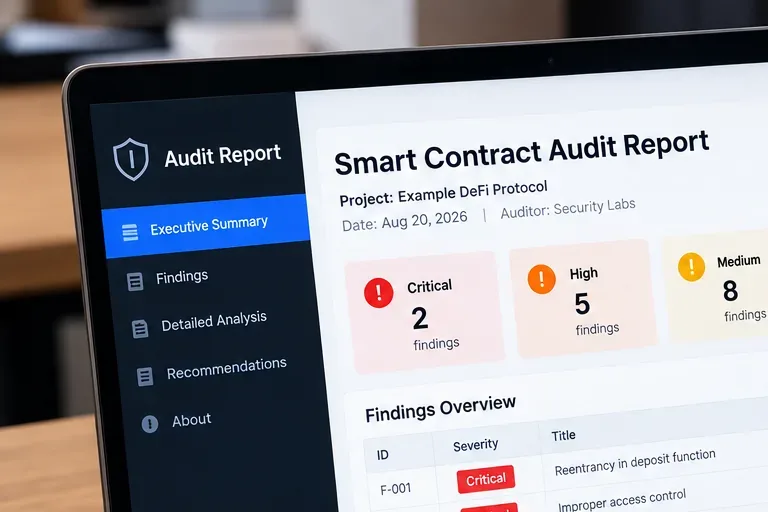
Caption: Start with the report identity, date, auditor, and severity summary before reading individual findings.
Verified: reputable audit reports usually identify the project, the assessment period, the auditor, and the reviewed code. OpenZeppelin’s published reports and Consensys Diligence reports commonly include a scope section and code revision. For example, Consensys’ USDKG report identifies the exact commit hash reviewed, while OpenZeppelin reports routinely specify the repository and commit or pull request in scope.
Misconception: a PDF uploaded by the project is automatically trustworthy because it contains an auditor’s logo. That is not enough. Files can be outdated, modified, or detached from their original context.
Action: find the report through the auditor’s own site or repository whenever possible. Compare the project name, report date, URL, and version details with the copy shared by the token team.
Primary references: OpenZeppelin audit documentation and Consensys Diligence USDKG audit.
Step 2: Read the Scope Before the Findings

Caption: The audit badge matters less than the scope: identify exactly which contracts and components were reviewed.
An audit only covers what is in scope. A report may review a token contract but exclude staking, bridges, vaults, governance, front-end infrastructure, external dependencies, or a later upgrade.
Verified: OpenZeppelin’s Panoptic audit lists its scope and also notes that fixes were distributed across different repositories. Another OpenZeppelin report on an EVM emulator explicitly states that only changes in a specific pull request were audited, not the full files in their entirety. These examples show why “the project was audited” can be an overbroad conclusion.
Misconception: if one contract in the ecosystem was audited, the whole protocol is covered. It is not.
Action: write down every component that can hold funds, move funds, set prices, change permissions, mint tokens, or upgrade contracts. Then mark whether each one appears in the audit scope. Any important blank is a follow-up question.
Example references: OpenZeppelin Panoptic audit and OpenZeppelin EVM Emulator audit.
Step 3: Match the Commit Hash to the Code That Was Actually Deployed
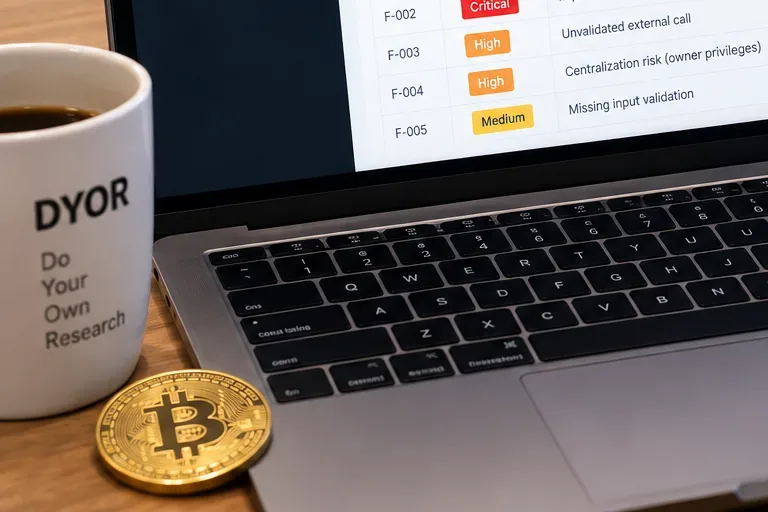
Caption: A report is tied to a code revision; verify that the audited revision still corresponds to the deployed contracts.
This is one of the most overlooked checks. An audit may have been excellent, yet the project may have changed the code afterward.
Verified: OpenZeppelin’s Code Inspector documentation says reports are tied to a specific commit, and Ethereum’s contract-verification guidance explains that verified source code helps users establish that published source corresponds to deployed bytecode.
Misconception: “audited last month” means today’s deployed contract is the audited contract. Time alone does not prove that.
Action: locate the commit hash, tag, or pull request in the report. Then check the project’s deployment documentation and verified source on the relevant block explorer. If the deployed implementation is newer, look for a follow-up audit or documented diff review.
Primary references: OpenZeppelin Code Inspector documentation and Ethereum.org contract verification guide.
Step 4: Treat Finding Status as Seriously as Severity

Caption: “Critical,” “High,” or “Medium” is only half the story; check whether each issue is resolved, partially resolved, or still open.
Severity tells you the potential importance of a finding. Status tells you what happened afterward. OpenZeppelin’s audit tooling distinguishes statuses such as resolved, partially resolved, acknowledged not resolved, and no response.
Misconception: the phrase “audit completed” means the project fixed everything. It does not. The audit can be complete while findings remain open.
Action: create a small list of every Critical and High issue, then record its final status and the evidence of the fix review. For Medium findings, pay special attention when several issues point to the same design weakness, such as access control, price manipulation, or accounting errors.
Do not automatically dismiss lower-severity findings either. Their significance depends on system context, combinations with other issues, and how privileged actors can use the affected functionality.
Step 5: Read the Finding, Impact, Preconditions, and Fix—Not Just the Title
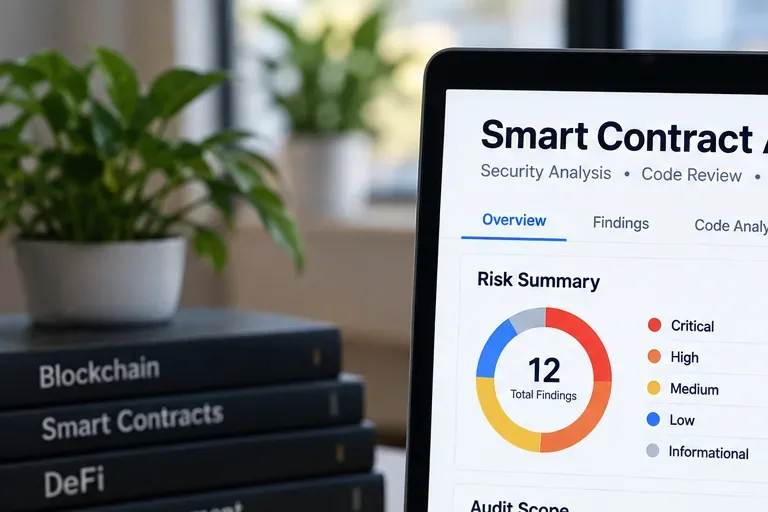
Caption: Severity labels are a starting point; understand exploit conditions, affected assets, and the auditor’s reasoning.
A useful finding normally explains what can go wrong, why it matters, the relevant code path, preconditions, and a recommendation. A “High” finding that requires a compromised admin may represent a different practical risk than a permissionless exploit any user can trigger.
Verified: OpenZeppelin describes issue severity as reflecting factors such as impact, likelihood, and exploit difficulty. Trail of Bits’ analysis of 246 smart-contract findings also found that severe issues arise across multiple categories—not only famous bug classes such as reentrancy. Their dataset highlighted access control, authentication, timing, numerics, validation, and other classes as important sources of risk.
Misconception: reentrancy is the only smart-contract bug worth worrying about. It is not. Business logic, access control, validation, oracle design, and accounting can be just as important.
Action: for each serious finding, answer four questions: Who can trigger it? What can they gain or break? What assumptions are required? Was the exact fix reviewed?
Primary references: OpenZeppelin audit issue model, Trail of Bits analysis of audit findings, and Solidity security considerations.
Step 6: Inspect Privileged Roles, Admin Keys, Pausing, Minting, and Upgrade Rights
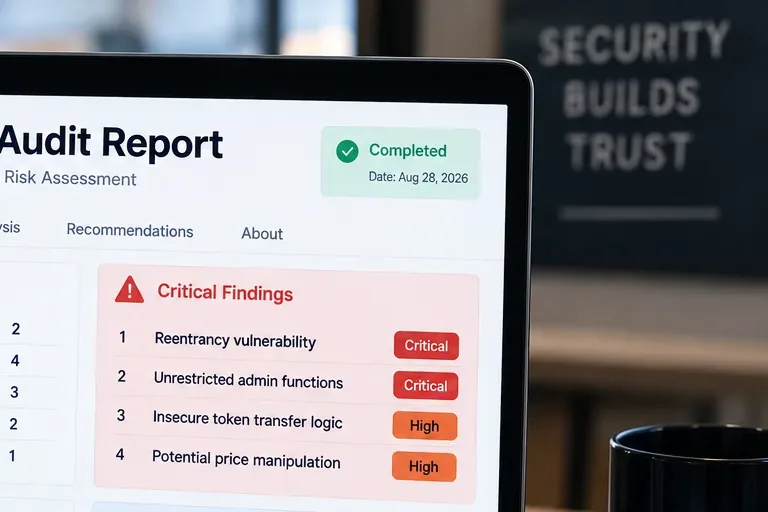
Caption: Privileged functions deserve special attention because a secure code path can still carry governance or key-management risk.
Many protocols deliberately include privileged roles. That does not automatically make them unsafe, but it changes the trust model.
Verified: Ethereum’s smart-contract security guidance warns that a single owner can become a central point of failure. It describes role-based access control and multisignature control as ways to reduce that risk. OpenZeppelin’s timelock documentation explains that delayed execution can give users time to review maintenance actions and exit when appropriate.
Misconception: “no critical vulnerabilities” means administrators cannot harm users. Audit severity and governance power are different questions.
Action: search the report for terms such as owner, admin, role, multisig, timelock, pause, mint, upgrade, blacklist, and withdraw. Then identify who holds each role today and how quickly that role can act.
Primary references: Ethereum smart-contract security guidance and OpenZeppelin access-control documentation.
Step 7: Check Upgradeability, Oracles, Bridges, and Other External Trust Assumptions

Caption: Audit the trust boundary, not just the Solidity files—proxies, oracles, bridges, and external dependencies can alter the real risk.
An upgradeable proxy can keep the same public address while changing the implementation logic. Oracles can feed prices that determine liquidations. Bridges can introduce separate custody or validator assumptions. External libraries and protocols can fail independently.
Verified: OpenZeppelin documents that proxy-based systems separate a stable proxy address from changeable implementation code. Its documentation also warns that upgradeability requires careful authorization. Ethereum’s security guide explains oracle-manipulation risk and notes that incorrect price inputs can cause contracts to execute against bad data.
Misconception: verified source code at the proxy address proves that future behavior cannot change. For upgradeable systems, that is not necessarily true.
Action: determine whether the contract is upgradeable, who authorizes upgrades, whether upgrades are delayed, and whether the current implementation is verified. Then list every external system whose failure could affect user funds.
Primary references: OpenZeppelin proxy documentation and Ethereum smart-contract security guidance.
Step 8: Make a Buy / Avoid / Investigate Decision From Residual Risk
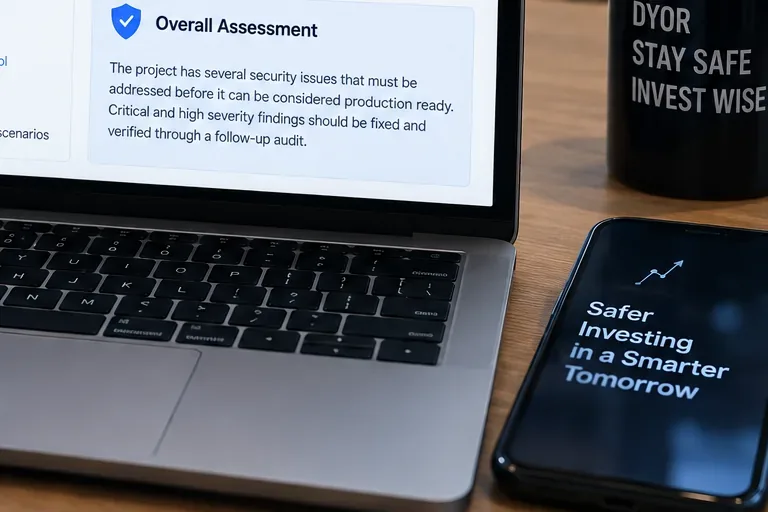
Caption: The final decision should reflect the risks that remain after fixes, not the existence of an audit badge.
Even after fixes, risk remains. OpenZeppelin has explicitly stated in published audits that time-limited reviews cannot guarantee every bug or risk has been found. In the Audius audit, for example, the auditors recommended beta testing, a bug bounty, and future re-auditing after a large set of serious findings. In the Panoptic audit, they recommended additional monitoring and another audit after significant code changes.
Misconception: multiple audits reduce smart-contract risk to zero. They do not. They improve assurance, but security also depends on deployment accuracy, operations, admin-key security, monitoring, incident response, economic assumptions, and future upgrades.
Action: classify the project into one of three buckets:
- Buy / continue research: current deployed code matches the reviewed scope; serious findings were resolved and rechecked; privileged powers are acceptable and transparent; external dependencies are understood.
- Investigate further: key information is missing, the audit predates major upgrades, or some Medium/High issues are only partially resolved or acknowledged.
- Avoid for now: Critical/High issues remain unresolved, the deployment does not match the audited revision, core contracts were out of scope, or administrators have poorly disclosed unilateral control over user funds.
How to Interpret Common Audit Phrases
| Phrase |
What It Usually Means |
Your Next Action |
| “No critical issues found” |
The review did not identify a Critical finding within its scope and timeframe. |
Still read High, Medium, trust assumptions, exclusions, and admin powers. |
| “Resolved” |
The project changed the code and the auditor accepted the remediation in the reviewed fix set. |
Confirm the fix is part of the deployed code. |
| “Acknowledged” |
The team accepts or recognizes the issue but may not have changed the code. |
Read the rationale; do not treat this as equivalent to fixed. |
| “Partially resolved” |
The mitigation reduces risk but does not fully eliminate the finding. |
Understand the remaining exploit path or assumption. |
| “Out of scope” |
The auditor did not assess that component. |
Do not infer security from the report for that component. |
| “Assumed trusted” |
The audit model relies on that actor or dependency behaving correctly. |
Decide whether you are willing to accept that trust assumption. |
Five Red Flags That Deserve an Immediate Stop
- The project cannot show the original auditor-hosted report. A screenshot or logo is not enough.
- The report lacks a reproducible scope or version. Without a commit, tag, or exact files, it is difficult to know what was reviewed.
- Critical or High issues remain open without a strong, documented rationale.
- The protocol is upgradeable, but the report barely discusses upgrade authority or privileged roles.
- The deployment changed materially after the audit and no follow-up review is available.
If any of these appears, the safest next step is not to rationalize it away. Pause the investment decision and request current evidence.
A 10-Minute Pre-Buy Audit-Report Routine
- Open the report from the auditor’s official site.
- Record the report date, repository, scope, and commit hash.
- Confirm the deployed contracts and implementation addresses.
- Read all Critical and High findings.
- Check the final status of every serious issue.
- Search for privileged roles and emergency powers.
- Identify proxy upgrades and who controls them.
- Identify oracles, bridges, custody systems, and external dependencies.
- Look for changes made after the audited commit.
- Decide what residual risk you are accepting before you buy.
Bottom Line
A smart contract audit is evidence of review, not proof of safety. The strongest signal is not the auditor’s logo but the chain of evidence connecting a clearly defined scope, an exact code revision, serious findings, verified fixes, deployed bytecode, and transparent operational controls.
The most dangerous reading mistake is to stop at “audited.” The more useful question is: What can still go wrong after this audit? If you can answer that clearly—and you are comfortable with the remaining risks—you are making a more informed decision. If the scope, fix status, admin powers, or deployed version are unclear, the correct action is to investigate before buying.
Primary Sources
This article is for informational purposes only and is not financial advice. An audit cannot eliminate smart-contract, governance, oracle, economic, operational, or market risk.