Home
» News
»
Solana Ecosystem Revival: 5 Altcoins to Watch Before the End of 2026
Solana Ecosystem Revival: 5 Altcoins to Watch Before the End of 2026
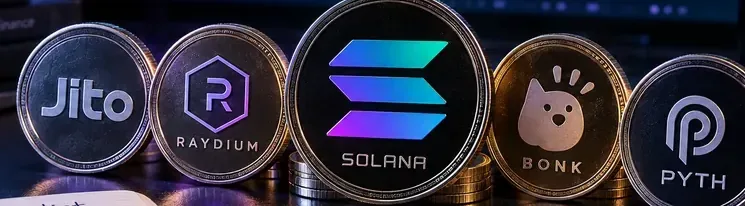
As of September 15, 2026, the strongest Solana ecosystem watchlist is JTO, JUP, RAY, PYTH, and KMNO—not because every token must rise before December, but because each gives exposure to a different part of Solana's expanding onchain economy. JTO is the clearest infrastructure-and-revenue thesis, JUP is the distribution and trading-superapp thesis, RAY is the DEX and tokenized-asset trading thesis, PYTH is the market-data monetization thesis, and KMNO is the lending and capital-efficiency thesis.
The broader setup is materially stronger than the simple “memecoin comeback” narrative suggests. In its August 2026 ecosystem roundup, the Solana Foundation reported that real-world assets on Solana exceeded $4 billion across roughly 350,000 addresses, xStocks surpassed $500 million in assets under management, Raydium passed $4 billion in cumulative tokenized-stock trading volume, and the network processed a record 216 million non-vote transactions in one day. Target slot time also fell to 300 milliseconds on August 28. Those are network-usage signals, not a guarantee of token returns.
Solana's year-end watchlist spans infrastructure, trading, liquidity, data, lending, and higher-risk speculative activity; network growth does not automatically translate into gains for every ecosystem token.
The short answer: which Solana altcoins are worth watching?
Token
Core thesis
What could confirm it before year-end
Main risk
JTO
Solana staking, MEV and market-layer infrastructure with increasingly explicit token value capture
Execution of revenue routing, buybacks/burns, JitoSOL economics and BAM adoption
Governance execution, token supply and dependence on Solana activity
JUP
Consumer and developer distribution around Solana trading
Continued product usage, fee generation and Litterbox token accumulation/burns
Competitive trading market and uncertainty around future governance proposals
RAY
DEX liquidity plus exposure to tokenized-stock and spot activity
Persistent trading volume and protocol-fee-funded RAY buybacks
DEX competition and highly cyclical trading volume
PYTH
Market-data infrastructure shifting from subsidized growth toward paid products
Subscription revenue, PYTH Reserve purchases and adoption of upgraded Core/Lazer products
Execution risk, competition and long-term token-supply dilution
KMNO
Solana lending, leverage and yield infrastructure
Growth in borrowing, institutional-yield products and governance participation
Credit/liquidation risk, smart-contract risk and weaker direct value capture than some peers
This is a research watchlist, not a ranking of guaranteed winners. A reasonable investor should require the thesis to keep improving after purchase; “Solana is doing well” is not enough on its own.
Why does the Solana revival look more durable in 2026?
Three developments matter. First, the network is handling more activity while improving capacity and latency. Solana's July 2026 ecosystem report says maximum block capacity increased from 60 million to 100 million compute units, a 66% increase. The August report then documented the move to 300ms target slot times and record daily non-vote transactions.
Second, economic activity is broadening. In May, the Solana Foundation reported more than $2.8 billion in real-world-asset value, more than $16 billion in stablecoin supply and a monthly record of $64.6 billion in perpetual-futures volume. By late July, its institutional RWA overview put non-stablecoin RWA value at $3.7 billion across 313,000 holders. August pushed that figure above $4 billion. The direction is more important than any single snapshot: payments, tokenized assets, trading and DeFi are all contributing.
Third, several ecosystem tokens now have clearer links between product usage and token economics. That does not mean “revenue equals price.” It means investors can test a measurable thesis rather than relying only on narratives.
1. JTO: the strongest infrastructure/value-capture setup
JTO is the most interesting Solana ecosystem token for investors who want infrastructure exposure rather than a single trading application. Jito sits close to Solana's staking, validator and transaction-ordering economy. JTO governs protocol parameters, treasury allocation and fee-related decisions, as described in the Jito governance documentation.
The key 2026 change is economic. Jito's official JIP-38 explicitly describes JTO as the network's value-capture asset. The proposal routes DAO revenues to tokenholder-controlled governance and commits the DAO's JTX revenue share to programmatic JTO buybacks and burns for at least one year through Q4 2027, subject to the proposal's implementation framework. That is materially more concrete than a token whose only function is voting.
Another near-term item is JitoSOL economics. JIP-39, published August 26, proposes changes aimed at making JitoSOL more competitive while defining a wind-down schedule for the BAM subsidy program beginning in 2027. Investors should watch execution rather than assuming every projected yield or revenue figure will materialize exactly as modeled.
Best fit: someone who believes Solana's transaction and staking economy will keep expanding and wants exposure to infrastructure. What would weaken the thesis: lower protocol revenue, governance that fails to convert revenue into durable token economics, or a sustained decline in Solana activity.
2. JUP: the distribution layer for Solana trading
JUP is the watchlist choice for investors who think the most valuable layer will be the interface and routing system through which users actually trade. Jupiter has expanded beyond swap aggregation into a broader trading and portfolio stack, while its developer platform exposes APIs that other applications can integrate.
The token economics are already more tangible than they were at launch. Jupiter's official tokenomics documentation says a community-approved supply reduction has taken place and that the Litterbox Trust receives 50% of Jupiter's onchain revenue. The same documentation states that approximately 134 million JUP had been burned when the page was last updated. Jupiter also says JUP will remain its only governance token.
There are new community proposals discussing additional staking, discounts and buyback-and-burn mechanisms in September 2026, but those should not be treated as final policy until governance approves and implements them. This distinction matters: buying a token because of a forum idea that never passes is very different from buying it based on an active revenue mechanism.
Best fit: investors seeking exposure to trading distribution and developer integrations. Key confirmation: rising sustainable fee generation and continued product adoption. Main risk: Solana trading interfaces are highly competitive, and user activity can migrate quickly.
3. RAY: a cleaner bet on Solana DEX volume
RAY is a more direct volume-and-liquidity thesis. Raydium remains an important automated market maker and liquidity venue on Solana, and its role has expanded as tokenized assets become more active. The Solana Foundation's August roundup reported that Raydium had passed $4 billion in cumulative tokenized-stock volume.
The token has a straightforward protocol-fee connection. According to Raydium's official fee documentation, 12% of trading fees from CLMM, CPMM and the standard AMM route to RAY buybacks, with the remaining fee shares going to liquidity providers and, for some pool types, the treasury. Raydium also publishes the relevant fee-collection and buyback addresses in its treasury documentation, allowing the flows to be checked onchain.
That makes the year-end test simple: is Raydium sustaining meaningful trading volume across more than one speculative niche? If tokenized assets, stablecoins and mainstream spot pairs contribute alongside memecoins, the revenue base is more diversified. If activity collapses when speculative volumes cool, the thesis weakens.
Best fit: investors comfortable with cyclical exchange activity who want a measurable buyback mechanism. Main risk: trading volume is competitive and reflexive; a high-volume month can reverse quickly.
4. PYTH: the monetization story investors can now measure
PYTH is the most distinct thesis on this list because it is not primarily a Solana DeFi application; it is market-data infrastructure with roots in the Solana ecosystem and distribution across many chains. The important 2026 shift is from growth subsidized by token emissions toward paid data products.
Pyth's Core upgrade announcement described a commercial model in which access to the upgraded data stack requires paid plans. The upgrade went live on August 26, 2026, according to the Pyth developer documentation. Pyth says subscription revenue flows to the DAO and the PYTH Reserve, which uses revenue for recurring open-market PYTH purchases.
Those purchases are observable rather than theoretical. The Pyth DAO's August 2026 purchase report records 669,661.72 PYTH acquired using DAO-approved USDC and SOL allocations during that purchase cycle. Pyth's September proposal list also shows the next purchase process continuing.
There is a counterweight: supply. Pyth's official distribution schedule started with 85% of supply locked and staged unlocks over multiple years. Investors should compare the scale of revenue-funded purchases with circulating-supply growth rather than looking at buybacks in isolation.
Best fit: investors who want exposure to crypto market-data infrastructure and can tolerate a longer monetization cycle. Main risk: paid-data adoption may grow slower than expected, while token dilution and competition remain real.
5. KMNO: lending growth with a more conditional token thesis
KMNO belongs on the list because Kamino is a major capital-efficiency layer on Solana, but it deserves a stricter entry standard than JTO or RAY. Kamino combines lending, borrowing, leverage and liquidity products. Its developer documentation describes an overcollateralized lending system and publishes integration interfaces for deposits, loans, repayments, market data and risk monitoring.
Kamino is also expanding beyond purely permissionless DeFi. Its Institutional Yield documentation describes an onchain vault connected to regulated, overcollateralized institutional lending operations, with BTC collateral held at qualified custodians and a stated maximum loan-to-value ratio of 60% at launch.
KMNO itself is primarily a governance and staking token. The official governance page says staked KMNO provides voting power and can boost participation-related rewards. The original KMNO distribution allocated substantial shares to stakeholders, advisors and core contributors with multi-year vesting, so supply dynamics matter.
Best fit: investors who believe Solana lending and leverage will keep taking share and who are willing to wait for a stronger link between protocol economics and token value. What would improve the thesis: sustained growth in lending usage plus clearer, durable token value capture. Main risk: usage of a protocol does not automatically accrue to its governance token.
What about BONK and DRIFT?
BONK is worth monitoring as a sentiment and retail-liquidity indicator, not as a core infrastructure pick in this framework. Solana's August roundup reported $5.2 billion in weekly Solana memecoin spot volume at one point, the highest weekly figure of 2026. If speculative activity accelerates, BONK can respond strongly; if risk appetite fades, the same reflexivity works in reverse. Investors looking for cash-flow or infrastructure-linked token economics should treat it as a different category.
DRIFT is a high-risk turnaround watch rather than a core pick. Drift's own June 2026 recovery update followed an April incident and described plans to relaunch with a user-recovery mechanism and additional security work. A successful relaunch could create upside, but unresolved recovery, execution and reputation risks make it unsuitable for investors who want the cleaner year-end setups.
How to decide which thesis fits you
If you want the most explicit infrastructure and revenue linkage, JTO is the first name to research. If your thesis is that the winning consumer layer captures Solana's trading flow, JUP is more direct. If you prefer a transparent DEX fee-and-buyback model, RAY is easier to monitor. If you expect institutional market data and onchain finance to converge, PYTH offers a differentiated bet. If you expect lending and leverage demand to keep deepening, KMNO provides that exposure but requires more patience on token value capture.
A practical approach is to track four things through the end of 2026: real protocol usage, protocol revenue, token supply changes, and whether announced governance decisions are actually implemented. A token can have excellent product growth and still underperform if unlocks overwhelm demand. Conversely, a token with buybacks can still fall if underlying activity contracts.
What would invalidate the Solana ecosystem revival thesis?
Network activity falls while headline adoption stories keep rising. Announcements matter less than transactions, stablecoin settlement, trading and sustained users.
Value capture does not reach tokenholders. Revenue can accrue to a company, treasury or liquidity providers without creating meaningful demand for a token.
Supply expands faster than organic demand. Always compare emissions, vesting and unlocks with buybacks or burns.
Security incidents damage trust. DeFi protocols, bridges, oracles and trading venues remain vulnerable to smart-contract, oracle and operational failures.
Solana loses its execution advantage. The ecosystem thesis partly depends on fast, inexpensive blockspace and reliable infrastructure.
Bottom line before year-end 2026
Solana's 2026 revival is broader than a rebound in token prices. Faster network parameters, record transaction activity, stablecoin adoption, tokenized real-world assets and increasingly mature DeFi infrastructure provide a stronger fundamental backdrop than a single speculative cycle. But the best ecosystem token is not automatically the one with the loudest narrative.
For a fundamentals-first watchlist, JTO currently has the clearest combination of system-level exposure and explicit token economics; JUP and RAY offer strong trading-distribution exposure; PYTH offers a differentiated data-monetization model; and KMNO is the higher-conditionality lending thesis. The right choice depends on which economic engine you actually believe will grow—and whether the token captures that growth.
This article is for informational purposes only and is not investment advice. Crypto assets are volatile and can lose most or all of their value. Verify current token supply, governance status, protocol risks and eligibility restrictions before making any financial decision.