Home
» News
»
Year-End Crypto Tax-Loss Harvesting: A Practical 2026 Guide
Year-End Crypto Tax-Loss Harvesting: A Practical 2026 Guide
For U.S. crypto investors, a good year-end tax-loss harvesting result is not simply “sell everything that is down.” The goal is to realize selected capital losses that improve your tax position without creating a worse investment outcome, a reporting problem, or an avoidable compliance risk. You should finish the process knowing exactly which lots you disposed of, how much loss you realized, what gains those losses may offset, what records support the calculation, and whether your post-trade portfolio still fits your investment plan.
This guide reflects federal tax rules and IRS guidance available as of September 2026. Digital assets are generally treated as property for federal income tax purposes, so selling or exchanging them can create capital gains or losses when the assets are held as investments. State rules, entity structures, dealer or trader status, tokenized securities, derivatives, retirement accounts, and unusual DeFi transactions can change the analysis. Use the process below as a planning framework, not individualized tax advice. The IRS overview is available at Digital assets.
What a successful tax-loss harvesting process should achieve
Before making a trade, define what “good” looks like. A successful year-end review should produce four concrete outputs:
A reconciled list of realized and unrealized gains and losses across the wallets and accounts you actually use.
A documented reason for harvesting each selected loss, including the tax lot and its basis.
An estimate of how the realized loss changes your federal capital-gain position, while recognizing that the final tax result depends on your complete return.
A post-trade portfolio that remains acceptable after fees, spreads, market movement, and any re-entry decision.
If you cannot produce those outputs with reasonable confidence, the right move may be to improve your records or involve a tax professional before trading.
Step 1: Start before the final day of the year
Tax-loss harvesting depends on completing a taxable disposition during the tax year. Waiting until the final hours of December creates unnecessary execution and recordkeeping risk. Exchanges can experience maintenance, withdrawal delays, order slippage, or account restrictions, and a transaction initiated before year-end is not useful if the relevant disposition is not treated as occurring in the intended tax year.
Start the review early enough to reconcile records, choose lots, execute trades, and preserve documentation before year-end.
Create a simple timeline: reconcile accounts, calculate gains and losses, review tax lots, decide which positions still belong in the portfolio, execute any chosen dispositions, and save the evidence. The quality signal here is not speed. It is whether you can explain each trade before you place it.
Step 2: Build one complete view of your gains, losses, and cost basis
Pull transaction histories from custodial exchanges, hosted wallets, self-custody wallets, and any other venue where you sold, exchanged, or spent digital assets. Do not assume a broker form will capture everything. The IRS states that taxpayers must report digital-asset income, gains, and losses whether or not they receive Form 1099-DA. See Understanding your Form 1099-DA.
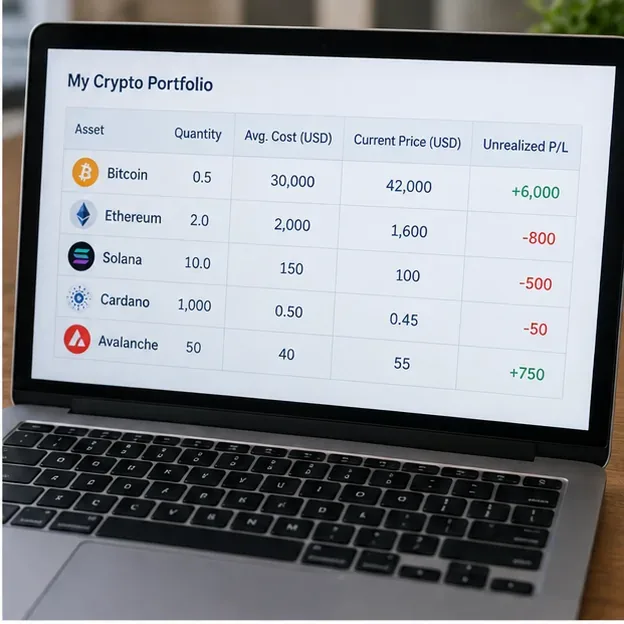
Review the portfolio by tax lot and cost basis rather than looking only at which coins are below their recent market highs.
An unrealized loss exists when the current value of a position is below its adjusted basis, but it generally does not become a deductible capital loss merely because the price fell. A sale or other taxable disposition is normally needed to realize the loss. The IRS explains that selling a digital asset for U.S. dollars generally produces a gain or loss, and exchanging one digital asset for another can also be a taxable disposition. Review the IRS digital asset transaction FAQs for current guidance.
Do not confuse account value with tax basis
If you bought the same asset many times, each acquisition may have a different basis and holding period. A coin can be down from its all-time high while some of your lots are still profitable. Harvesting should therefore be based on specific lots, not a chart showing that an asset is “down 60%.”
Step 3: Estimate the tax impact before deciding what to sell
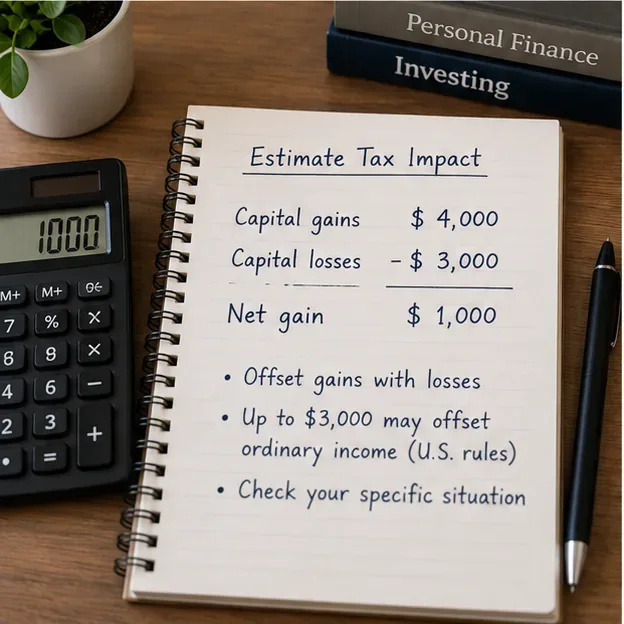
Capital losses can offset capital gains. If your total capital losses exceed your capital gains, individuals may generally deduct the lesser of the remaining net loss or $3,000 against other income for the year, or $1,500 if married filing separately. Unused net capital losses may generally carry forward to later years. The IRS summarizes these rules in Topic No. 409, Capital Gains and Losses and Publication 550.
Estimate the effect of the proposed loss on your total capital-gain position before trading; the final tax result depends on the whole return.
Suppose you have $12,000 of realized capital gains and a position with a $7,000 unrealized capital loss. If you sell that position and the loss is fully recognized, the loss may reduce the net capital gain before other Schedule D netting rules and return items are applied. That is more useful than harvesting a $7,000 loss when you have no current gains, little taxable income, and no reason to expect the carryforward to be useful soon.
The key quality check is after-tax benefit versus economic cost. Estimate trading fees, bid-ask spread, slippage, the risk of being out of the asset, and the possibility that a replacement position behaves differently. A tax deduction is not automatically worth an investment loss caused by a poor trade.
Step 4: Select the tax lot correctly before placing the order
This step became especially important under the post-2025 digital-asset basis rules. For transactions after December 31, 2025, if digital assets are held with a custodial broker and you want to use specific identification, the IRS says you generally must specify the units to the broker no later than the date and time of the sale, disposition, or transfer using identifiers the broker accepts, and you must maintain adequate records. If you fail to make a valid specific identification, the default identification rule generally treats the earliest-acquired units of the same asset in that wallet or account as disposed of first. Similar wallet-level rules apply to unhosted wallets. See IRS FAQs 82 through 88 in the digital asset transaction FAQs.
This means a “highest-cost lot” strategy is not useful unless your identification actually satisfies the rules and your broker can honor it. Before selling, record the wallet or account, acquisition date, acquisition price, quantity, intended lot, expected proceeds, holding period, and the method used to identify the units.
If your basis records conflict across software tools, stop and reconcile them. A mathematically attractive harvest built on the wrong lot can create a larger tax problem than doing nothing.
Step 5: Execute only the losses that still make investment sense
Once the tax lots and expected impact are clear, decide whether you actually want to dispose of the asset. Tax considerations should not force you out of a position you would otherwise hold if the expected tax benefit is small relative to the investment consequences.
Execute the selected disposition only after the lot, expected loss, fees, and investment consequences are understood.
A taxable sale to cash is the clearest example, but exchanging one cryptocurrency for another can also be a taxable disposition. Remember that transaction fees paid in digital assets may themselves involve a disposition; IRS FAQ 97 states that using digital assets to pay transaction services can produce gain or loss on the units used for the fee.
After execution, save the trade confirmation and actual proceeds. Do not leave your worksheet using a pre-trade estimate if the final fill price or fee changed the result.
Step 6: Decide what happens to your market exposure after the sale
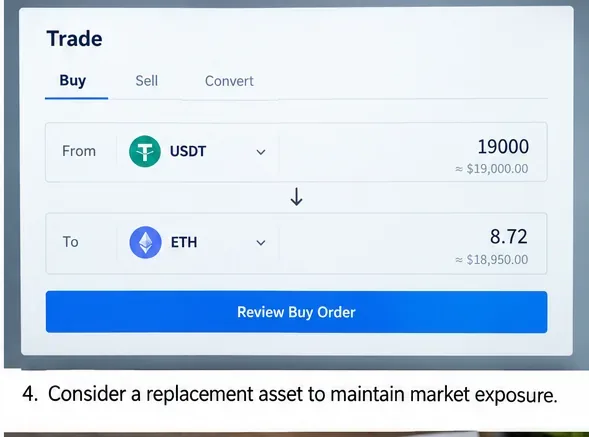
A harvested loss changes the portfolio. You can remain in cash or a stable position, buy a different asset, or potentially re-establish exposure later. The right choice depends on your investment thesis, risk tolerance, and the tax rules that apply to the asset you sold.
A replacement asset can preserve some market exposure, but it introduces its own price, correlation, tax, and execution risks.
Be careful with wash-sale assumptions
Do not rely on the simplistic claim that “wash-sale rules never apply to crypto.” Current IRS instructions state that wash-sale rules generally apply to digital assets that are also stock or securities for federal tax purposes, including tokenized securities. The 2026 Form 1099-DA instructions specifically provide wash-sale reporting rules for tokenized securities treated as stock or securities under Internal Revenue Code section 1091. See the 2026 Instructions for Form 1099-DA and the Schedule D instructions.
For many conventional cryptocurrencies that are not stock or securities for section 1091 purposes, the statutory wash-sale regime may not apply in the same way. But classification can be fact-specific, and future legislation or guidance can change the result. If your strategy depends on selling and immediately rebuying the same asset, verify the asset’s tax classification and the current law first rather than relying on a generic crypto rule.
Step 7: Preserve records that can reproduce the result
Your documentation should allow you—or a preparer months later—to reconstruct the trade without guessing. Save transaction IDs, timestamps, quantities, wallet or account identifiers, acquisition records, basis, fees, proceeds, specific-identification instructions, broker confirmations, and supporting exchange statements.
Keep enough transaction-level evidence to reproduce basis, proceeds, holding period, fees, and the lot that was actually disposed of.
The IRS requires taxpayers to maintain records sufficient to support positions taken on a federal return, including records of digital-asset receipts, sales, exchanges, dispositions, transfers, and fair market values. The recordkeeping standard is discussed in FAQ 95 of the digital asset transaction FAQs.
A strong quality signal is that your tax software, broker records, and independent transaction history agree on quantity, proceeds, and basis. If they do not, investigate the mismatch before filing.
Step 8: Reconcile Form 1099-DA and prepare Form 8949 and Schedule D
Broker reporting is more significant in 2026 than it was in 2025. Brokers have been required to report gross proceeds on Form 1099-DA for certain transactions since 2025, and for sales after 2025 they generally must report basis for digital assets that qualify as covered securities. Under the 2026 instructions, a digital asset generally becomes a covered security when it was acquired after 2025 in an account for which the broker provided custodial services and remained in that account until disposition, subject to detailed exceptions. Digital assets acquired before 2026 or transferred into the broker are generally noncovered securities for this purpose. See the 2026 Form 1099-DA instructions.
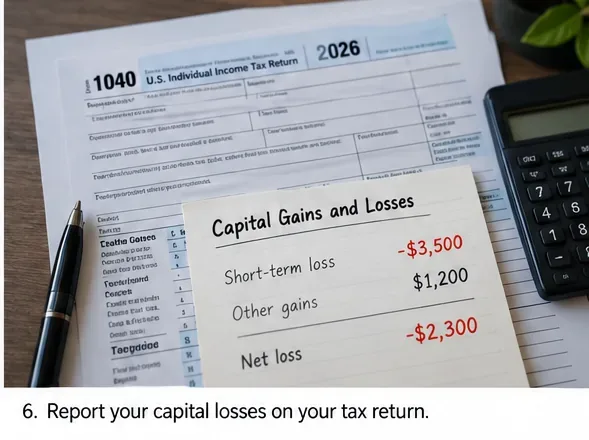
Reconcile broker reporting with your own records, then report applicable capital transactions on Form 8949 and summarize them on Schedule D.
Do not assume Form 1099-DA is automatically complete or correct for every lot. Transferred-in assets and older holdings can lack broker-reported basis, and foreign or non-reporting venues may not provide the form at all. Taxpayers remain responsible for reporting the correct amounts.
Most capital-asset dispositions are reported on Form 8949 and summarized on Schedule D. The current IRS instructions distinguish digital-asset reporting boxes and holding periods. Check the filing-year forms when preparing the actual return rather than copying a prior-year format.
How to tell whether the strategy worked
After the trades settle, evaluate the result against measurable signs rather than the size of the harvested loss alone.
Check
Good result
Reason to reconsider
Tax effect
The realized loss offsets gains or creates a usable carryforward consistent with your broader return.
The loss creates little near-term value and the trade introduces substantial economic cost.
Lot accuracy
The disposed units, basis, holding period, and identification records agree.
Broker, wallet, and tax-software records identify different lots.
Portfolio fit
You remain comfortable with the resulting allocation and risk.
The tax trade forces you out of an asset or into a substitute you do not actually want.
Execution cost
Fees, spread, and slippage are small relative to the expected tax benefit.
Trading costs or market movement consume much of the expected benefit.
Documentation
You can reproduce the calculation from source records.
The loss depends on missing basis, estimated dates, or unexplained transfers.
When should you change course or stop harvesting?
Tax-loss harvesting is not automatically better when the loss is larger. Change course when the records are unreliable, the asset may be subject to wash-sale treatment you have not analyzed, the expected tax benefit is smaller than trading and investment costs, the transaction would materially damage your desired portfolio, or the position involves derivatives, lending, staking, liquidity pools, entity accounts, or other structures whose tax treatment is more complex than a straightforward capital-asset sale.
Use a written decision process and stop when the tax assumptions, basis records, or investment consequences are not sufficiently clear.
You should also consider professional review if you have large gains, substantial carryforwards, many self-custody wallets, migrated basis from pre-2025 records, tokenized securities, high transaction volume, or a material mismatch between Forms 1099-DA and your own calculations.
Year-end crypto tax-loss harvesting checklist
Reconcile every exchange and wallet that contains taxable dispositions.
Separate realized results from unrealized price declines.
Review short-term and long-term holding periods.
Confirm the basis and identification method for each lot you may sell.
Estimate how the loss changes your total capital-gain position.
Compare the expected tax benefit with fees, spread, slippage, and investment risk.
Check whether wash-sale rules or another special rule may apply to the asset.
Execute early enough to avoid year-end operational problems.
Save transaction confirmations, IDs, fees, proceeds, and identification records.
Reconcile Form 1099-DA with your independent records before filing.
Bottom line
The strongest year-end crypto tax-loss harvesting strategy is selective, documented, and economically sensible. A realized loss can be valuable when it offsets taxable gains or creates a useful carryforward, but tax savings should not be measured in isolation. The result is good only when the tax calculation is supportable, the lot identification is valid, the records are complete, and the portfolio still makes sense after the trade.
For 2026, pay particular attention to wallet- and account-level basis identification and the expanding Form 1099-DA basis-reporting regime. Those changes make accurate lot selection and record reconciliation more important than simply finding a red number on a portfolio screen.