Home
» Knowledge
»
Crypto Taxes for Beginners: How to Track and Report Your Transactions
Crypto Taxes for Beginners: How to Track and Report Your Transactions
If you are new to crypto taxes, the most important thing to know is this: the IRS treats digital assets as property for U.S. federal income tax purposes, and many common crypto activities can create taxable income or capital gains and losses. That includes selling crypto for dollars, trading one digital asset for another, spending crypto, and receiving digital assets from activities such as staking or mining. Simply holding crypto, buying it with U.S. dollars, or moving it between wallets you own is generally different.
This guide focuses on U.S. federal income tax rules and reflects IRS guidance available as of September 2026. State taxes can add separate requirements, and specialized situations such as businesses, trusts, large gifts, derivatives, tokenized securities, DeFi arrangements, foreign accounts, or disputed basis records may require professional advice. The IRS maintains its current overview at Digital assets.
Start with the biggest misconception: a crypto trade can be taxable even if no dollars hit your bank account
Verified: exchanging one digital asset for another can be a disposition for tax purposes. If you trade Bitcoin for Ether, the transaction is not ignored merely because you never converted the Bitcoin to cash. The IRS treats digital assets as property, so the gain or loss on the Bitcoin you gave up generally depends on its value at the time of the exchange compared with your adjusted basis.
Action: flag every sale, swap, trade, purchase made with crypto, and other disposal in your transaction history. Do not build your tax file from bank deposits alone.
Step 1: Gather records from every exchange, wallet, and protocol you used
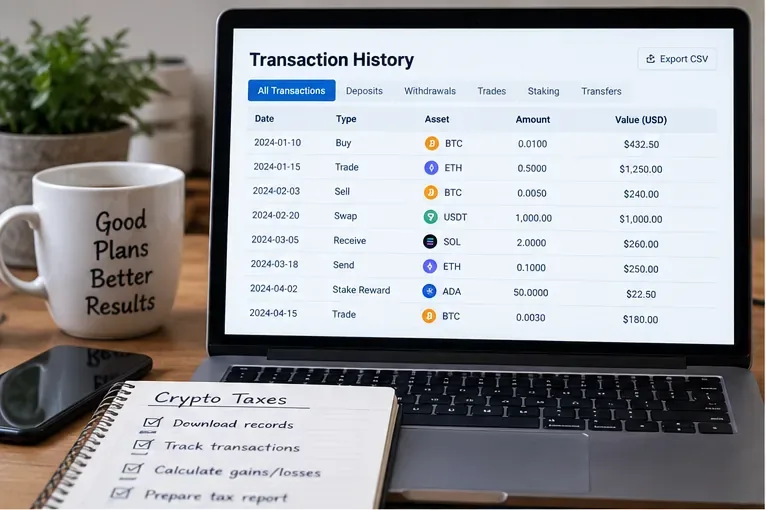
Your tax calculation is only as complete as your transaction history. Download records from centralized exchanges, review wallet histories, and collect records from any platform where you bought, sold, swapped, earned, sent, or received digital assets. Keep original CSV exports or statements instead of relying only on a year-end dashboard that might change later.
Start by collecting transaction histories from every exchange, wallet, and service you used. Keep the original exports so you can trace later calculations back to source records.
The IRS says taxpayers must maintain records sufficient to support positions taken on their federal income tax returns. Relevant records can include receipts, sales, exchanges, transfers, fair market values, and other documentation. See the IRS digital asset transaction FAQs.
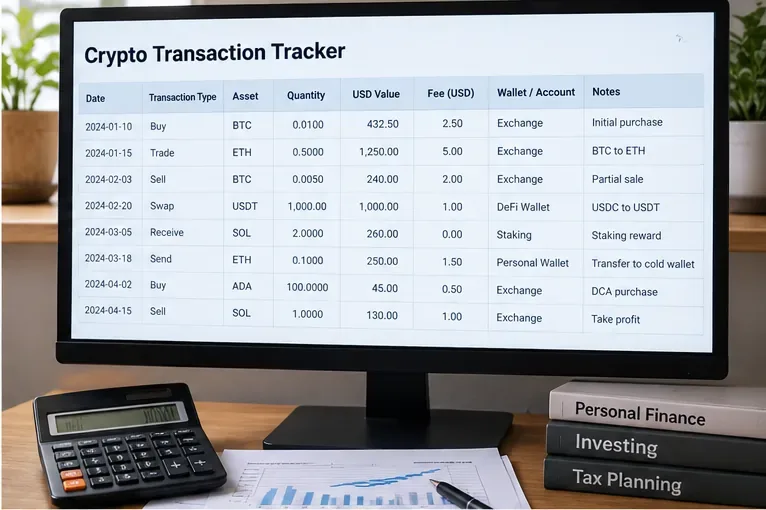
What information should you track?
Field
Why it matters
Date and time
Helps identify acquisition and disposal dates and the holding period.
Asset and quantity
Identifies exactly what was acquired, received, transferred, or disposed of.
Transaction type
Separates buys, sales, swaps, rewards, transfers, gifts, and other activity.
U.S. dollar fair market value
Needed to measure income, proceeds, and basis in many situations.
Fees
Some transaction costs can affect basis or amount realized; treatment depends on the transaction.
Wallet or account
Important because current digital-asset basis identification rules operate at the wallet or account level.
Transaction ID or hash
Provides a traceable link to an on-chain transaction when available.
Source document
Shows where the numbers came from if you need to reconcile them later.
What depends on circumstances: a blockchain explorer may show quantities and addresses but not reliably tell you the tax character of the transaction or your U.S. dollar basis. Exchange exports may also omit activity that occurred elsewhere.
Action: create one master list that combines all sources while preserving the original source for each row.
Step 2: Classify transactions before calculating tax
Do not calculate gains until you know what each transaction represents. A transfer between your own wallets is not the same as a sale. A staking reward is not the same as buying coins with cash.
Classify each row before calculating tax. Buys, disposals, income events, and self-transfers can have different tax consequences.
Common transaction types
Activity
General federal treatment
Beginner action
Buy crypto with U.S. dollars
Generally not a taxable disposal by itself.
Record the date, units, purchase amount, and eligible acquisition costs for basis.
Hold crypto
Holding alone generally does not create taxable income or gain.
Keep acquisition records even if you made no sale.
Sell crypto for dollars
Generally creates a capital gain or loss when held as a capital asset.
Match proceeds to the basis of the units disposed of.
Trade one crypto for another
Generally a taxable disposition of the asset you give up.
Record the fair market value at the exchange time.
Spend crypto on goods or services
Generally a disposition that can create gain or loss.
Record what you spent and its fair market value.
Receive staking or mining rewards
Can create ordinary income; facts and timing matter.
Record the amount received and fair market value when includible in income.
Transfer between wallets you own
Generally not taxable by itself.
Label both sides as a self-transfer so software does not mistake it for a sale.
Verified: the IRS states that transferring digital assets from one wallet, account, or address you own to another you own is generally a non-taxable event. However, if digital assets are used or withheld to pay the transaction fee, disposing of those fee units can itself create gain or loss under current IRS guidance.
Action: reconcile outgoing transfers with matching incoming transfers before treating unexplained withdrawals as sales.
Step 3: Separate capital transactions from ordinary income
For many individual investors, crypto held for investment is a capital asset. When you sell or exchange it, you generally calculate a capital gain or loss. Digital assets received as compensation, mining rewards, staking rewards, or other income may instead create ordinary income when received or when the applicable tax rule says the income becomes includible.
The IRS directs individuals to report sales and other capital transactions using Form 8949 when required and summarize capital gains and deductible capital losses on Schedule D. Non-business ordinary digital-asset income may be reported on Form 1040 or Schedule 1 as applicable; self-employment activity can require Schedule C. See the IRS page on how to report digital asset transactions.
Action: add a “tax category” column to your tracker: capital disposal, ordinary income, self-transfer, purchase, gift, or review needed.
Step 4: Calculate basis, proceeds, and gain or loss
For a basic capital-asset sale, the simplified idea is:
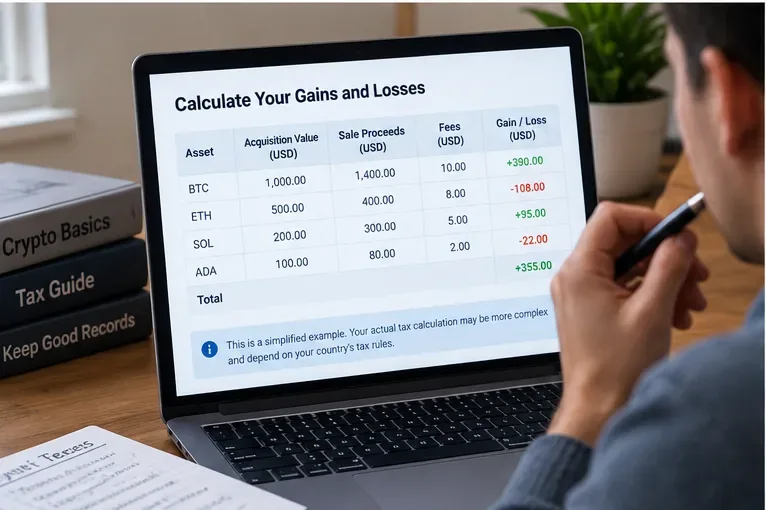
Gain or loss = amount realized − adjusted basis.
Suppose you bought 0.05 BTC for $2,000 and later sold those same units for $3,000. Ignoring other adjustments for a moment, the gain would be $1,000. If you sold for $1,600, the loss would be $400. Real calculations can differ because transaction costs and lot identification matter.
For capital transactions, match each disposal to the correct basis and compare it with the amount realized. Fees and lot identification can change the result.
Do not assume your exchange knows your full basis
Verified: Form 1099-DA is now part of the federal reporting system for digital-asset broker transactions. Brokers generally began reporting gross proceeds for covered reporting transactions effected on or after January 1, 2025. Basis reporting is phased in for certain transactions beginning with assets acquired after 2025. The IRS noted that most Forms 1099-DA for 2025 transactions would not include basis, meaning taxpayers often had to calculate it themselves. Current information is available on Understanding your Form 1099-DA.
What depends on circumstances: whether a broker reports basis depends on the asset, acquisition date, broker reporting status, and whether the broker has enough information. Assets moved into an exchange from a self-custody wallet can be particularly difficult to reconcile if the broker never received the original acquisition data.
Action: compare any 1099-DA with your own records instead of treating it as a complete substitute for them.
Step 5: Use the correct lot identification within each wallet or account
This is an area where older online explanations can be misleading. Current IRS rules generally require basis identification to be applied within the specific wallet or account holding the units, rather than freely selecting basis from identical assets held somewhere else.
If you make an adequate specific identification, you may be able to identify the particular units being disposed of. If you do not make a valid specific identification, the default generally works from the earliest acquired units of the same asset in that wallet or account. The IRS explains these post-2024 rules in its digital asset FAQs.
Action: do not let tax software silently pool every Bitcoin lot across all wallets unless its method matches the current IRS rules and your records. Review the lot-selection settings and keep evidence of any specific identification.
Step 6: Determine whether gains are short-term or long-term
For capital assets, holding period affects where transactions are reported and can affect the tax rate. The 2025 Form 8949 instructions state that a holding period of one year or less is generally short-term; longer holdings are generally long-term.
Digital-asset transactions now have dedicated Form 8949 boxes. For the 2025 form, short-term digital-asset transactions use boxes G, H, or I and long-term digital-asset transactions use boxes J, K, or L, depending on whether basis was reported and whether a Form 1099-DA was received. Always use the instructions for the tax year you are filing because forms can change. See the official Form 8949 instructions.
Action: calculate holding period for each disposal and keep short-term and long-term transactions separate.
Step 7: Reconcile Form 1099-DA and other tax documents
A common misunderstanding is that “no tax form means no tax.” That is incorrect. The IRS explicitly says digital-asset income, gains, and losses must be reported even if you do not receive Form 1099-DA, W-2, 1099, or another information return.
Another mistake is the opposite: assuming every number on a broker statement is automatically complete. A broker may know the gross proceeds from a sale but not the basis of coins transferred in from another platform. Foreign brokers may not issue a U.S. Form 1099-DA even when the transaction still belongs on a U.S. federal return.
Action: reconcile broker tax statements against your transaction ledger. Investigate missing basis, duplicate transactions, unmatched transfers, and proceeds that differ from your records before filing.
Step 8: Report the transactions on the appropriate federal forms
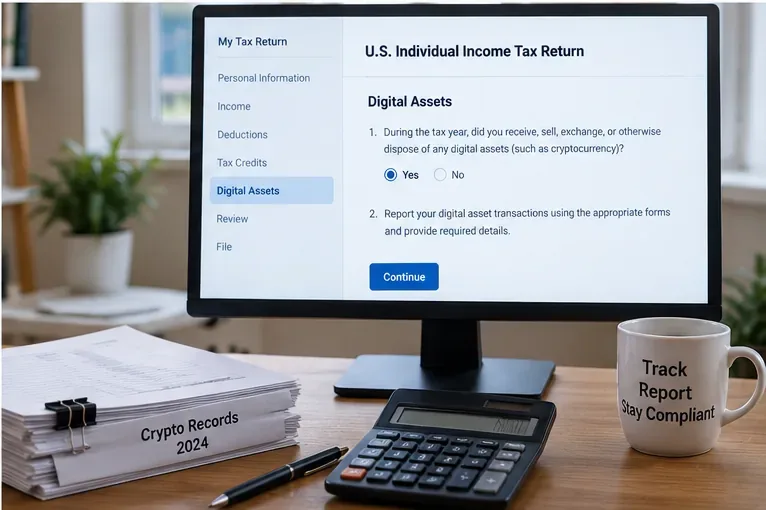
After reconciling the records, transfer the results to the forms required for your situation and answer the federal digital-assets question accurately.
For individuals, the reporting path commonly looks like this:
Capital sales and exchanges: Form 8949 when required, then Schedule D.
Non-business ordinary digital-asset income: Form 1040 or Schedule 1 as applicable.
Independent-contractor or business crypto income: potentially Schedule C.
Employee compensation paid in digital assets: generally reported as wages through the normal wage-reporting framework.
Certain gifts of digital assets: Form 709 may apply depending on the facts and applicable thresholds.
The exact forms depend on what happened, not merely on the fact that crypto was involved.
Action: map each tax category in your tracker to the current IRS form instructions for the tax year you are filing.
Do you have to answer “Yes” to the digital-assets question?
Federal income tax returns include a digital-assets question. The IRS says you generally answer “No” if, during the year, you only held digital assets, only purchased them with U.S. or other real currency, or only transferred assets between wallets or accounts you own, subject to the IRS rules on fees paid with digital assets. You generally answer “Yes” when you received digital assets as rewards or payments, sold them, exchanged them, or otherwise disposed of a financial interest in them.
Action: review the current wording on your actual tax-year return instead of reusing last year’s answer.
What about crypto tax software?
Crypto tax software can save time when you have hundreds or thousands of transactions, but software does not know facts that are missing from your imports. A withdrawal can look like a disposal when it was really a self-transfer. A deposit can look like income when it was simply a transfer from another wallet. Missing historical purchases can make basis appear to be zero or unknown.
What is not automatically knowable: software cannot always determine intent, ownership of external wallets, whether a receipt was a gift or compensation, or whether an imported transaction belongs to a business activity. Those are factual questions you may need to resolve.
Action: use software as a reconciliation tool, not as a substitute for reviewing classifications and source records.
A practical year-end checklist
Download transaction histories before exchanges remove or limit old exports.
List every wallet and account used during the year.
Match self-transfers between sending and receiving accounts.
Identify sales, swaps, spending, and fee disposals.
Identify staking, mining, compensation, rewards, and other income events.
Calculate U.S. dollar fair market values where required.
Confirm basis and lot identification within the correct wallet or account.
Separate short-term and long-term capital transactions.
Reconcile Forms 1099-DA and other tax documents with your own ledger.
Review the current Form 8949 and Schedule D instructions.
Answer the digital-assets question on the return.
Keep the supporting records with your tax files.
When should a beginner get professional help?
Consider a CPA, enrolled agent, or tax attorney with digital-asset experience if your records are incomplete, you used many DeFi protocols, you have substantial staking or mining activity, you moved assets among many wallets without preserving basis, you received tokens from a business or employer, you made large gifts, you have foreign reporting questions, or a tax document conflicts materially with your records.
Complex crypto taxes are often not difficult because of one formula; they are difficult because classification, ownership, basis, and transaction history must all agree.
The bottom line
Beginners do not need to memorize every crypto tax rule. They do need a reliable process: gather all transactions, classify what happened, separate taxable disposals from non-taxable transfers, track basis and fair market value, calculate gains and losses, reconcile broker forms, and report each category on the appropriate return.
The most useful habit is to maintain records throughout the year rather than reconstructing everything at tax time. A complete ledger gives you something the IRS forms, exchanges, and blockchain explorers cannot provide on their own: one coherent history of what you owned, where it was held, what happened to it, and how each number on your return was derived.