Home
» Knowledge
»
Futures Contango and Backwardation: How Roll Yield Can Help or Hurt a Long-Term Position
Futures Contango and Backwardation: How Roll Yield Can Help or Hurt a Long-Term Position
A long-term futures position can disappoint even when your market view is broadly right. You may correctly expect crude oil, natural gas, a commodity index, or another underlying market to rise over time, yet the return from repeatedly holding and replacing futures contracts can lag the change you see in the spot price. The missing piece is often the shape of the futures curve and the effect of rolling from one contract month into the next.
That is where contango, backwardation, and roll yield matter. They do not replace your directional view, but they can materially change the outcome of a position that must be maintained across multiple expirations.
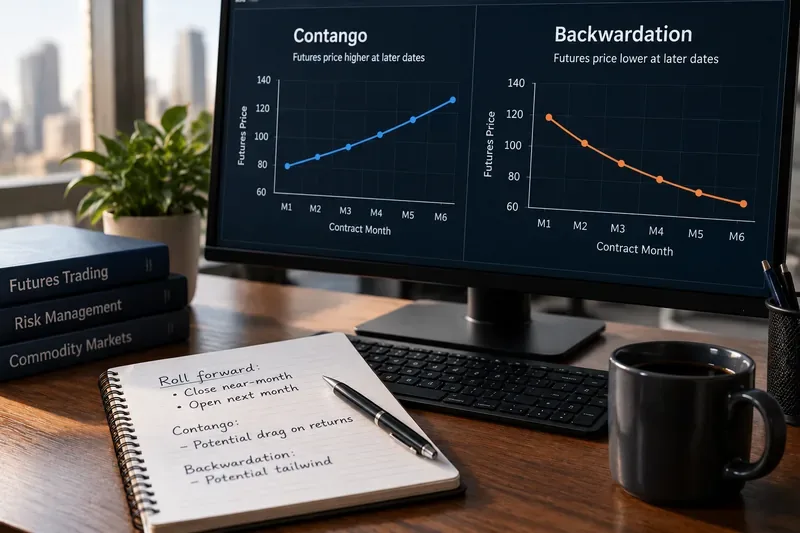
A long futures position may face a return drag in contango or a tailwind in backwardation as contracts are rolled forward.
The practical problem: why did my futures return differ from the spot move?
Futures contracts expire. If you want to keep exposure beyond the life of the contract you currently hold, you generally have to close or offset that contract and establish a position in a later-dated contract. CME Group describes this as rolling a position forward. The exchange also notes that a calendar spread can execute the exit from the expiring contract and entry into the deferred contract together, reducing the time gap between the two legs.
The price of the later contract may be above or below the price of the near contract. That difference is not just a cosmetic feature of the quote screen. As contracts age and move toward expiration, futures prices normally converge toward the relevant spot or cash market. CME explains this convergence in its contango and backwardation primer. For a long-term strategy that repeatedly rolls, the curve can therefore create a persistent drag or tailwind.
First, identify the curve: contango or backwardation?
The easiest first check is to compare nearby futures prices with more distant delivery months.
Curve condition
Typical shape
Simple description
Usual implication for a long roll strategy
Contango
Upward sloping
Later delivery months trade above nearer months
Potential negative roll-yield pressure
Backwardation
Downward sloping
Later delivery months trade below nearer months
Potential positive roll-yield support
The CFTC glossary defines contango as a situation in which succeeding delivery months are progressively higher than the nearest month, and backwardation as the opposite pattern. See the CFTC futures glossary for the regulator's terminology.
For physically delivered commodities, the curve can reflect storage, financing, insurance, inventory availability, and the benefit of having the physical commodity immediately available. CME notes that these carrying costs can contribute to contango, while tight inventories and a high convenience yield can contribute to backwardation.
What roll yield actually means
For a long position, roll yield describes the return effect associated with maintaining exposure as one futures contract ages and the position is shifted into another contract. It is closely related to the curve's shape and the tendency of futures prices to converge as expiration approaches.
A common shortcut is to say that contango means you “sell low and buy high,” while backwardation means you “sell high and buy low.” That wording is useful for intuition, but it can be misleading if taken literally. Exchanging one contract for another at different quoted prices does not, by itself, create a realized gain or loss equal to the price gap. Futures are marked to market, contract specifications matter, and the new contract represents a new exposure. The economic effect emerges through the return path of the contracts you hold over time, including convergence and subsequent price changes.
A simple contango example
Suppose the front-month contract is 100 and the next-month contract is 103. The curve is in contango. You close the 100 contract as part of the roll and establish the next contract at 103.
If market conditions do not otherwise change and that 103 contract gradually converges toward a lower spot or near-month level as it approaches expiration, the long position faces a headwind. Repeating that process through many rolls can cause the futures strategy to underperform a simple chart of spot-price appreciation.
A simple backwardation example
Now suppose the nearby contract is 100 and the next-month contract is 97. The curve is backwardated. You roll into the lower-priced deferred contract. If the curve remains similar and the new contract rises toward the higher nearby or spot level as time passes, that convergence can support the long position's return.
CME's 2026 analysis of WTI futures provides a real market illustration of this mechanism: it describes backwardation as producing positive roll yield for a rolled long position and contango as producing negative roll yield. The article also stresses that the curve can change quickly, so today's apparent roll benefit is not guaranteed to persist. See CME Group's WTI futures analysis.
An easy way to estimate the curve's roll pressure
You do not need a complex model for a first-pass check. Start with the two contracts relevant to your planned roll.
If the result is positive, the deferred contract is more expensive and the curve is in contango across those two months. If it is negative, the deferred contract is cheaper and that section of the curve is backwardated.
For a long position, you can reverse the sign to create a rough roll-carry indicator:
Example: if the near contract is 100 and the next is 103, the indicator is about -2.9%. If the near contract is 100 and the next is 97, it is about +3.1%.
This is a diagnostic, not a promise of future return. The curve may flatten, steepen, or reverse before the next roll. Prices can move for reasons unrelated to convergence, and the holding period may not match the full time between expirations.
Move from the easy check to a better long-term estimate
If you plan to hold a futures strategy for months or years, one snapshot is not enough. Improve the analysis in stages.
1. Check the exact contracts your strategy will use
Do not label an entire market “in contango” because one pair of distant contracts slopes upward. A curve can be steep in one segment and flat or inverted in another. Compare the contract you actually hold with the contract you actually intend to buy next.
2. Use your real roll schedule
Some traders roll near expiration; others roll when liquidity shifts; indexes and funds may use preset windows. CME notes that traders often watch volume in the expiring and next contract when deciding when to roll. Your realized result can therefore differ from a theoretical calculation based on settlement prices on a different date. See CME's futures expiration and contract-roll overview.
3. Separate curve effects from outright price moves
A strongly rising underlying market can overwhelm negative roll yield. Likewise, positive roll yield does not protect a long position from a large decline in the futures price. Evaluate both components: the change in the contract while you hold it and the effect of maintaining exposure across rolls.
4. Include transaction costs and collateral economics
Real returns can also be affected by bid-ask spreads, commissions, slippage, margin requirements, and the return earned on collateral or uncommitted cash. These are separate from roll yield but matter when comparing a long-term futures strategy with a spot asset, an ETF, or another vehicle.
The CFTC warns that futures are volatile, complex, and risky, and that losses can exceed the amount initially invested in some circumstances. Its Futures Market Basics page is a useful reference before treating curve analysis as a stand-alone risk control.
When contango becomes a serious warning sign
Contango deserves more attention when it is both steep and persistent. A one-time 1% gap between contract months is very different from repeatedly paying a large premium every month for a year. The cumulative effect can become meaningful even if each individual roll looks modest.
Watch for these signs:
The deferred contract you must buy is consistently well above the contract you are selling.
The curve remains in contango through several roll cycles rather than briefly.
Your futures strategy is underperforming the underlying spot move by more than transaction costs can explain.
The market has high storage or financing costs that plausibly support persistent contango.
Your strategy rolls very frequently, increasing exposure to the curve and trading costs.
When those conditions appear, the right response is not automatically to abandon the trade. Instead, reassess whether the expected directional return is large enough to overcome the estimated roll drag and other costs.
When backwardation can help, but should not make you complacent
Backwardation can be favorable for a long rolling strategy because the investor may repeatedly enter deferred contracts below nearby prices and benefit if those contracts rise as they approach expiration. But the benefit is conditional.
A supply shortage can resolve. Inventory can rebuild. Interest rates, storage economics, hedging demand, or expectations can change. A curve that is backwardated today can flatten or flip into contango before your next roll. CME explicitly cautions that backwardation can strengthen, weaken, disappear, or reverse.
That means positive roll yield should be treated as a possible return component, not as a guaranteed income stream.
How to decide whether your approach needs to change
A useful long-term process is to define a tolerance before you enter the trade. For example, you might decide that if estimated annualized roll drag exceeds a certain share of your expected market return, you will reconsider the position size, contract selection, roll timing, or even the instrument used to express the view.
There is no universal threshold because the correct choice depends on volatility, leverage, liquidity, taxes, collateral treatment, investment horizon, and why you want the exposure. The important point is to make the curve part of the decision instead of discovering its effect after several rolls.
Self-check: verify the result before you keep holding
Before carrying a long futures position into another roll cycle, answer these questions with current contract prices:
What is the near-contract price?
What is the exact deferred contract I will roll into?
Is that section of the curve in contango or backwardation?
What is the percentage gap between the two contracts?
How often will I repeat the roll?
Has the curve shape been stable, or has it recently changed?
How much of my actual return came from price movement versus the rolling process?
After spreads, commissions, slippage, and collateral effects, is the strategy still meeting the return objective I set?
If you can answer those questions, your long-term futures result should be much easier to interpret. The key is not to predict the curve perfectly. It is to recognize that a futures position is not the same thing as owning the spot asset indefinitely. Expiration forces a decision, and repeated rolls can quietly become a major part of the return.
Source check: Definitions and mechanics in this article were cross-checked against CFTC and CME Group materials available in September 2026. Product-specific contract rules, expiration procedures, margin requirements, and market structure can change, so verify the current contract specifications before trading.