Home
» Knowledge
»
FX Forward Points Explained: Why They Are Not a Forecast of the Future Spot Price
FX Forward Points Explained: Why They Are Not a Forecast of the Future Spot Price
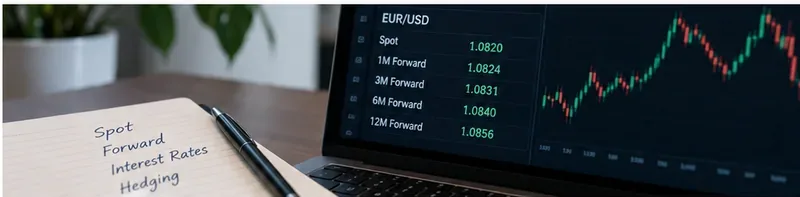
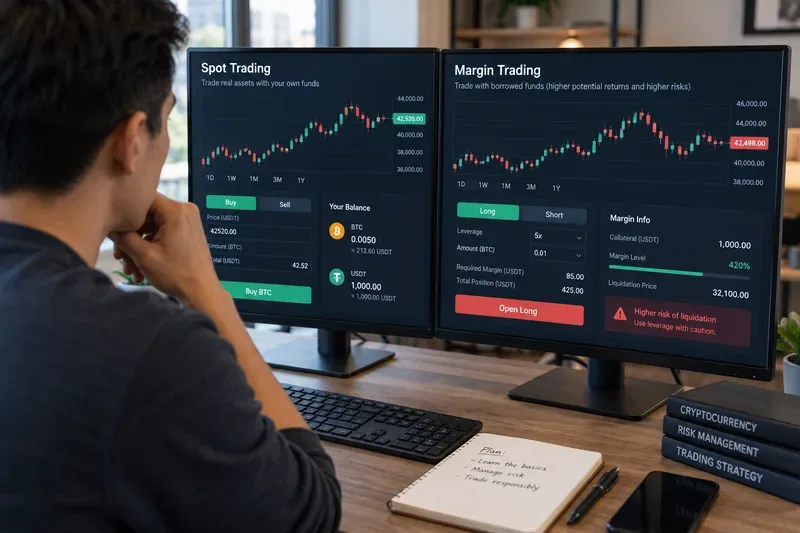
A trading screen compares a spot FX quote with several forward tenors, while a notebook highlights the main concepts behind forward pricing: spot, interest rates, and hedging.
FX forward points are easy to misread. A three-month forward rate that sits above today’s spot rate can look like the market is “predicting” a stronger base currency three months from now. That is not what the quote primarily means.
In a standard deliverable FX forward, the forward rate is a price for exchanging two currencies on a future date. Its distance from spot is driven mainly by the relative cost of borrowing and lending those currencies over the contract’s life. In textbook form, that relationship is covered interest parity. In real markets, the quoted forward can also reflect cross-currency basis, funding pressure, balance-sheet constraints, liquidity, credit terms, and transaction costs.
This practical reference shows how to read forward points, calculate a simplified forward rate, and avoid treating a hedge price as a directional forecast.
Quick reference: what forward points do and do not tell you
Question
Practical answer
What are forward points?
The difference between an FX forward rate and the corresponding spot rate, quoted in small exchange-rate units.
What drives them?
Mainly the interest-rate differential between the two currencies for the relevant maturity, plus any market basis and execution effects.
Are positive points bullish?
No. Positive points only mean the quoted forward rate is above spot under that currency-pair convention.
Are negative points bearish?
No. Negative points only mean the forward rate is below spot.
Is the forward rate the market’s best estimate of future spot?
Not in a pure sense. It is an arbitrage-linked financing price and can contain risk premia and market frictions.
What is the main use?
Locking an exchange rate, valuing hedges, comparing funding routes, and managing known foreign-currency cash flows.
What exactly are FX forward points?
Suppose EUR/USD spot is 1.0800 and the three-month forward is 1.0854. The forward is about 0.0054 above spot. For a pair normally quoted to four decimal places, that difference is about 54 conventional forward points, subject to the dealer’s quoting convention and rounding.
The simple relationship is:
Forward rate = spot rate + forward points
That arithmetic is straightforward. The economic meaning is where confusion begins. Forward points are not added because dealers collectively expect spot to move by that amount. They emerge because holding euros and holding dollars have different financing returns over the same period.
The Bank for International Settlements describes covered interest parity as a no-arbitrage condition linking the interest-rate differential between two currencies to the gap between forward and spot exchange rates. In an FX swap, the difference between the forward and spot legs is commonly quoted as forward points. See the BIS discussion of covered interest parity and the cross-currency basis.
How the interest-rate differential creates forward points
Take a currency pair quoted as units of the quote currency per one unit of the base currency. For EUR/USD, euros are the base currency and U.S. dollars are the quote currency.
Ignoring compounding details, day-count conventions, transaction costs, and cross-currency basis, a simplified relationship is:
F ≈ S × (1 + rquote × T) / (1 + rbase × T)
where S is spot, F is the forward rate, rquote is the quote-currency interest rate, rbase is the base-currency interest rate, and T is time to maturity in years.
The logic is no-arbitrage. If two otherwise comparable strategies—funding in one currency versus converting, investing in the other currency, and hedging the exchange rate—produced reliably different locked-in returns, traders could in principle arbitrage the gap. Forward pricing adjusts to remove or reduce that opportunity.
The simplified forward adjustment is therefore about +0.00536, or roughly +53.6 points if one point is 0.0001 for this quote. That does not mean EUR/USD is expected to trade at 1.08536 in three months. It means that, under these simplified funding assumptions, 1.08536 is the approximate no-arbitrage forward exchange price.
Why a forward rate is not a forecast of future spot
1. The forward is constrained by tradable financing relationships
A forward quote is connected to spot markets and money-market funding. That link is mechanical enough that large inconsistencies can create arbitrage incentives. The Federal Reserve’s research on covered interest parity likewise treats forward pricing as part of a financing relationship across currencies, not merely as a survey of where traders think spot will go. See the Federal Reserve FEDS paper on quantities and covered-interest parity.
2. Expectations and forward prices are not the same object
A market expectation is a belief about a future uncertain outcome. A forward price is the rate at which counterparties can contract today for a future exchange. Those concepts can be related, but they are not identical.
Federal Reserve research that tests whether forward and futures rates are rational expectations of future realized prices finds that, for many instruments, the hypothesis can be rejected; the authors emphasize that forward and futures prices can also be affected by the market price of risk. The paper includes foreign exchange forwards among the markets studied. See The Information Content of Forward and Futures Prices: Market Expectations and the Price of Risk.
3. The future spot rate can move for reasons absent from today’s carry
By maturity, spot may have changed because of inflation surprises, central-bank policy, growth data, capital flows, political events, risk sentiment, positioning, or shocks that were not known when the forward was priced. The forward locks an exchange rate for a future transaction; it does not eliminate uncertainty about what the spot market itself will print on that future date.
What is the cross-currency basis, and why does it matter?
In a frictionless textbook world, covered interest parity would hold exactly. In practice, it can deviate. The difference is commonly discussed as the cross-currency basis.
BIS research after the global financial crisis documents persistent covered-interest-parity deviations and links them to forces including hedging demand and limits to arbitrage created by costly bank balance sheets. That means a real-world forward quote can reflect more than the clean interest-rate differential alone. Funding scarcity, dealer balance-sheet capacity, demand to hedge one currency, liquidity conditions, and transaction costs can all matter.
This is another reason not to translate a forward premium or discount directly into a directional currency view. A wider forward discount may partly reflect funding conditions rather than a stronger consensus that the currency will fall.
How to read a forward quote in practice
Use this short checklist before interpreting a forward:
Confirm the currency-pair convention. Know which currency is base and which is quote.
Check the tenor. One week, one month, three months, and one year embed different funding periods.
Convert points correctly. Apply the market’s decimal convention for that pair instead of assuming every point equals the same absolute amount.
Separate carry from direction. Ask what the rate differential explains before drawing any conclusion about future spot.
Watch for basis and liquidity. In stressed or segmented markets, the textbook formula may not match the executable quote.
Use bid/ask, not a mid-price fantasy. A hedge is executed at a tradable price and may include dealer spread, credit, or collateral effects.
Common mistakes
“The forward is above spot, so the base currency should rise.”
Not necessarily. A forward above spot can be a consequence of the relevant interest-rate differential under the quotation convention. Directional meaning does not follow automatically.
“Forward points show what professional traders expect.”
They may contain information influenced by market expectations, but their primary pricing anchor is the financing relationship between the two currencies. Treating the entire forward-spot gap as a forecast strips away that structure.
“If spot finishes away from the forward, the forward was mispriced.”
No. A correctly priced hedge can mature with spot far from the contracted forward rate. The forward solved a different problem: it fixed the future conversion price under the market conditions available when the trade was entered.
When forward points are useful
For a corporate treasurer, importer, exporter, fund, or investor, forward points are especially useful for budgeting and hedging. They show the carry embedded in locking a future FX rate. They can also help compare hedged versus unhedged returns, assess the cost of rolling a hedge, and analyze whether funding directly in one currency differs from synthetically obtaining it through an FX swap.
CME describes the difference between its FX futures price and OTC spot as a basis or forward-points measure and notes that the spot level, interest-rate differential, and time to settlement are important pricing inputs. See CME Group’s FX Link overview. CME’s current FX tools also include an FX Swap Rate Monitor designed to assess implied interest-rate differentials from swap points; see the CME FX market tools page.
Bottom line
FX forward points answer a pricing question: What adjustment to spot is needed to lock a future exchange rate given the relative economics of the two currencies? They do not directly answer a forecasting question: Where will spot actually trade on that future date?
The distinction matters. Read forward points first as carry, funding, and basis. Then, if you want a directional view on the future spot rate, analyze that separately using the economic, policy, valuation, positioning, and risk factors relevant to the currency pair.