Home
» Knowledge
»
Partial Fills Explained: Why One Order Can Execute at Several Prices and Times
Partial Fills Explained: Why One Order Can Execute at Several Prices and Times
A partial fill happens when only part of an order executes while the rest remains open, is routed elsewhere, or is canceled under the order’s instructions. The important point is that an order is an instruction, not necessarily one indivisible trade. A single order can therefore produce several execution reports, each with its own quantity, price, and timestamp.
To make the mechanics concrete, this article uses one clearly hypothetical example throughout. It is an illustration of how matching can work, not a report of an actual trade or brokerage test.
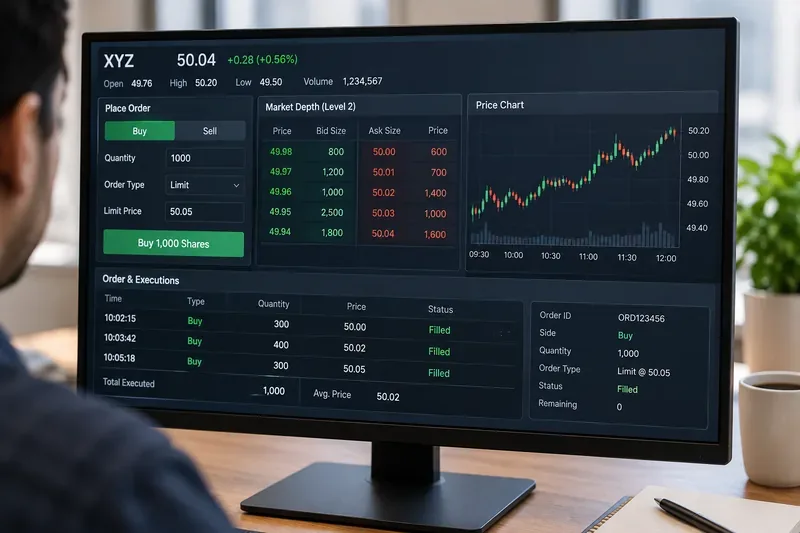
A hypothetical 1,000-share order appears as three separate fills, illustrating how one order can execute in pieces as liquidity becomes available at eligible prices.
The hypothetical order: 1,000 shares, but not one execution
Suppose Maya submits a buy limit order for 1,000 shares of fictional stock XYZ with a limit price of $50.05. Her instruction means she is willing to buy up to 1,000 shares, but not above $50.05.
Now imagine her broker reports these executions:
Time
Shares filled
Price
Shares remaining
10:02:15
300
$50.00
700
10:03:42
400
$50.02
300
10:05:18
300
$50.05
0
Nothing about that sequence is inherently abnormal. Each execution satisfies the original buy-limit instruction because every price is $50.05 or lower. The order is complete only after the cumulative filled quantity reaches 1,000 shares.
The share-weighted average execution price in this example is $50.023, commonly displayed as $50.02 if a platform rounds to two decimals. That average is useful for reviewing the completed order, but it does not erase the fact that the order actually traded at three prices.
Why can one order execute at several prices?
The most common reason is simple: there may not be enough immediately available sell interest at one price to satisfy the entire buy order.
The SEC’s investor bulletin on order types, updated August 18, 2026, explicitly notes that parts of a large market order can execute at different prices when there is not enough liquidity at one price. A market order seeks the best available prices but does not guarantee one execution price. See the SEC Investor.gov bulletin on understanding order types.
Limit orders behave differently because they impose a price boundary. In Maya’s case, the system may match available shares at $50.00 first, then $50.02, then $50.05, but it cannot execute her buy limit order at $50.06. If the only remaining sellers are asking more than $50.05, the unfilled balance normally remains open or is handled according to the order’s time-in-force instruction.
Available liquidity is spread across the order book
Think of displayed offers as layers. A simplified sell side might show 300 shares at $50.00, 400 at $50.02, and 900 at $50.05. A marketable buy order for 1,000 shares could consume the first 300, then 400, then 300 from the $50.05 level. The result is three executions even if matching occurs almost instantaneously.
This is one reason the last traded price is not a promise about the price available for an entire new order. The SEC explains that quotes apply to a specific number of shares and that prices can change while an order is being routed and executed. See Investor.gov’s explanation of trade execution.
Why can partial fills occur at different times?
Different prices explain only part of the story. An order can also fill in pieces over seconds, minutes, or longer because the remaining quantity may have to wait for new contra-side interest.
Return to Maya’s example. Perhaps 300 eligible shares are immediately available. The remaining 700 shares rest as an open limit order. A seller then arrives later with 400 shares at $50.02, followed by another seller with 300 shares at $50.05. The same original order can receive another execution each time compatible liquidity becomes available.
Reaching your limit price does not necessarily mean your entire order fills immediately. Other orders may already be waiting at the same price.
Nasdaq’s current equity rulebook describes a price/display/time execution algorithm: better-priced orders are considered first, while displayed orders at the same price are ranked by time priority. In plain English, if several displayed orders are competing at the same price, earlier eligible orders can be ahead in the queue. See Nasdaq Equity 4, Rule 4757.
That matters to Maya if she posts the remaining 700 shares at $50.05 behind other buyers already resting at $50.05. A seller may trade at $50.05, yet only the orders ahead of hers receive executions. Her order could remain partially filled until enough additional selling interest reaches her queue position.
Matching rules are not identical across every venue or product. Some markets use different allocation methods for particular products, auctions, displayed versus non-displayed interest, or specialized order types. The practical lesson is to treat “the market touched my price” and “my order was entitled to a fill” as different questions.
Market orders and limit orders create different partial-fill risks
Market order: execution priority, less price control
A market order generally seeks immediate execution at the best available prices. FINRA warns that the price seen when the order is entered may not be the final execution price, especially in fast-moving markets. See FINRA’s order types guidance.
If Maya instead used a market order for 1,000 shares, it could sweep through several offer levels. She might get a faster completion, but there would be no $50.05 ceiling protecting the purchase price.
Limit order: price protection, no guarantee of completion
A buy limit order can execute only at the limit price or lower. That protects the maximum acceptable price, but it introduces execution uncertainty. Maya’s 1,000-share order at $50.05 might fill 300 shares and then stop if sellers move to $50.06 or higher.
This trade-off is central to understanding partial fills: stronger price control can mean accepting that some or all of the order may remain unexecuted.
Can you prevent partial fills?
Sometimes, but the instruction you choose can reduce the chance of execution.
Fill-or-Kill (FOK): the order must execute immediately in its entirety or be canceled. The SEC’s order-types bulletin states that no partial execution is allowed for FOK orders.
All-or-None (AON): the order must execute in its entirety or not at all, but unlike FOK it does not necessarily require immediate execution.
Immediate-or-Cancel (IOC): the portion that can execute immediately does so, and any remaining quantity is canceled. IOC therefore explicitly allows a partial fill.
Availability and exact handling of these instructions can differ by brokerage firm, venue, asset class, and session. The SEC advises investors to verify which order types and instructions their brokerage actually supports. Do not assume the same label behaves identically everywhere.
What should you check when an order shows “partially filled”?
Start with the execution details rather than the headline status. A useful review sequence is:
Check cumulative quantity. Compare the original order size with shares already executed and shares still open.
Check each execution price. For a buy limit order, every execution should be at or below the limit; for a sell limit order, at or above it.
Check timestamps. Several fills milliseconds apart may reflect liquidity at multiple price levels or venues. Fills farther apart may indicate that the remaining order rested until new liquidity appeared.
Check the time-in-force instruction. Day, GTC, IOC, FOK, and AON instructions can determine whether the remainder stays open or is canceled.
Check whether you changed the order. Cancel/replace actions can affect queue priority depending on venue rules and the nature of the change.
Check your broker’s execution report and fee policy. A platform may display one parent order with multiple child executions. Commission and fee treatment varies, so use the broker’s actual confirmation rather than assuming each partial fill is billed separately.
What partial fills do not prove
A partial fill by itself does not prove that a broker made an error, that another trader “jumped the queue,” or that there was enough liquidity to fill the whole order at the visible price. Public quotes show prices and quoted sizes at specific moments, while orders can be added, canceled, executed elsewhere, or change before your order reaches the relevant venue.
Likewise, seeing a trade print at your limit price does not by itself establish that your resting order should have executed. Queue position, displayed status, venue, order attributes, and the sequence of incoming orders can all matter.
The practical takeaway from Maya’s three fills
Maya submitted one 1,000-share instruction, but the market did not need to satisfy it with one 1,000-share trade. Her order interacted with available liquidity in pieces. The three executions at $50.00, $50.02, and $50.05 all remained inside her limit, and the different timestamps reflected when eligible liquidity reached her order.
That is the essential model for understanding partial fills: one order can map to many executions. Price levels determine what can trade, queue and venue rules help determine whose order trades first, and time-in-force instructions determine what happens to the remainder. Once you separate the parent order from its individual executions, a “partially filled” status becomes much easier to interpret.
Scope note: This article focuses on common U.S. stock-order mechanics and uses current SEC, FINRA, and Nasdaq materials checked in September 2026. Futures, options, crypto venues, foreign markets, and individual brokers may use different matching, routing, and order-instruction rules.