Home
» Knowledge
»
Liquidation Price vs. Bankruptcy Price: What Crypto Futures Traders Miss
Liquidation Price vs. Bankruptcy Price: What Crypto Futures Traders Miss
A futures position can be liquidated before its margin is completely exhausted. That is the distinction traders miss when they treat the liquidation price and bankruptcy price as interchangeable. The liquidation price is generally a risk trigger: it is where the exchange’s margin rules say the position or account can no longer meet maintenance requirements. The bankruptcy price is a deeper accounting threshold, where the margin allocated to the position has been depleted. After liquidation begins, an exchange may use that bankruptcy level as a reference for taking over or closing the position.
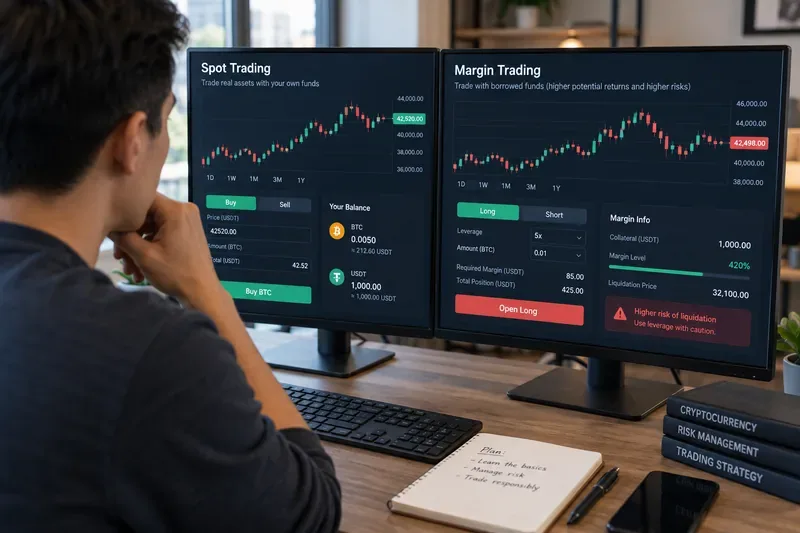
A descending futures chart approaches a marked risk level, illustrating why the liquidation trigger and the point where margin is exhausted are different thresholds.
Understanding the gap helps you read a position screen, plan an exit, and avoid relying on a price that may not be the one the exchange uses to trigger liquidation. It does not predict the exact fill you will receive. Exchange rules, contract design, account mode, fees, funding, liquidity, and rapid price moves all affect the result.
The difference in plain language
Liquidation price: the price level, or account risk condition, at which the exchange starts its liquidation process because margin is no longer sufficient to support the position. In isolated margin, platforms commonly show a liquidation price for the position. In cross or portfolio margin, liquidation may instead depend on the account’s maintenance margin ratio, so a displayed per-position figure can be only an estimate.
Bankruptcy price: the theoretical price at which the margin assigned to a position has been fully consumed by losses. It is typically an internal risk-management reference used in the liquidation process, not a price at which a trader can expect to place an ordinary order. Bybit describes the mark price reaching the liquidation price as the trigger and the position being closed at the bankruptcy price. Binance’s protocol likewise describes bankruptcy positions being taken over or closed at the bankruptcy price when liquidation cannot be completed without a deficit.
For a losing long, the bankruptcy price is normally below its liquidation price; for a losing short, it is normally above. The space between them represents the remaining margin buffer needed to meet maintenance requirements and manage liquidation. The exact distance is not universal.
A simplified example: one long position
Suppose a trader opens a 1 BTC linear USDT-margined long at $50,000 and allocates $5,000 of isolated margin. Ignore fees, funding, slippage, and maintenance-margin tiers for this illustration. If the exchange requires $250 of maintenance margin, liquidation would begin when the position has lost enough that only about $250 remains: a $4,750 loss, corresponding roughly to a mark price of $45,250. The bankruptcy price, under these simplified assumptions, would be near $45,000, where the full $5,000 margin has been consumed.
Reference
Illustrative level
What it means
Entry
$50,000
Position opens; $5,000 is allocated
Liquidation
About $45,250
Maintenance margin is no longer covered; liquidation process starts
Bankruptcy
About $45,000
Allocated margin is exhausted in this simplified model
This is not an exchange calculator. Actual maintenance margin can depend on position size and risk tier. Fees to close, accrued funding, added or removed margin, contract specifications, and other positions can shift the displayed liquidation level. A gap can also be smaller or larger than the example suggests. Use it to understand the sequence, then use the platform’s current position details and rules for your contract.
What happens between the two prices?
When the liquidation condition is reached, the platform’s process takes control. Depending on its rules and market conditions, it may cancel orders, reduce risk, partially close the position, or transfer the remaining position to a liquidation engine or insurance fund. Those actions are designed to manage a margin shortfall; they do not promise a fill at the displayed liquidation price.
Bankruptcy price should not be read as a guaranteed execution price or a protective stop. If the market moves quickly, available bids or asks may be worse than expected. Exchange rules also differ on what happens if the position cannot be closed at or near that reference. Binance documents an insurance fund that can cover the difference between bankruptcy and liquidation execution prices, with auto-deleveraging possible under specified conditions if the fund cannot absorb losses. The fund is a platform risk mechanism, not a refund of the trader’s loss.
Three checks that make the price display useful
Check the trigger reference. Liquidation may be triggered by mark price rather than last traded price. Mark price is a calculated reference intended to reduce sensitivity to short-lived trades on one order book. If a chart displays last price while the liquidation engine monitors mark price, the two can differ. Check which price type triggers both liquidation and your stop-loss.
Check the margin mode. With isolated margin, the position has a defined margin allocation, though that allocation can change when you add or remove margin. With cross margin, positions share account collateral. Other positions, open orders, unrealized profit or loss, and available balance can move the account’s liquidation risk. In this case, a displayed liquidation price may be a snapshot rather than a fixed boundary.
Check the contract and risk tier. Inverse and linear contracts can use different calculations, and maintenance requirements may change with notional size or exchange risk limits. A formula copied from another platform—or from a different contract type—may give a misleading answer.
How to judge whether your risk plan is working
Before entering a position, record the entry price, direction, size, margin mode, allocated margin, current liquidation estimate, and the price reference used to trigger liquidation. Then compare your planned stop level with the liquidation condition. A stop that triggers from last price can fail to act before a mark-price liquidation if the references diverge. A stop set only a few ticks from liquidation can also be vulnerable to volatility, latency, and slippage.
After entry, judge your setup by observable conditions rather than the distance between the two price labels alone:
Does your stop trigger on the same price basis used by the liquidation engine, where the platform allows that choice?
Has the liquidation estimate changed after adding a position, moving collateral, paying funding, or seeing another position’s unrealized loss?
Is account maintenance margin rising toward the platform’s stated threshold?
Could a normal adverse move or a thin order book reach the stop and liquidation area before you can act?
If the answers expose a small buffer or changing account risk, reduce position size, lower leverage, add margin only if it fits your risk limit, or close the position. These actions can move the liquidation threshold, but none removes market risk. Adding margin without reconsidering the position can simply increase the amount at stake.
When a simple price calculation is not enough
A hand calculation is useful for learning why liquidation usually starts before margin reaches zero. It is not reliable as the sole risk control for cross margin, portfolio margin, multi-asset collateral, inverse contracts, hedged positions, or positions whose maintenance tier can change. In these setups, the account-level calculation can incorporate several assets and positions, and the displayed estimate can update as conditions change.
Likewise, a liquidation price does not tell you how much you will lose after fees or what execution price the market will offer. A bankruptcy price does not tell you whether the exchange will close the full position at once, reduce it in stages, or invoke another risk mechanism. Read the current contract specifications and liquidation rules for the platform you use, and review the order or liquidation history after an event to understand what actually happened.
Exchange documentation can change, and each venue applies its own rules. Recheck the current contract page and account-specific risk display before trading. The useful outcome is not a perfectly predicted liquidation point; it is knowing which price triggers intervention, what collateral backs the position, and whether your exit plan acts before the exchange does.