Home
» Knowledge
»
Red Flags in Crypto Whitepapers and Roadmaps You Must Never Ignore
Red Flags in Crypto Whitepapers and Roadmaps You Must Never Ignore
A polished website can make a crypto project feel more mature than it really is. A colorful whitepaper, a multi-year roadmap, and a countdown to a token sale may look like evidence of progress, but they are still claims made by the project. For a beginner, the first skill is not predicting price. It is learning which claims can be checked and which gaps should stop you before you connect a wallet or send money.
Research note: the information and links in this guide were checked on September 16, 2026. Crypto assets, project documents, contract addresses, and legal requirements can change. This is an educational due-diligence checklist, not a recommendation to buy or sell any asset.
What a whitepaper and roadmap actually tell you
A whitepaper is a project document that describes a proposed problem, technical design, token or network role, and operating assumptions. A roadmap is a plan for future milestones. Tokenomics means the economic design of a token: supply, distribution, utility, incentives, and unlock schedule. A smart contract is a program deployed on a blockchain that can control token transfers, permissions, and other actions.
These documents are useful because they show what a team says it is building. They are not independent proof that the product works, that the team will deliver, or that the token will retain value. Ethereum’s own documentation describes its roadmap as a plan that is expected to change, while the current Ethereum site warns that its original whitepaper no longer reflects the network after years of development. That is a useful lesson: even a serious project’s documents have a date and a scope.
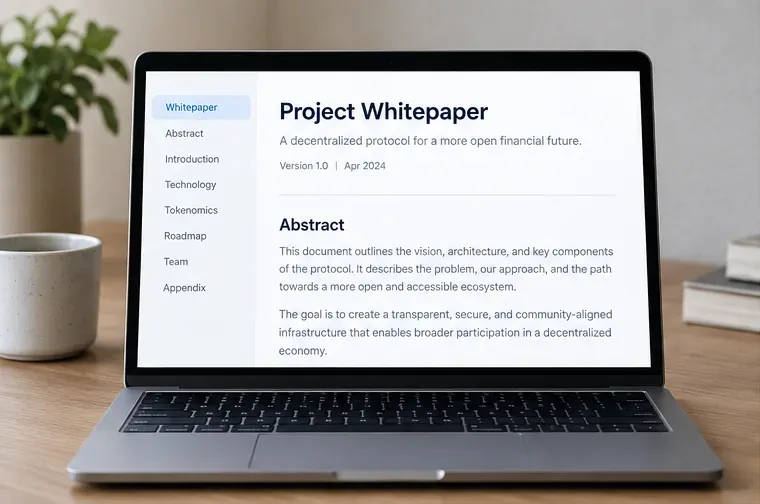
An illustrative whitepaper screen shows an abstract, a version date, and sections such as technology, tokenomics, roadmap, and team; use these sections as an initial reading checklist.
Beginner action: before thinking about price, record the document title, version, publication date, project name, blockchain, token contract address, and official links. If the project cannot provide a stable versioned document or a consistent contract address, pause immediately.
Step 1: Read for a testable explanation, not impressive vocabulary
Start with the problem statement. What user problem exists today? Who has it? Why does a blockchain or token improve the solution? A credible explanation should connect the problem, the proposed mechanism, and the way users would actually interact with the product. Technical terms are not automatically a sign of quality. A document can be long and still avoid explaining what the token does.
Red flag: the document is mostly slogans
Be cautious when the whitepaper repeats phrases such as “revolutionary,” “next-generation,” or “global adoption” but gives no measurable mechanism, assumptions, limitations, or test results. A short document is not automatically bad, and a detailed document is not automatically good. The question is whether you can translate the main claim into something that could later be checked.
Check this: highlight three factual claims. For each one, write what evidence would prove or disprove it: a public testnet, a working repository, a deployed contract, a customer integration, or a published dataset. If no evidence could ever settle the claim, treat it as marketing rather than analysis.
Red flag: copied or inconsistent material
Look for unexplained changes in the token name, chain, supply, launch date, team names, or terminology. Plagiarized text, broken citations, references to another project, or a document that has no version history are serious quality warnings. The CFTC has specifically advised people considering digital coins or tokens to conduct extensive research and to investigate the individuals and entities connected with an offering.
Check this: search a distinctive sentence in quotation marks, compare the current document with an archived version when available, and ask the project to explain any changed numbers. Do not treat a fast answer in a chat group as evidence; look for a public correction and a consistent update log.
Step 2: Inspect tokenomics before you study the price chart
Token allocation tells you who may receive supply and when those tokens may become transferable. Find the maximum or initial supply, current circulating supply, allocations for the team and investors, treasury holdings, market-making arrangements, staking rewards, emissions, and any minting authority. “Community allocation” is too vague unless the document explains recipients, distribution rules, and timing.
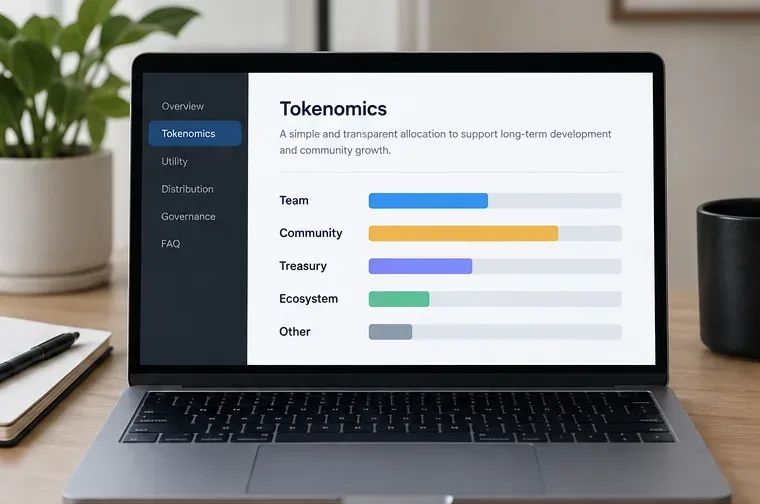
An illustrative tokenomics screen separates team, community, treasury, ecosystem, and other allocations; the reader should look for exact numbers, wallets, and unlock rules in the real documents.
Red flag: large or unclear insider allocations
A large team or private-investor allocation is not automatically fraudulent. It does create a concentration and selling risk. The problem becomes more serious when the project does not publish wallet addresses, vesting terms, or a schedule for unlocking. A low circulating supply can also make early price movement look stronger than the fully diluted supply would suggest.
Check this: build a simple table with four columns: holder category, percentage or number of tokens, wallet or custodian, and unlock date. Mark every field that is missing. Missing information is not proof of a scam, but it is a reason not to rely on the project’s market-cap narrative.
Red flag: utility is defined only as “the token will go up”
A utility token is described as giving access to a service, feature, fee discount, governance right, or other function. That function may still fail, but it is different from promising that buyers will profit. The CFTC warns buyers to understand what rights are attached to a coin or token and to be especially wary of promises or guarantees of future value. A whitepaper that treats price appreciation as the main utility is describing speculation, not a proven product need.
Check this: ask what a user can do with the token on the product today, not after an indefinite future launch. If the answer is only “hold it,” “stake for high returns,” or “sell it to the next wave,” stop and investigate the economic source of those returns.
Step 3: Treat the roadmap as a record of promises, not proof of delivery
A useful roadmap has milestones that are concrete enough to verify: a testnet release, a code release, a security review, a governance deployment, an integration confirmed by the partner, or a mainnet launch with a public transaction history. Dates can move for legitimate technical reasons. The important question is whether the team records what changed and why.
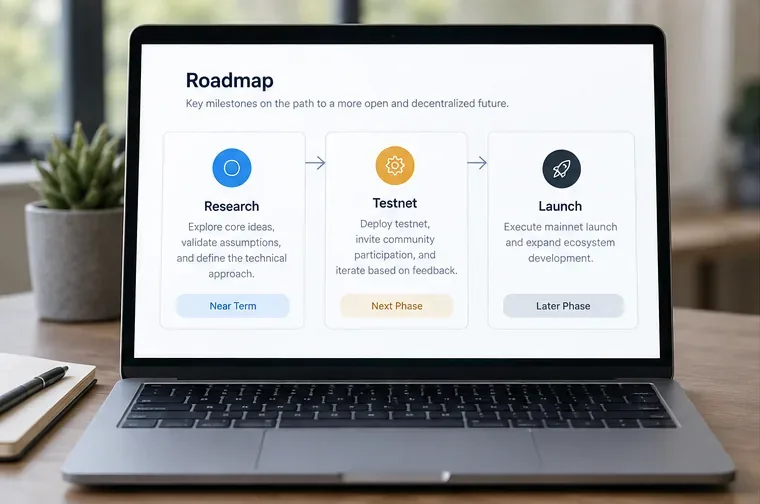
An illustrative roadmap presents research, testnet, and launch as separate milestones; each claimed milestone should be checked against dated evidence rather than accepted as a promise.
Red flag: vague milestones and permanent “coming soon” language
“Expand ecosystem,” “secure major partnerships,” and “global marketing” are activities, not outcomes. A roadmap with no owners, release links, dependencies, or completed history is difficult to audit. A project may still be early, but it should say so plainly instead of presenting aspirations as delivered technology.
Check this: for every past milestone, locate a dated artifact outside the roadmap: a release tag, testnet explorer record, technical announcement, or partner confirmation published by the partner. If an item is marked complete but no independent artifact exists, downgrade your confidence and do not move to a financial step.
Red flag: countdowns and urgency replace evidence
“Last hours,” “private allocation closing,” referral bonuses, and pressure to act before you can read the documents are classic fraud signals. Investor.gov lists pressure to act now, unsolicited offers, guaranteed returns, and “everyone is buying” pitches among investment-fraud warning signs. A legitimate time-limited event can still exist, but urgency never removes the need for verification.
Check this: close the sale page and set a cooling-off period. During that time, verify the contract, allocation, legal terms, and team from independent sources. If the offer disappears because you refused to rush, that is information about the offer—not a reason to override your checklist.
Step 4: Verify the team, code, and claimed partnerships
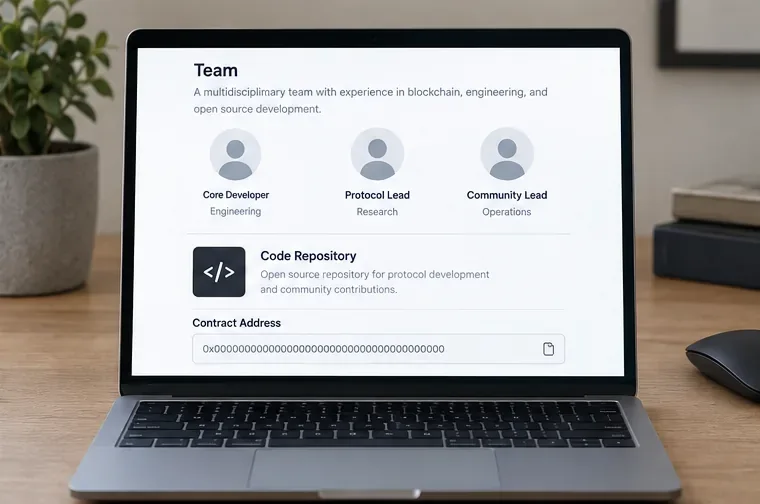
An illustrative team page pairs generic roles with a code repository and contract-address field; verify the real people, repository activity, and deployed address independently.
Search for named contributors on professional profiles, conference records, prior open-source work, and company registrations where relevant. Do not assume a photograph or a social-media follower count proves identity. An anonymous team is not conclusive proof of fraud; some open-source projects use pseudonyms. It is nevertheless a material trust limitation when the project asks for money, controls a treasury, or makes strong claims about regulated services.
For partnerships, use the partner’s own website or verified account. A logo on a project page is not confirmation. Distinguish between a pilot, a technical integration, a marketing collaboration, and a casual mention. These are not equivalent.
Check this: write down each important person and partnership claim, then find a second source that did not originate from the project. If the only evidence is a screenshot, repost, influencer video, or referral page, label the claim unverified.
Step 5: Inspect the smart contract without pretending to be an auditor
Start with the exact contract address published by the project, then confirm the blockchain network and deployment transaction. On Ethereum, source-code verification means the published source and compilation settings match the bytecode deployed at the address. Ethereum’s documentation also makes an important distinction: source verification is not the same as formal verification of correctness. Verified code can still contain a design flaw, dangerous permission, or economic risk.
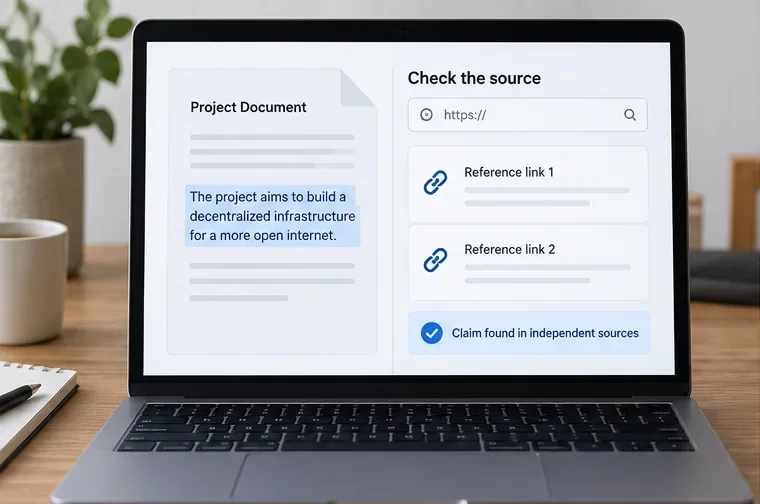
An illustrative source-checking screen compares one highlighted claim with independent references; a claim is stronger when it can be confirmed outside the project’s own marketing.
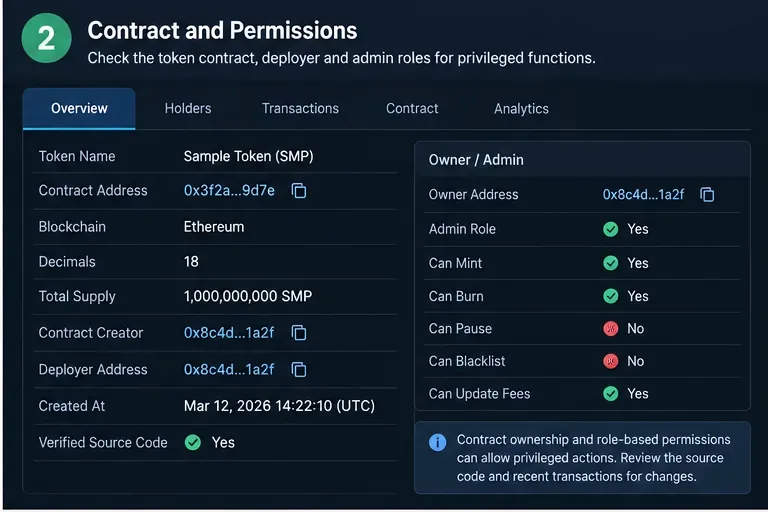
Look for functions or roles that can mint new tokens, pause transfers, blacklist addresses, change fees, upgrade the implementation, withdraw assets, or alter a sale. OpenZeppelin’s documentation explains that ownership and role-based access control determine who may perform privileged actions. Those permissions may be legitimate, but they should be disclosed, limited, monitored, and governed by a credible process.
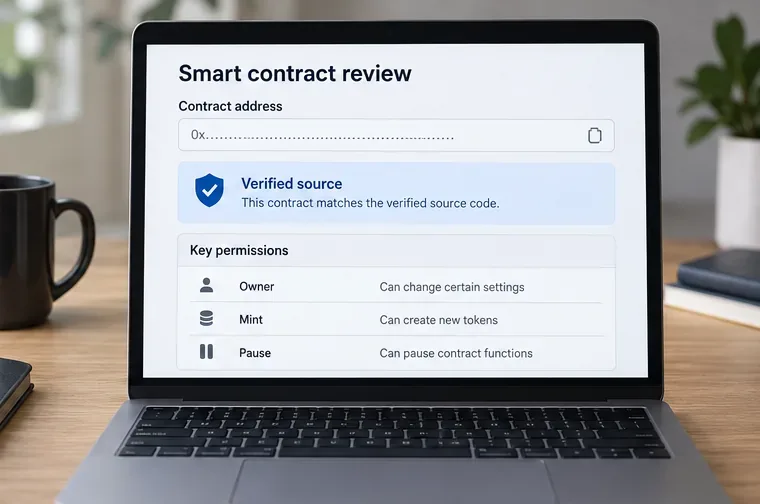
An illustrative contract-review screen lists Owner, Mint, and Pause permissions beside a verified-source notice; verification improves visibility but does not prove that the design is safe.
Check this: record every privileged role, its current address, and the stated reason it exists. If the source is unverified, the address is missing, the owner can change critical rules without delay, or the project cannot explain an administrative function, do not connect your wallet to the application. If you cannot read the code, treat the review as incomplete rather than assuming an audit badge makes it safe.
Step 6: Match the unlock schedule to on-chain reality
Vesting is a rule that locks tokens and releases them over time. A cliff is a waiting period before releases begin. An unlock can create selling pressure, but the schedule alone does not tell you whether holders will sell. You need to compare the documented schedule with actual wallet balances, transfers, and changes to circulating supply.
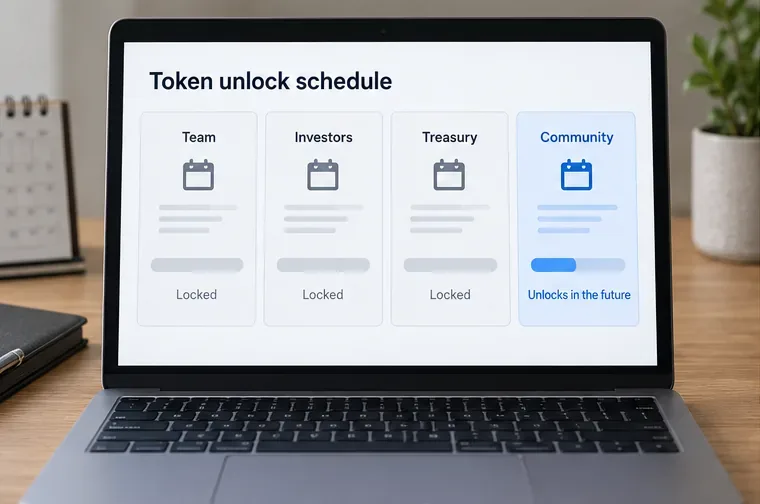
An illustrative unlock schedule separates team, investors, treasury, and community holdings; compare these categories with the real vesting dates and wallet balances.
Red flag: the whitepaper gives only one percentage, while the sale terms or contract contains different dates; team and investor wallets are undisclosed; or a large unlock is approaching without a clear explanation. This is a risk signal, not a guaranteed prediction of a price fall.
Check this: create a calendar of the next unlocks and identify which wallets receive the tokens. Compare it with the contract and official announcements. If the numbers do not reconcile, stop the review and ask for a written correction before considering any transaction.
Red flags that should change your next action
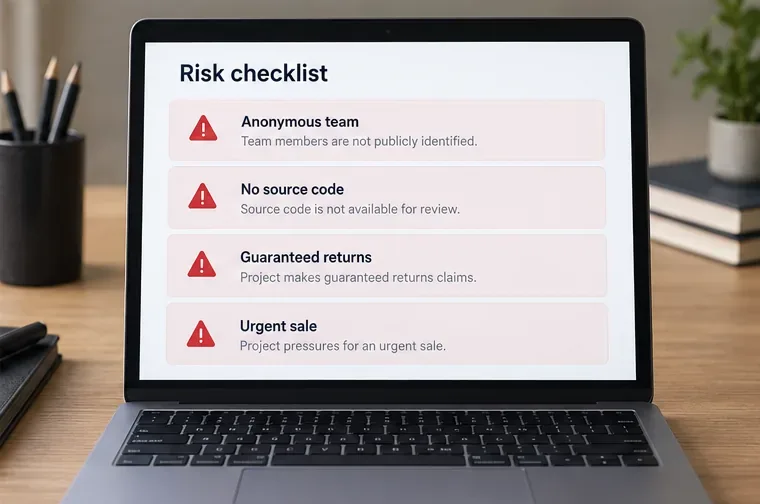
An illustrative risk checklist highlights an anonymous team, missing source code, guaranteed returns, and an urgent sale as reasons to stop and investigate further.
Signal
What it can indicate
Immediate response
Guaranteed or unusually high returns
Possible fraud, unsustainable incentives, or undisclosed risk
Do not send funds; compare the claim with regulator warnings
Anonymous or unverifiable team
Limited accountability and higher identity risk
Verify independent evidence or stop
No verifiable source code
You cannot inspect the deployed logic
Do not connect a wallet or approve a transaction
Unclear supply or unlocks
Hidden dilution or concentrated selling risk
Reconcile documents, wallets, and contract data
Urgent sale or referral pressure
Emotion is replacing due diligence
Leave the page and use a cooling-off period
Roadmap milestones without evidence
Marketing may be ahead of delivery
Look for dated artifacts and third-party confirmation
No single missing item proves that a project is fraudulent. The decision changes when several independent problems point in the same direction: promotional promises, hidden supply, unverified code, and pressure to act. CFTC guidance warns that buying digital coins only because you expect to sell them for more is speculation, even if the whitepaper or business plan sounds persuasive.
What to do when a project fails the checklist
Stop sending money and do not sign a new wallet transaction.
Do not share a seed phrase, private key, remote-access code, or identity document with a promoter.
Save the whitepaper version, roadmap, contract address, wallet addresses, messages, and transaction hashes.
Check whether the project changed its documents after your question or after a token unlock.
If you already transferred funds, contact the exchange or wallet provider through its official support channel and preserve the evidence.
Report suspected fraud to the relevant authority in your jurisdiction; U.S. readers can start with the investor-fraud resources at Investor.gov and the digital-asset advisories from the CFTC.
Final beginner checklist
Before moving from research to any financial decision, you should be able to answer these questions in plain language:
What problem does the project solve, and why is a token necessary?
What can the token do today, rather than only after a future launch?
What are total supply, circulating supply, insider allocations, and unlock dates?
Can each important claim be confirmed outside the project’s own website?
Who controls minting, pausing, upgrades, fees, and withdrawals?
Does the deployed contract match the published source code?
Which roadmap milestones are already backed by dated evidence?
Would you still consider the project if the price chart and social-media hype were removed?
If you cannot answer several of these questions, the correct next step is not to guess. Return to the missing evidence or walk away. A whitepaper can explain an idea, a roadmap can describe intentions, and verified code can make logic visible; none of them eliminates market, technology, governance, liquidity, or fraud risk.