What is Synthetix?
Synthetix is a decentralized finance (DeFi) protocol that facilitates the issuance and trading of synthetic assets on Ethereum. Similar to derivatives in traditional finance, synthetic assets are assets that derive value from cryptocurrencies and real-world assets. Synthetix's native token (SNX) provides collateral with synthetic assets. Besides, SNX is used to secure the Synthetix network through staking.
You can buy and sell assets in the real world by creating aggregate assets that track their real-time prices through an oracle feed. Unlike other systems, Synthetix does not ask you to provide your personal information or go through your know-your-customer (KYC) and anti-money laundering (AML) process. Moreover, you don't even need to create an account.
Through the Synthetix platform, you can access stocks, forex markets, raw materials, and other real-world assets. You can do this by simply locking the SNX token on the protocol. Alternatively, you can staking synthetic assets to generate passive income from the fees paid by buyers. Another cool feature of the Synthetix platform is that you can cash out trillions of US dollars in assets from legacy markets through real-world asset price exposure on the blockchain.
![What is Synthetix? Learn about the Synthetix project and the SNX . token]()
Who founded Synthetix?
Kain Warwick is the founder and CEO of Synthetix. Before founding Synthetix, he created many crypto payment gateways in Australia, including Blueshyft. In addition, Warwick serves as an Advisory Board Member at Blockchain Australia and an Advisory Board Member at The Burger Collective. Initially, Warwick started Synthetix as Havven and raised US$30 million in 2018 through an Initial Coin Offering (ICO ).
![What is Synthetix? Learn about the Synthetix project and the SNX . token]()
In addition to Warwick, there are two core members of the Synthetix team – Justin Moses and Clinton Ennis. Moses is the Chief Technology Officer (CTO) at Synthetix and has been with the company since its inception. Previously, he was Technical Director at MongoDB, with extensive experience in large-scale systems, especially in design and implementation. On the other hand, Ennis boasts 18 years of experience in software engineering. Previously he was Architect Lead at JPMorgan Chase.
How does Synthetix work?
Synths are blockchain tokens issued to represent real-world assets in the marketplace, interact with them, and maximize the properties of the underlying assets without holding them. They strive to allow exposure to a wide range of assets (commodities, fiat currencies, bonds, etc.), remove barriers to entry, and improve real-world asset liquidity. Synths achieve all of this without sacrificing the potential of the underlying assets, such as their value, liquidity, and global adoption.
Each Synth is backed by a system of guarantees, participation, inflation control, fees, and governance. Therefore, if you want Synth to represent copper, the protocol will issue you a token, such as sCOPPER. Since the token is issued on the Synthetix chain, it is supported by the entire Synthetix infrastructure and governed by smart contracts.
This infrastructure acts as a system of guarantees, unintended damage mitigation, inflation control, exchange rates, miracles, and governance for that Synth. The Synthetix protocol's native token (SNX) controls these parameters because you must lock some SNXs in the protocol to create a Synth. Furthermore, Synthetix works similarly to MakerDAO . The difference is, in MakerDAO you can use different assets to mint DAI, but in Synthetix you can only mint different Synths using SNX.
Therefore, the use of oracles is essential for the normal operation of the Synthetix network, as they bridge real-world assets with Synths features on the blockchain. Example: If copper falls in value in the global market, the oracle passes this information to the Synthetix protocol and revalues sCOPPER to the global market.
How Synths Maintain Their Peg
Since Synths track the value of real-world assets, they must ensure their value is the same as the value of real-world assets. There are three ways through which Synths maintain their latch:
Arbitrage trading
SNX stakers were in debt when they created Synths. If the rate falls, they can handle the situation by buying back sUSD at a lower price and burning it to minimize their debt as the protocol is always equivalent to 1 sUSD to 1 US dollar.
sETH Liquidity Pool on Uniswap
When users staking SNX, the system generates an exchange fee and allocates it to a liquidity pool accessible by SNX stakers. This process allows users to purchase Synths for various investment purposes.
SNX Auction
Synthetix has partnered with dFusion to sell discounted SNX tokens in an auction for ETH. The ETHs that were then used to buy Synths fell below their peg.
Tokenomics
SNX originated from the Havven project and ICO, which raised US$30 million with 100 million Havven tokens. However, when Havven changed its name to the Synthetix network, the Havven tokens were also renamed Synthetix (SNX).
![What is Synthetix? Learn about the Synthetix project and the SNX . token]()
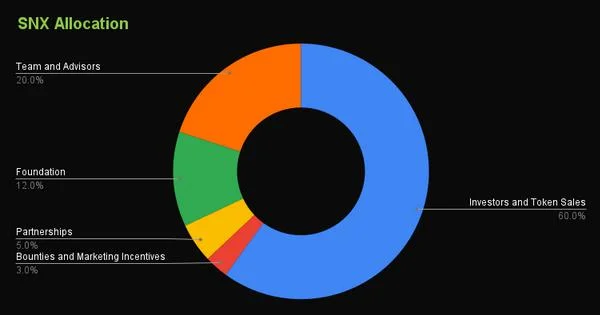
According to Synthetix token allocation, 60% of SNX is assigned to investors and token sales, 20% to team and advisors, 12% to foundation, 5% to partnerships and 3% for bonuses and marketing incentives.
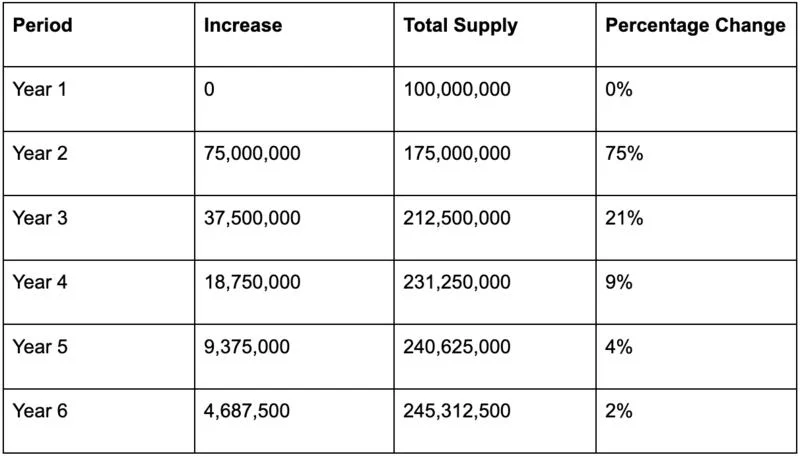
In March 2019, Synthetix developed an inflation token offering mechanism to incentivize investors. The table below shows an overview of this mechanism, based on a 1.25% weekly decline in inflation.
![What is Synthetix? Learn about the Synthetix project and the SNX . token]()
The inflation mechanism will end in September 2023 with a total token supply of around 250 million SNX. At this point, the protocol will move to a constant 2.5% annual release rate. However, there is a Synthetix Improvement Proposal (SIP) from Kain to end SNX inflation with a total supply of 300 million tokens in 10 weeks.
SNX is an ERC20 utility token that powers the Synthetix blockchain by supporting two main purposes:
- It is used to mint Synth, allowing participation, purchase and income from various Synth tokens.
- It is used in Synthetix DAO administration. SNX holders can vote on Synthetix proposals and shape the future of the project.
Staking SNX to mint Synths
As mentioned, Synth is generated by SNX tokens. You can mine Synth by staking SNX as collateral through its staking feature. Currently, Synths requires a 400% mortgage rate, but this could be modified in the future via community governance. Basically, SNX stakers ran into debt when they created Synths, and to unlock SNX, they had to write off debt by burning Synths.
In addition, Synthetix accepts ETH as an alternative collateral token. This means you can withdraw Synths using your ETH and start trading immediately instead of converting your ETH to SNX first. However, staking ETH requires a collateral of 150%, creating a debt in ETH. As a result, ETH stakers are issued in sETH instead of sUSD and are not eligible for gross debt. Pooled debt is where stakers share the risk to the debt pool and are incentivized for that role.
SNX holders are encouraged to stake their assets in a variety of ways.
![What is Synthetix? Learn about the Synthetix project and the SNX . token]()
First, an exchange reward is generated when a user exchanges Synths on the synthetic decentralized exchange (DEX) – Kwenta. Every transaction applies a transaction fee, which is allocated to a set of fees that the bidders claim their fair share of on a weekly basis. Fees range from 10 to 60 bps (0.1% to 0.6%) and are displayed in transactions.
The second incentive is the SNX staking reward, which is the result of the network's inflationary token mechanism. Currently, this mechanism is based on goal setting rate, which applies a target setting rate of 85%. The policy of increasing or decreasing inflation weekly based on whether the rate is lower or higher than the target, incentivizing policymakers to hit the target. If the reduction is in the range of 80-90%, the policy of reducing inflation is 5%.
Synthetix Administration
The second major role of SNX is to give holders voting rights in the Synthetix DAO. The second major role of SNX is to give holders voting rights in the Synthetix DAO. All in all, Synthetix administration is facilitated by two components – SIP and SCCP. SIP is an acronym for Synthetix Proposal Improvement, and SNX holders use it to make proposals for protocol improvements. SCCP stands for Synthetix Configuration Change Proposal, and it allows protocol suggestions.
Initially, Synthetix's participation in governance was limited, meaning the project was not completely decentralized. Example: Core protocol design, reward mechanism setup, and system development are managed by the Synthetix Foundation, excluding them from governance voting. But as of 2020, the platform has split into three completely decentralized DAOs:
- DAO Protocol – Funding management for protocol upgrades and modifications for Synthetix smart contracts.
- Grants DAO – Fund management for public goods proposals on Synthetix.
- Synthetix DAO – Fund management for parties working in project development.
What makes Synthetix unique?
Several characteristics distinguish the Synthetix protocol from other DeFi projects. The most obvious is the ability for users to transact Synths without intermediaries. You can trade any Synth with another Synth on Kwenta and enjoy high liquidity. Another key function of Synthetix that makes it unique is peer-to-peer (P2C) trading, where transactions are processed quickly and easily without the use of an order book. A decentralized pool of SNX holders provides the necessary collateral and ensures the stability of the entire exchange.
Synths come in many forms and are labeled with the prefix, “s” – for example, sUSD and sGOLD. You do not need to trade with the same Synth that you originally minted. As long as the Synth you use for payment has a market value similar to the value you minted, it will be accepted by the protocol.
Synthetix Ecosystem
SNX – Mining sUSD
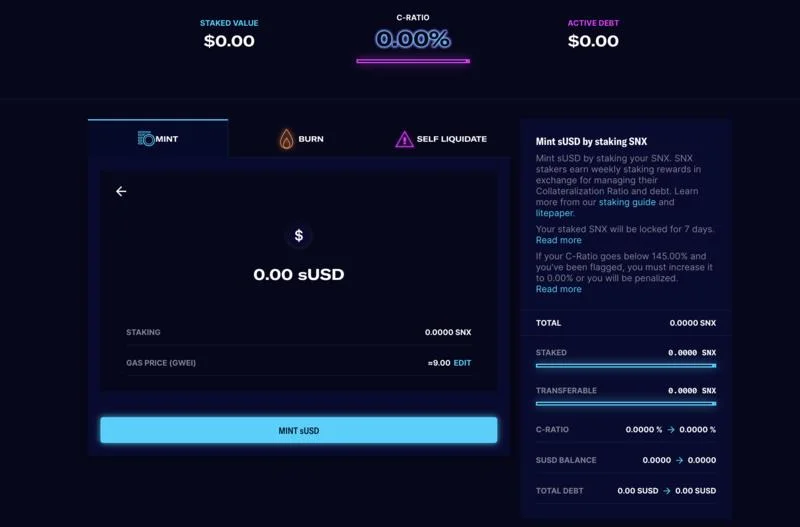
To facilitate the process of creating Synths, Synthetix has developed a platform that allows users to earn sUSD with SNX as collateral. Whenever you interact with the platform to create Synths, it contacts the Synthetix smart contract responsible for managing the mining processes. Here's the step-by-step process on how to do it:
First, go to the SNX minting site and connect your web3 wallet. Make sure you keep some SNX to use as transaction fees.
![What is Synthetix? Learn about the Synthetix project and the SNX . token]()
Second, you want to generate sUSD tokens using a certain amount of SNX. The protocol will lock SNX.
![What is Synthetix? Learn about the Synthetix project and the SNX . token]()
Finally, you can trade any Synths on the platform using the sUSD that you mined in step 2. Besides, you can staking SNX to generate passive income instead of leaving assets. Yours doesn't work.
Kwenta – Synthetix DEX
Kwenta is a DEX where you can trade Synths. It was built on top of the Synthetix network to allow users to trade Synths directly instead of going the tedious and expensive route of withdrawing assets to a Web3 wallet before trading them on the DeFi protocol. Interestingly, Kwenta doesn't use orderbooks; instead, it is based on P2C transactions, where transactions are made using smart contracts. It also leverages the feats of Chainlink to generate a price feed to establish exchange rates for tokens.
To use Kwenta, you just need to connect your Web3 wallet, buy sUSD or any other Synth token and start trading. The platform includes three features:
- There is a dashboard feature where users create Synths and view available tokens.
- There is an exchange feature where you track and trade Synth.
- The short sale function provides a quick way to trade tokens.
Kwenta offers unlimited liquidity, no slippage, and permissionless and unattended trading. Currently, it supports the following Synths categories:
- Fiat currencies, like sUSD, sEUR, sJPY…
- Commodities, such as synthetic gold (sGOLD) and synthetic silver (sSILVER).
- Digital currencies, including sBTC, sETH, and sBNB.
Besides the three categories, Kwenta supports inverse digital currencies and crypto indices. In contrast, cryptocurrencies like iBTC, iETH, and iBNB will track cryptocurrency prices. For example, when the price of ETH increases, the price of iETH decreases equally and vice versa. On the other hand, crypto indices and inverse crypto indices, such as sDEFI/iDEFI and sDEX/iDEX, track a basket of DeFi tokens and native DEX coins.
Lyra – Options trading powered by Synthetix
![What is Synthetix? Learn about the Synthetix project and the SNX . token]()
Lyra is a decentralized trading platform powered by an automated market mechanism (AMM). Notably, it uses Synthetix's stablecoin sUSD as its main quote token – traders use sUSD to pay fees for creating long or short positions. In addition, Lyra uses Synthetix as a one-stop protocol to get long and short details about the market's underlying tokens, such as delta hedging.
Conclude
Synthetix has built one of the most essential and demanding protocols on the Ethereum network. It provides exposure to a wide range of crypto and non-crypto assets in a decentralized, permissionless and censorship-resistant manner, facilitating participation in the DeFi space. . Similar to derivatives in traditional finance, Synthetix assets are financial instruments in the form of ERC20 tokens known as Synths, that track and provide returns on other assets without requiring anyone to pay. use to hold assets.
However, the potential of synthetic assets remains largely untapped. It remains to be seen whether future developments will significantly boost Synthetix's utility and growth.